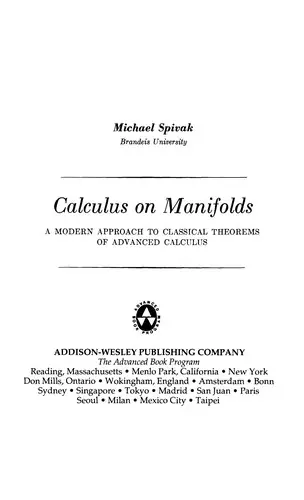
Calculus on manifolds
a modern approach to classical theorems of advanced calculus.
by Michael Spivak · first published 1965
46% recommend50% neutral4% critical
Why HN recommends it
A concise, rigorous bridge from single-variable calculus to multivariable analysis and differential geometry. It builds exterior algebra and differential forms to reach Stokes' theorem, for readers with some analysis.
Common criticism: Dense and demanding; not suited to beginners in calculus
Summarised by Claude from recommending comments
A supplementary text for undergraduate courses in the calculus of variations which provides an introduction to modern techniques in the field based on measure theoretic geometry. Varifold geometry is presented through and appraisal of Plateau's problem.
Affiliate links. As an Amazon Associate I earn from qualifying purchases.
Mentions per year
What Hacker News says
Related books
 2009–2026
Finite-dimensional vector spaces
Paul R. Halmos
Recommended by 24 · mentioned by 3824 recommend · 38 mention24 recommend · 3824 recommend
 2008–2026
Principles of Mathematical Analysis
Walter Rudin
Recommended by 52 · mentioned by 8852 recommend · 88 mention52 recommend · 8852 recommend
 2008–2023
Vector calculus, linear algebra, and differential forms
Hubbard, John H., John H. Hubbard, Barbara Burke Hubbard
Recommended by 16 · mentioned by 1816 recommend · 18 mention16 recommend · 1816 recommend
 2009–2025
Real and complex analysis
Walter Rudin
Recommended by 25 · mentioned by 4025 recommend · 40 mention25 recommend · 4025 recommend
 2009–2024
Functions of Several Variables
Wendell Fleming, W. H. Fleming
Recommended by 4 · mentioned by 54 recommend · 5 mention4 recommend · 54 recommend
 2012–2024
Mathematical Analysis
Tom M. Apostol
Recommended by 6 · mentioned by 96 recommend · 9 mention6 recommend · 96 recommend
Digital Signal Processing
SCHAFER OPPENHEIM
Recommended by 2 · mentioned by 22 recommend · 2 mention2 recommend · 22 recommend
…useful for building up an intuition (Landau & Lifshitz - Statistical Physics is good). Classical Field Theory, i.e. Electromagnetism should now be learned (J.D. Jackson). Then, I'd recommend learning Calculus on Manifolds (Spivak) and Differential Geometry (I can't remember a good textbook on this right now). If you're at this point you will now have a solid understanding of the maths needed to know GR and QFT. Zee has…
on “Humanly Traversable Wormholes” ↗…determinant... I have just read it (page 99 of my copy) and he admits that it is a "somewhat roundabout procedure", just after giving the definition! There's other references that seem much cleaner (e.g. Spivak's calculus on manifolds, using exterior algebra).
on “Free Math Books” ↗…df(x)/dx makes mathematics, and especially introductory calculus, extremely confusing for beginning students; and he enjoins mathematics educators to use more formal modern notation. 2 In his beautiful book Calculus on Manifolds [40], Michael Spivak uses functional notation. On p. 44 he discusses some of the problems with classical notation. We excerpt a particularly juicy passage: The mere statement of [the chain rule] in classical…
on “Does one have to be a genius to do maths?” ↗That may well be true in your discipline, but there are some excellent, concise texts in undergraduate mathematics. For example, Apostol's Calculus or Spivak's Calculus on Manifolds. Not the most accessible texts by a longshot, but not your average Pearson or Wiley drivel either.
on “No bullshit guide to math and physics” ↗The exterior/wedge product is actually very closely related to the cross product, and works to generalize the cross product to n dimensions. You can read Spivak or Munkres, "Calculus on Manifolds" and "Analysis on Manifolds" respectively. One of their main uses is to prove the generalized Stokes theorem in n dimensions. 3D rotors are isomorphic to quaternions, so go ahead and rename your variables…
on “Let's remove quaternions from every 3D engine (2018)” ↗For sure there is an effect on Reddit and other places where someone will post a question such as, "I'm having trouble with my Calc class, what is a good book?" and people seriously answer Calculus on Manifolds. Now, CoM is a classic, a real great book, but it is useful only to people who have reached a certain level of mathematical maturity. That, presumably, is not the questioner. A version of this is that…
on “An Intuitive Guide to Linear Algebra (2012)” ↗Spivak's Calculus on Manifolds (aka little Spivak) is another really good treatment.
on “Differential Forms and Integration (2008) [pdf]” ↗…element, etc.). I think some grassmannian computations would be good in this context but, on the other hand, they would become very cumbersome very soon. As someone says below: Spivak's Differential Calculus on Manifolds is exceptionally good.
on “Differential Forms and Integration (2008) [pdf]” ↗Great suggestions. I would add that Calculus on Manifolds might be sufficient for differential geometry. One note on expectations - each of the domains you mentioned is typically an upper level undergraduate course (except for the first three). These courses…
on “Humanly Traversable Wormholes” ↗…imagination by Hilbert and Cohn-Vossen * Methods of mathematical physics by Courant and Hilbert * A comprehensive introduction to differential geometry by Spivak (and its little brothers Calculus and Calculus on manifolds) * Fourier Analysis by Körner * Arnold's books on ODE, PDE and mathematical physics are breathtakingly beautiful. * The shape of space by Weeks * Solid Shape by Koenderink * Analyse fonctionnelle…
on “Ask HN: Math books that made you significantly better at math?” ↗Calculus on Manifolds by Michael Spivak. http://www.strangebeautiful.com/other-texts/spivak-calc-mani... For me, the eye opening thing was that any n-dimensional body is a transformation of the n-dimensional standard cube.…
on “Ask HN: What are the most eye-opening textbooks you have ever read?” ↗…Rudin, Principles of Mathematical Analysis AKA baby Rudin. Prove the theorems of calculus; see how such math is done; learn some more material important in the rest of mathematical analysis. Spivak, Calculus on Manifolds The three above were at one time the main references for Harvard's famous Math 55. Royden, Real Analysis Measure theory and a start on functional analysis. Elegant. Rudin, Real and Complex Analysis…
on “What's a Mathematician to do?” ↗For 4, try Calculus on manifolds, then Differential Geometry (both by Michael Spivak).
on “ComputerVisionWiki.org” ↗Calculus on Manifolds by Spivak is a good book to read before (the first few chapters anyways).
on “Structure and Interpretation of Classical Mechanics” ↗…Courant) - A Course of Pure Mathematics (G.H. Hardy) - Linear Algebra (Kenneth Hoffman and Ray Kunze) - Elementary Differential Equations (William Boyce and Richard DiPrima) - Topology (James Munkres) - Calculus On Manifolds (Michael Spivak) - Principles of Mathematical Analysis (Walter Rudin) - Real and Complex Analysis (Walter Rudin) - Functional Analysis (Walter Rudin) - Partial Differential Equations (Lawrence Evans)…
on “Mathematician's anger over his unread 500-page proof” ↗