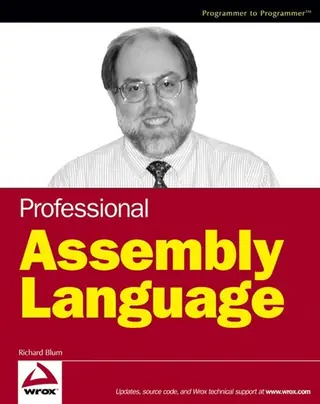
Professional assembly language
by Richard Blum · first published 2005
83% recommend17% neutral
Why HN recommends it
Covers x86 assembly language for working programmers. It serves as a practical starting point for learning assembly and low-level programming, with a focus on writing real code.
Summarised by Claude from recommending comments
Unlike high-level languages such as Java and C++, assembly language is much closer to the machine code that actually runs computers; it's used to create programs or modules that are very fast and efficient, as well as in hacking exploits and reverse engineering Covering assembly language in the Pentium microprocessor environment, this code-intensive guide shows programmers how to create stand-alone assembly language programs as well as how to incorporate assembly language libraries or routines into existing high-level applications Demonstrates how to manipulate data, incorporate advanced fun
Affiliate links. As an Amazon Associate I earn from qualifying purchases.
Mentions per year
What Hacker News says
Related books
 2010–2025
Operating System Concepts
Abraham Silberschatz
Recommended by 26 · mentioned by 5426 recommend · 54 mention26 recommend · 5426 recommend
 2009–2026
Programming from the Ground Up
Jonathan Bartlett
Recommended by 36 · mentioned by 4836 recommend · 48 mention36 recommend · 4836 recommend
 2009–2026
Computer systems
Randal Bryant, Randal E. Bryant, David R. O'Hallaron
Recommended by 67 · mentioned by 8367 recommend · 83 mention67 recommend · 8367 recommend
 2008–2026
Computer architecture
John L. Hennessy, David A. Patterson
Recommended by 59 · mentioned by 9459 recommend · 94 mention59 recommend · 9459 recommend
 2007–2026
The C Programming Language
Brian W. Kernighan, Dennis MacAlistair Ritchie
Recommended by 246 · mentioned by 501246 recommend · 501 mention246 recommend · 501246 recommend
 2008–2026
Code
Charles Petzold
Recommended by 243 · mentioned by 287243 recommend · 287 mention243 recommend · 287243 recommend
 2007–2026
The art of computer programming
Donald Knuth
Recommended by 336 · mentioned by 1,125336 recommend · 1,125 mention336 recommend · 1,125336 recommend
 2007–2026
Code Complete
Steve McConnell
Recommended by 393 · mentioned by 669393 recommend · 669 mention393 recommend · 669393 recommend
…http://www.amazon.com/Serial-Storage-Architecture-Applicatio... 25- http://www.amazon.com/SATA-Storage-Technology-Serial-ATA/dp/... 26- http://www.amazon.com/Beyond-BIOS-Developing-Extensible-Inte... 27- http://www.amazon.com/Professional-Assembly-Language-Program... 28- http://www.amazon.com/Linux-Kernel-Development-3rd-Edition/d... 29- http://www.amazon.com/Version-Control-Git-collaborative-deve... 30- http://www.amazon.com/Embedded-Software-Primer-David-Simon/d...…
on “I’m writing my own OS” ↗…and in the right frame of mind: http://www.amazon.com/Code-Language-Computer-Hardware-Softwa... Then I suggest you pick up a good book on Assembler. This might be a good choice: http://www.amazon.com/Professional-Assembly-Language-Program... Start writing some drivers for Linux. Like a memdrive or something. Do it all in Assembler! Oh, you need to read other books on how to do this... Then pick up the K&R book on C. Now write…
on “Learning C and ASM, what's the way to go?” ↗…I haven't started but I spent an hour or two perusing books on assembly language on Amazon, reading product descriptions and users' reviews, and I decided to start from this one: http://www.amazon.com/Professional-Assembly-Language-Program... The reasons I chose it are (1) It's introductory, i.e., a good first book for a complete noob. (2) It's very Linux-centric. Most good books on assembly language assume you use Windows or…
on “Learning C and ASM, what's the way to go?” ↗…learning assembly? For MASM I enjoyed this book years ago: http://www.amazon.com/Assembly-Language-Intel-Based-Computer... For GAS something like this might be more appropriate: http://www.amazon.com/Professional-Assembly-Language-Richard... Patterson & Hennessy is used a lot in colleges to teach low-level architecture and assembly: http://www.amazon.com/Computer-Architecture-Fifth-Quantitati...
on “Future instruction set: AVX-512” ↗…while still appreciating its considerable strengths. In that general direction Van Der Linden's "Expert C" and "The C Puzzle Book" remain fantastic books to grok C and low level programming. The Wrox "Professional Assembly Language" is both out of date (32 bit x86) and still about your best bet, update it and play with the x86-64 abi docs, a download of the intel optimisation manual, "Hackers Delight" and http://aggregate.org/MAGIC/
on “Ask HN: Are older programming books useful?” ↗…suck when it comes to learning assembly for the first time. Maybe someone else has a good book that they would recommend? Maybe this [0] but with some of the updates in mind. [0] http://www.amazon.com/Professional-Assembly-Language-Richard...
on “Let's Write Some x86-64” ↗…someone can link us up to show how wrong I am? https://wiki.osdev.org/Calling_Conventions Richard Blum [2] after Dunteman. [1] At a reasonable level of approximation. [2] https://www.wiley.com/en-us/Professional+Assembly+Language-p...
on “The faker's guide to reading (x86) assembly language” ↗