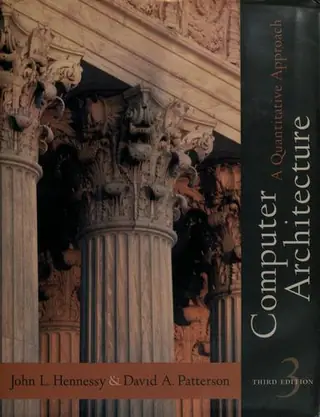
Computer architecture
by John L. Hennessy, David A. Patterson · first published 1989
62% recommend37% neutral1% critical
Why HN recommends it
Standard textbook on how CPUs work: pipelining, caches and memory hierarchies, and RISC design. Suits students and programmers who want to understand hardware performance, and it is kept current across editions.
Summarised by Claude from recommending comments
This new edition of 'Computer Architecture' has been updated throughout to address the historic shift from single-core to multi-core processors.
Affiliate links. As an Amazon Associate I earn from qualifying purchases.
Mentions per year
What Hacker News says
Related books
 2008–2026
Computer organization and design
David A. Patterson
Recommended by 50 · mentioned by 8450 recommend · 84 mention50 recommend · 8450 recommend
 2008–2026
Introduction to the theory of computation
Michael Sipser
Recommended by 66 · mentioned by 8966 recommend · 89 mention66 recommend · 8966 recommend
 2010–2023
Microelectronic circuits
Adel S. Sedra, Kenneth C. Smith
Recommended by 9 · mentioned by 119 recommend · 11 mention9 recommend · 119 recommend
 2008–2025
Transaction processing
Gray, Jim
Recommended by 13 · mentioned by 1813 recommend · 18 mention13 recommend · 1813 recommend
 2008–2025
Introduction to automata theory, languages, and computation
John E. Hopcroft, Jeffrey D. Ullman, Rajeev Motwani
Recommended by 24 · mentioned by 3324 recommend · 33 mention24 recommend · 3324 recommend
 2010–2025
Operating System Concepts
Abraham Silberschatz
Recommended by 26 · mentioned by 5426 recommend · 54 mention26 recommend · 5426 recommend
 2008–2026
Code
Charles Petzold
Recommended by 243 · mentioned by 287243 recommend · 287 mention243 recommend · 287243 recommend
…here's some standard textbooks I like: Algorithms and Data Structures: http://www.amazon.ca/Introduction-Algorithms-Thomas-H-Cormen... http://www.amazon.ca/Algorithms-4th-Robert-Sedgewick/dp/0321... Computer Architecture and Operating Systems: http://www.amazon.ca/Computer-Architecture-Quantitative-John... http://www.amazon.ca/Design-Implementation-FreeBSD-Operating... Mathematics: http://www.amazon.ca/Calculus-James-Stewart/dp/0495011606…
on “The software development final exam: Algorithms and Data Structures” ↗Computer Architecture: A Quantitative Approach by John L. Hennessy the creator of MIPS and David Patterson the creator of Berkeley RISC (later SPARC) Advanced Programming in the Unix Environment by W. Richard Stevens
on “Ask HN: Which books do you consider real gems in your field of work/study?” ↗Hardware doesn't work like this. You might want to read Hennessy and Patterson, and the original RISC I paper. http://www.amazon.com/Computer-Architecture-Fifth-Edition-Qu... http://www.cecs.pdx.edu/~alaa/ece587/papers/patterson_isca_1...
on “The Problem with Friendly C” ↗- The Pragmatic Programmer (Hunt/Thomas) - Computer Architecture - A Quantitative Approach (Hennessy/Patterson) - Expert C Programming - Deep C Secrets (van der Linden) I woud call the Pragmatic Programmer though by far the most influential.
on “Ask HN: What three books impacted your career the most?” ↗A computer architecture class. For books, [1] is what you will probably use in any decent computer architecture class, and [2] is a good read from a more general audience perspective, if a bit dated. 1. https://www.amazon.com/Computer-Architecture-Fifth-Quantitat...…
on “AMD Zen Microarchitecture: Dual Schedulers, Micro-Op Cache and Memory Hierarchy” ↗…seems to praise either the Cormen et al. or the Sedgewick books, I have the feeling that “Algorithms” by Dasgupta, Papadimitriou and Vazirani is my choice for “fundamental” book. But I decided to * “Computer Architecture: a Quantitative Approach”, by Hennessy and Patterson. * “Modern Operating Systems”, by Andrew Tanenbaum. * “Artificial Intelligence: a Modern Approach”, by Russel and Norvig. * “Modern Compiler Implementation…
on “Ask HN: What are the most fundamental books on computer science?” ↗http://www.amazon.com/Computer-Architecture-Quantitative-App... You're welcome.
on “Wildbit launches dploy.io: Ship code from GitHub, Bitbucket, anywhere” ↗…absolutely require reading for many Computer Science/Electrical Engineering/Computer Engineering departments (even my state school required it) in undergrad, and most certainly required in graduate school when Computer Architecture turns to pipelining, cache structures and hierarchies, micro-architecture vs. macro-architecture, instruction set design, etc. Without MIPS, there isn't a baseline architecture to talk about in these…
on “The Most Influential Microprocessors of All Time” ↗…influences): 1) Philip and Alex's Guide to Web Publishing (not strictly a book). http://philip.greenspun.com/panda/ 2) The "Dragon Book" https://en.wikipedia.org/wiki/Principles_of_Compiler_Design 3) Computer Architecture: A Quantitative Approach Second part (at hindsight): 1) https://en.wikipedia.org/wiki/Rich_Dad_Poor_Dad (cheesy, but useful) 2) http://toddkashdan.com/upside.php 3) https://www.schranner.com/de/news/2012/04/16/-verhandeln-im-...…
on “Ask HN: What three books impacted your career the most?” ↗I also recommend: https://www.amazon.com/Computer-Architecture-Fifth-Quantitat...
on “Why do CPUs have multiple cache levels?” ↗…know C at the level of K&R, a good start would be learning from Bryant and O'Hallaron's book: http://csapp.cs.cmu.edu/ From there, you would be well served by working through Hennessy and Patterson's Computer Architecture and Computer Organization and Design. In parallel, you could work through a book on Operating Systems, maybe even playing with the code for a toy system (e.g., http://pages.cs.wisc.edu/~remzi/OSTEP/…
on “Efficient music players remain elusive” ↗…into to know about memory, flops, and things like that? What you are after are books/courses on "architecture", I think. A classic book on the subject is Hennessy & Patterson. https://www.amazon.com/Computer-Architecture-Sixth-Quantitat...
on “NumPy Tricks and Pitfalls” ↗…it, or that you understand the tradeoffs at the hardware level, or any appreciation of the blinding speed of current chips. How would faster XYZ improve your life? Go and read <https://www.amazon.co.uk/Computer-Architecture-Quantitative-... then maybe you'll understand your plaint is falling on uninterested ears (mine anyway). Suggest something constructive based on the realities of hardware then I'll talk.
on “mTCP: A high-performance user-level TCP stack for multicore systems” ↗I'd suggest reading the wiki articles about it for an introduction, and Ch 5 of https://www.amazon.com/Computer-Architecture-Quantitative-Jo... for a detailed understanding. Right now you're asserting things about all this, while not being familiar with relatively basic aspects of how it works.
on “Lock-free multithreading with atomic operations” ↗This is THE textbook on the subject: https://www.amazon.com/Computer-Architecture-Quantitative-Jo... There are older editions available free online that cover the same concepts, they just don't have the very latest info.
on “Surprising new feature in AMD Ryzen 3000” ↗