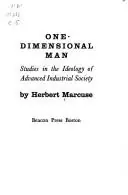
One-Dimensional Man
by Herbert Marcuse · first published 1963
60% recommend35% neutral5% critical
Why HN recommends it
Frankfurt School critique of consumerism and late capitalism, with a vivid picture of 1950s-60s American consumer society; suits readers wanting depth on mass media, commercial culture and ideology.
Summarised by Claude from recommending comments
One-Dimensional Man: Studies in the Ideology of Advanced Industrial Society is a 1964 book by the philosopher Herbert Marcuse, in which the author offers a wide-ranging critique of both contemporary capitalism and the Communist society of the Soviet Union, documenting the parallel rise of new forms of social repression in both these societies, as well as the decline of revolutionary potential in the West. He argues that "advanced industrial society" created false needs, which integrated individuals into the existing system of production and consumption via mass media, advertising, industri
Affiliate links. As an Amazon Associate I earn from qualifying purchases.
Mentions per year
What Hacker News says
Related books
 2011–2024
The Undiscovered Self
Carl Gustav Jung
Recommended by 2 · mentioned by 42 recommend · 4 mention2 recommend · 42 recommend
Dialectic of Enlightenment
Theodor W. Adorno
Recommended by 10 · mentioned by 2110 recommend · 21 mention10 recommend · 2110 recommend
 2007–2026
Escape from Freedom
Erich Fromm
Recommended by 23 · mentioned by 3123 recommend · 31 mention23 recommend · 3123 recommend
Society of the spectacle
Guy Debord, Black & Red Press
Recommended by 27 · mentioned by 7427 recommend · 74 mention27 recommend · 7427 recommend
 2007–2026
The phenomenology of spirit
Georg Wilhelm Friedrich Hegel
Recommended by 7 · mentioned by 297 recommend · 29 mention7 recommend · 297 recommend
 2010–2026
Nonviolent Communication
Marshall B. Rosenberg, Deepak Chopra, Magiarí Díaz Díaz, Alan Rafael Seid Llamas
Recommended by 99 · mentioned by 14099 recommend · 140 mention99 recommend · 14099 recommend
 2008–2026
The Denial of Death
Ernest Becker
Recommended by 40 · mentioned by 6140 recommend · 61 mention40 recommend · 6140 recommend
 2010–2026
The Rise and Fall of the Third Reich
William L. Shirer
Recommended by 37 · mentioned by 6737 recommend · 67 mention37 recommend · 6737 recommend
…it cannot gain mass media time, because of its nature as subversive; it can only be snuck in under capitalism, as capitalism is willing to accept any ideology for the sake of profit. I would recommend One-Dimensional Man on the topic of what problems Communists have with late capitalist media and production, and the hiding of information. >If you are interested, you might want to read Orwell's 1984 I have; although…
on “The Western Elite from a Chinese Perspective” ↗…Situationist International, particularly Debord’s Society and the Spectacle, provide a great look at thought currents that drove some of the more tumultuous scenes of that year (and decade). Marcuse’s One-Dimensional Man (1964) fits squarely within the current of cultural critique that fueled the decade. I’d say a great many of the writings age eerily well—they’re often still poignant and relevant to issues we deal with…
on “Today is the last chance to comment on the proposal to kill net neutrality” ↗…N. Taleb: Black Swan and Antifragile[0] - Robert Cialdini: Influence: The Psychology of Persuasion[1] - Franklin Foer: World Without Mind: The Existential Threat of Big Tech[2] - Herbert Marcuse: One-Dimensional Man: Studies in the Ideology of Advanced Industrial Society[3] [0] https://www.amazon.com/Black-Swan-Improbable-Robustness-Frag... [1] https://www.amazon.com/Influence-Psychology-Persuasion-Rober... [2]…
on “Ask HN: What are the books you wish your colleagues had read?” ↗"One Dimensional Man" by Marcuse certainly, "Escape From Freedom" by Erich Fromm and for more contemporary review, Mark Fisher of course. You also can't miss Guy Debord (his Society of the Spectacle) and, although I haven't…
on “The Lost Futures of Mark Fisher” ↗Since you mentioned him, anyone interested in this would do themselves a favor by reading Marcuse’s One-Dimensional Man. I’d imagine Marcuse’s essay draws on similar themes as the book.
on “Today is the last chance to comment on the proposal to kill net neutrality” ↗…Proponents of technology but critics of the rationality it has created exist, most notably Marcuse. He criticises the development both in the capitaliat countries abd the USSR from a Marxist perspective in One-Dimensional Man, a widely acclaimed analysis of the rationality of creating false needs. Please read it, you may like it given your viewpoint. He very well integrates the last paragraph of your comment. Man is one-dimensional…
on “Manipulating Human Psychology To Turn Users Into Addicts” ↗…against the Human Race" - Peter Wessel Zapffe "On the Tragic" & "The Last Messiah" - Sokal, Alan D "Intellectual Impostures" - Simon Herbert "A The Sciences of the Artificial" - Herbert Marcuse "One-Dimensional Man" - Schopenhauer "Parerga and Paralipomena" - Lewis Mumford "The Story of Utopias" - Michel Foucault "Discipline and Punish" - Edward S. Herman "Manufacturing Consent - The Political Economy of…
on “Ask HN: What books changed the way you think about almost everything?” ↗I'd recommend One-Dimensional Man by Marcuse. You're not going to extract anything too wild out of it, but the picture he paints of 50's American consumerism is worth it.
on “The Utopian Promise of Adorno’s ‘Open Thinking,’ Fifty Years On” ↗Deschooling Society - Ivan Illich One-Dimensional Man - Herbert Marcuse Tools for Conviviality - Ivan Illich On Liberty - J. S. Mill The Annals - Tacitus The Histories - Tacitus
on “Ask HN: Books Worth Rereading Periodically?” ↗…art, I hope A.I. will help us divorce from the insidious form of commercial art and leave us time to focus on actual art that usher positive social change. An interesting take on that is in Marcuse's One Dimensional Man.
on “AI wins state fair art contest, annoys humans” ↗Recently, "The Situation is Hopeless... But Not Serious" - Paul Watzlawick All of Nietzsche. Antioedipus. Marcuse's One Dimensional Man. Wittgenstein's Notebooks. The works of Vilem Fluser. Basically most major/famous philosophers are a solid bet.
on “Ask HN: Which non-fiction books had the biggest impact on you?” ↗There has been discussion on this topic for about 100 years, but the most prominent is in the books Dialectic of Enlightenment by Theodor Adorno or One-Dimensional Man by Herbert Marcuse. They are a bit heavier than this article but they go into the problem with far more depth. The Frankfurt school in general deals with this problematic of Capitalism losing its revolutionary…
on “The age of average (2023)” ↗…they look at other elements of capitalist society: - Guy Debord - Society of the Spectacle (philosophy-economics): https://www.marxists.org/reference/archive/debord/society.ht... - Herbert Marcuse - One Dimensional Man (sociology): https://libcom.org/files/Marcuse,%20H%20-%20One-Dimensional%... - Erich Fromm - Escape From Freedom (social psychology): https://libcom.org/library/escape-freedom - Habermas - The Structural…
on “How Venezuela went from a rich democracy to a collapsing dictatorship” ↗…to read not only for the obscurity of the terms and the form of content used but also for their disturbing and socially challenging content, I don't think they rely on sloppy reasoning; take Marcuse's One-Dimensional Man for example; he speaks in terms the reader can identify with, not using formal logic. For example, an enlightening passage on freedom under the idea of freedom of enterprise: >Freedom of enterprise…
on “Simulacra and Simulation” ↗Read more about it in Herbert Marcuse: One-Dimensional Man
on “Woman in Brazil enslaved for 55 years by 3 generations of the same family” ↗