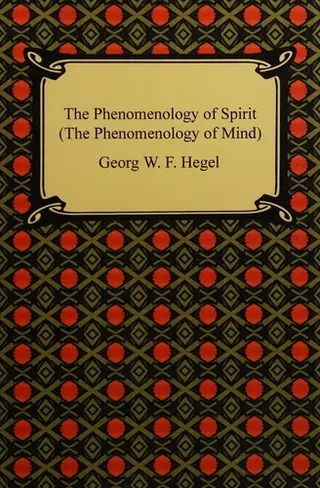
The phenomenology of spirit
by Georg Wilhelm Friedrich Hegel · first published 2009
24% recommend62% neutral14% critical
Why HN recommends it
A dense but rewarding work of philosophy. Its preface and early chapters offer ideas about history, consciousness, and the relation between thought and reality, and it pairs well with Kant.
Common criticism: Very hard to read; several find the prose opaque and the German-influenced style tiring.
Summarised by Claude from recommending comments
Affiliate links. As an Amazon Associate I earn from qualifying purchases.
Mentions per year
What Hacker News says
Related books
German Idealism
Frederick C. Beiser
Recommended by 5 · mentioned by 75 recommend · 7 mention5 recommend · 75 recommend
 2007–2026
Sophie's world
Jostein Gaarder
Recommended by 30 · mentioned by 4030 recommend · 40 mention30 recommend · 4030 recommend
 2010–2024
The Interpretation of Dreams
Sigmund Freud
Recommended by 4 · mentioned by 94 recommend · 9 mention4 recommend · 94 recommend
 2017–2026
The science of logic
Georg Wilhelm Friedrich Hegel
Recommended by 3 · mentioned by 123 recommend · 12 mention3 recommend · 123 recommend
 2009–2026
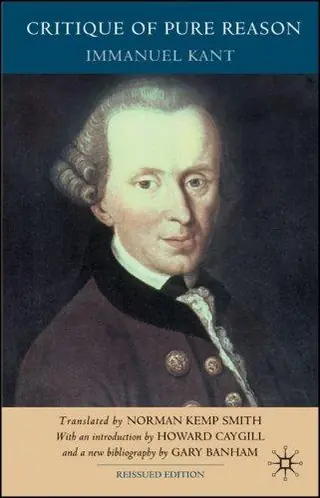
Critique of Pure Reason
Immanuel Kant
Recommended by 28 · mentioned by 13228 recommend · 132 mention28 recommend · 13228 recommend
Thus Spoke Zarathustra
Friedrich Nietzsche
Recommended by 31 · mentioned by 5831 recommend · 58 mention31 recommend · 5831 recommend
 2012–2025
Essay concerning human understanding
John Locke
Recommended by 5 · mentioned by 165 recommend · 16 mention5 recommend · 165 recommend
 2007–2026
An enquiry concerning human understanding
David Hume
Recommended by 18 · mentioned by 2418 recommend · 24 mention18 recommend · 2418 recommend
…Leibniz - Monadology Leibniz - Grace Voltaire - Candid Diderot - D'Alembert's Dream Kant - How to orient oneself in thinking Kant - Critique of Pure Reason Kant - Critique of Judgment Hegel - Phenomenology of Spirit Hegel - Logic von Kleist - Marionette Theatre Kierkegaard - The Sickness Unto Death Heidegger - Being and Time Sartre - Being and Nothingness Sartre - Flies Sartre - Nausea Deleuze - Difference…
on “Ask HN: What books changed the way you think about almost everything?” ↗Hegel's Phenomenology of Spirit. Kant's Critique of Pure Reason. Hofstadter's Godel, Escher, Bach. I also recommend Zizek's The Sublime Object of Ideology, but it's dense, so his film The Pervert's Guide to Ideology is a good stand…
on “Simulacra and Simulation” ↗…emphasizes a more optimistic view of global human progress. It challenges the notion that the world is worse off today than it was in the past by providing facts and statistics that argue the contrary. * "Phenomenology of Spirit" by Hegel (1 mention) * Summary: This is a central work of German philosophy in which Hegel explores the concept of 'spirit'. He examines the relationship between consciousness and its objects, eventually…
on “Ask HN: Which non-fiction books had the biggest impact on you?” ↗I’d suggest Kojeve’s Introduction to the Reading of Hegel (a classic expository work on the Phenomenology of Spirit)
on “Ask HN: What scientific phenomenon do you wish someone would explain better?” ↗…here as his concept of time is no different from Hegel's concept of time and the movement of history. I would recommend, for anyone interested in this sort of thing, to just read the "Preface" to his Phenomenology of Spirit.[0] [0]https://files.libcom.org/files/Georg%20Wilhelm%20Friedrich%2...
on “On the Nature of Time” ↗> Hegel is irrelevant in the age of measurement That’s bs. Even just the preface to Phenomenology of Spirit is chock full of ideas that folks would be better off if they contemplated. Hegel can be considered a visual thinker (or visionary) whose ideas don’t need “measurement”. If folks understand his thoughts…
on “Hypothesis, Antithesis, Synthesis” ↗Phenomenology of Spirit - G.W.F. Hegel
on “Ask YC: favorite books” ↗…investigations: * Descartes' Meditations * Locke Essay Concerning Human Understanding * Hobbes Leviathan * Kant Critique of Pure Reason * Kant Prolegomena * Kuhn Structure of Scientific Revolution * Hegel Phenomenology of Spirit * Foucault Discipline & Punish * Sellars Epistemology and the Philosophy of Mind * Sellars The Scientific Image of Man * Quine Word & Object * Davidson On the Very Idea of a Conceptual Scheme *…
on “Ask HN: Learning about philosophy” ↗G.E.B is hegelian philosophy without one mention to Hegel and more mechanic than organic Anyone read the Phenomenology of Spirit and notice the same ideas?
on “Gödel, Escher, Bach: an in-depth explainer” ↗> They didn’t even know what they “knew”. That reminds me of one of Hegel's better lines, from the preface to The Phenomenology of Spirit: "What is well-known is not necessarily known merely because it is well-known." (This particular translation is Walter Kaufmann's, if I remember correctly.)
on “What I've Learned About Learning” ↗…substance and solid worth is quite easy, to comprehend it is much harder, and to blend judgement and comprehension in a definitive description is the hardest thing of all.” Excerpt From: G. W. F. Hegel. “Phenomenology of Spirit.” Oxford University Press.
on “Why read old philosophy?” ↗> Anyone read the Phenomenology of Spirit and notice the same ideas? Can you elaborate? I've had some friends talk about Hegel with me but I never understood much of it
on “Gödel, Escher, Bach: an in-depth explainer” ↗…source of inspiration; some people stay there all the time, which isn't very fun. My random idea is to keep two books on your nightstand, one being something like for example an introduction to Hegel's phenomenology of spirit, and the other being something like a biography, novel, or history book. I've always found that thinking is most fun when you get these little sparks between the abstract and the concrete. "Oh, the way…
on “How to be interesting (2006)” ↗Vaguely reminds me of Hegel as Hegel describes in his Phenomenology of Spirit the history of the human kind as a progress of collective consciousness (and as I see it, in parallel the progress of individual consciousness). What Hegel describes, in my perspective, is science as…
on “Physics as a Way of Thinking (1936) [pdf]” ↗…makeup. If some insect species develops self-consciousness and civilization, I'd argue that we ought to recognize it as of our kind. Moreso than, say, apes who are closer to "us" genetically. [1] Hegel. Phenomenology of Spirit, 1807. "self-consciousness achieves its satisfaction only in another self-consciousness… A self-consciousness exists for a self-consciousness. Only so is it in fact self-consciousness, for only in this…
on “Things the most successful people I know struggle with to be happy” ↗