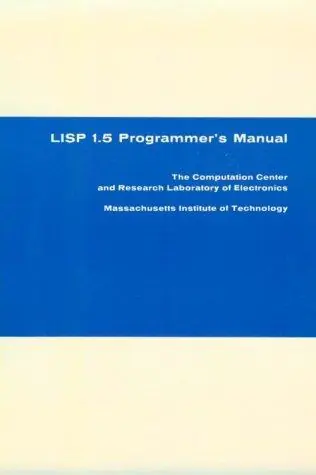
LISP 1.5 Programmer's Manual
by John McCarthy, Paul W. Abrahams, Daniel J. Edwards, Timothy P. Hart, Michael I. Levin · first published 1962
35% recommend65% neutral
Why HN recommends it
A historical primary source from 1962 that explains eval and apply and includes a compact Lisp interpreter written in Lisp. It is useful for understanding how Lisp works internally.
Summarised by Claude from recommending comments
2nd edition
Affiliate links. As an Amazon Associate I earn from qualifying purchases.
Mentions per year
What Hacker News says
Related books
 2009–2026
Threaded interpretive languages
R. G. Loeliger
Recommended by 24 · mentioned by 2624 recommend · 26 mention24 recommend · 2624 recommend
 2008–2026
Starting FORTH
Leo Brodie, Inc Staff Forth
Recommended by 76 · mentioned by 9176 recommend · 91 mention76 recommend · 9176 recommend
 2007–2026
Practical Common Lisp
Peter Seibel
Recommended by 218 · mentioned by 294218 recommend · 294 mention218 recommend · 294218 recommend
 2007–2026
On LISP
Paul Graham
Recommended by 192 · mentioned by 355192 recommend · 355 mention192 recommend · 355192 recommend
 2007–2026
The Pragmatic Programmer
Andy Hunt, Dave Thomas
Recommended by 353 · mentioned by 589353 recommend · 589 mention353 recommend · 589353 recommend
 2007–2026
Structure and Interpretation of Computer Programs
Harold Abelson, Gerald Jay Sussman, Julie Sussman
Recommended by 347 · mentioned by 602347 recommend · 602 mention347 recommend · 602347 recommend
Smalltalk-80: The Language and Its Implementation The Unix Programming Environment LISP 1.5 Programmer's Manual Computer Lib/Dream Machines Papert: Mindstorms
on “Ask HN: Best software books written before 2000” ↗I just finished reading the LISP 1.5 Programmer's Manual (still readily available from Amazon), published in 1962. The book is mind-blowing, because it mixes discussions of high-order functions with instructions on how to properly lay out programs on punch…
on “Doug McIlroy: McCarthy Presents Lisp” ↗…My favorite part of this book is its discussion of the metacircular interpreter (i.e., a Scheme interpreter written in Scheme), which is key to understanding how a Lisp works internally. 2. Read the Lisp 1.5 Programmer's Manual. While this Lisp has long been succeeded by more modern Lisps, it is a very nicely designed manual that discusses the implementation of Lisp. It also has a short metacircular interpreter on page 13…
on “Between two Lisps” ↗…original LISP dialect; a quick Google search / Wikipedia session yielded this memo about a LISP 1.5 compiler written in 1962: ftp://publications.ai.mit.edu/ai-publications/pdf/AIM-039.pdf Also there's LISP 1.5 Programmer's Manual dated August 17, 1962 which is quite an interesting read: http://www.softwarepreservation.org/projects/LISP/book/LISP%...
on “Before you start learning Lisp...” ↗Reading "Lisp 1.5 Programmer's Manual" when I was a post-graduate student at Waterloo (around 1977) was a revelation to me. In particular, "Appendix B: The Lisp Interpreter" gives a version of the Lisp interpreter in just 39 lines of code!…
on “How Lisp Became God's Own Programming Language (2018)” ↗…interpreters, with jit, or with types, etc, it was super fun, but most of all it allowed me to see a completely new paradigm of programming, kind of the first time you understand eval/apply from 13th page of the LISP 1.5 Programmer's Manual. A language that writes itself and it is written in itself. If you are making your own Forth, this Brad Rodriguez's article is also really good [2]. [1]: https://archive.org/details/R.G.LoeligerThreadedInterpretive...…
on “I learned Snobol and then wrote a toy Forth” ↗A PDF version of the first recommended book Lisp 1.5 Programmer's Manual: http://www.softwarepreservation.org/projects/LISP/book/LISP%...
on “Alan Kay's answer to ‘what are some forgotten books programmers should read?’” ↗Likewise, especially given my recent interest in Lisp. I actually own a paper copy of the LISP 1.5 Programmer's Manual, thanks to Baltimore's excellent free book exchange [1]; I haven't cracked it yet in any serious way, but this news might push it up my stack a bit, especially since I also now know it's possible to emulate…
on “Timothy Hart, Rest in Peace” ↗…make the notation much easier to read by most software developers. Indeed, the original Lisp didn't have "quote", but no one would be happy today if you had to write (quote a) instead of 'a. (See the "LISP 1.5 Programmer's Manual" by McCarthy et al. of 1962 at http://www.softwarepreservation.org/projects/LISP/book/LISP%... ... and note that it has only QUOTE.) I think adding a few more abbreviations to the s-expression reader…
on “The Machine That Builds Itself: The Strengths of the Lisp Languages (2016)” ↗I spoke to Rob shortly after he wrote this code (a few weeks ago). He said he had been wanting to do some coding over the weekend and pulled his copy of the LISP 1.5 Programmer's Manual - which he bought long ago, in grad school I think he said - off his shelf, and this code was the result. He also talked about how reading that book back when he bought it was incredibly eye-opening at…
on “Robpike/Lisp: Toy Lisp 1.5 interpreter in Go” ↗LISP 1.5 Programmer's Manual (and others) in PDF: http://www.softwarepreservation.org/projects/LISP/book
on “Doug McIlroy: McCarthy Presents Lisp” ↗…discrepancies between the situation as it is and what might be expected from the previous chapter should be noted. 1. The commas in writing S-expressions may be omitted. This is an accident." By 1962, the Lisp 1.5 Programmer's Manual was saying[1]: "Historically, the separator for elements of lists was the comma (,); however, the blank is now generally used. The two are entirely equivalent in LISP." I wonder when we got unquote.…
on “Can QML become the next standard for web UI?” ↗What a timely post. I actually just finished implementing an S-expression lexer and parser written in Python; I'm going through the LISP 1.5 Programmer's Manual and my next step is to implement that manual's legendary Page 13 that describes a basic LISP 1.5 interpreter written in itself. All of this is in preparation for teaching an undergraduate-level course…
on “The Art of the Interpreter (1978) [pdf]” ↗>Alan Kay has famously described Lisp as the “Maxwell’s equations of software”. He describes the revelation he experienced when, as a graduate student, he was studying the LISP 1.5 Programmer’s Manual and realized that “the half page of code on the bottom of page 13… was Lisp in itself. These were “Maxwell’s Equations of Software!” This is the whole world of programming in a few lines that I can put…
on “What Is the Essence of Computing? (2017)” ↗> Lol I am 100% sure that the majority of lisps cannot be aot compiled. Ahead-of-time compiling has been the principal method in mainstream Lisps going back to the 1960's. The Lisp 1.5 Programmer's Manual from 1962 describes ahead-of-time compiling. The curious thing is how can you be "100% sure" in making a completely wrong statement, rather than some lower number, like "12% sure".
on “It's 2023, so of course I'm learning Common Lisp” ↗