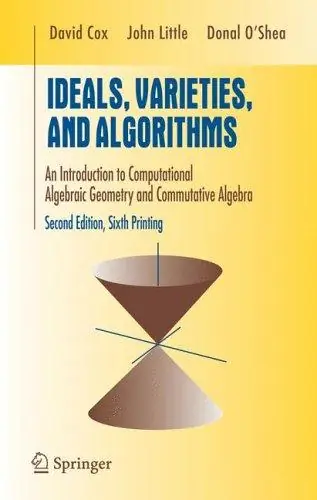
Ideals, varieties, and algorithms
by David A. Cox, David Cox, John Little, Donal O'Shea · first published 1992
75% recommend25% neutral
Why HN recommends it
Undergraduate-level introduction to algebraic geometry through computation, pairing varieties and ideals with algorithms; suggested for readers with some math background who want the core ideas quickly.
Summarised by Claude from recommending comments
Algebraic geometry is the study of systems of polynomial equations in one or more variables, asking such questions as: Does the system have finitely many solutions, and if so how can one find them? And if there are infinitely many solutions, how can they be described and manipulated? The solutions of a system of polynomial equations form a geometric object called a variety; the corresponding algebraic object is an ideal. There is a close relationship between ideals and varieties which reveals the intimate link between algebra and geometry. Written at a level appropriate to undergraduates, thi
Affiliate links. As an Amazon Associate I earn from qualifying purchases.
Mentions per year
What Hacker News says
Related books
A Book of Abstract Algebra
Charles C. Pinter
Recommended by 25 · mentioned by 2725 recommend · 27 mention25 recommend · 2725 recommend
No bullshit guide to math and physics
Ivan Savov
Recommended by 21 · mentioned by 2221 recommend · 22 mention21 recommend · 2221 recommend
 2007–2026
How to prove it
Daniel J. Velleman
Recommended by 78 · mentioned by 10478 recommend · 104 mention78 recommend · 10478 recommend
 2008–2026
Linear Algebra Done Right
Sheldon Jay Axler
Recommended by 130 · mentioned by 179130 recommend · 179 mention130 recommend · 179130 recommend
 2007–2026
How to solve it
George Pólya
Recommended by 161 · mentioned by 206161 recommend · 206 mention161 recommend · 206161 recommend
You might enjoy Ideals, Varieties, and Algorithms: An Introduction to Computational Algebraic Geometry and Commutative Algebra by David Cox.
on “How to Study Mathematics (2017)” ↗…to be read (and have not been mentioned elsewhere in this thread, i.e. Axler and Pugh). Algebra: Chapter 0 by Paolo Aluffi Measurement by Paul Lockhart The Nature of Computation by Moore & Mertens Ideals, Varieties, and Algorithms by Cox, Little, & O'Shea
on “Ask HN: How or where to begin learning mathematics from first principles?” ↗…and current modern viewpoint of Algebraic Geometry, it's not hard to get a decent understanding of algebraic varieties which are the original motivation in the field. An undergrad book on the subject Ideals, Varieties, and Algorithms by Cox, Little, and O'Shea does a great job of introducing the subject. And has a really cool project on calculating Groebner bases for polynomial equations in sin and cosine to define the configuration…
on “The Stacks Project, a new model for organizing and visualizing mathematics” ↗…http://en.wikipedia.org/wiki/Linear_equation_over_a_ring it would take a long time to read up the background to understand it, and I don't have the background to distill it to the exact result we want. Note the wiki article references this book: Ideals, Varieties, and Algorithms by Cox, Little and O'Shea. This is a standard and approachable reference on this kind of topics. Although this topic is interesting, I think it's best to treating it as a technology. Knowing it's existence…
on “Inverter” ↗For the algebraic geometry side, though, *Ideals, Varieties and Algorithms" by Cox, Little and O'Shea is great.
on “ImplicitCAD: Powerful, Open-Source, Programmatic CAD” ↗If you do have some math background, "An Invitation to Algebraic Geometry" by Karen Smith et al is a lovely, slim volume that gets to important ideas right away. "Ideals, Varieties, and Algorithms" is an "invitation to computational geometry" by Cox, Little, and O'Shea. I think parts of it might really appeal to HN readers and it's supposed to be for an undergrad math major audience.
on “How I Learned to Love Algebraic Geometry” ↗Abhyankar and others spent years trying to find an easier proof. I’m not an algebraic geometer and I don’t know the state of things now. I was under the impression that on the level of Ideals, Varieties, and Algorithms one can introduce the concept and do some calculations but not present a proof of the theorem. But the point is that pre-AI it was already the case that famous results were published that very few could…
on “Mathematics in the Age of AI” ↗…/everywhere/. Algebraic geometry sees a fair bit of use, mostly through the use of objects called as a Grobner basis, which allows us to solve for large systems of polynomial equations efficiently. The book "Ideals, Varieties, and Algorithms" goes into detail about this sort of "effective algebraic geometry" that's used to solve systems. One algebraic geometry tool I have personally used is known as cylindrical algebraic decomposition. It's…
on “Who Is Alexander Grothendieck? (2008) [pdf]” ↗