No bullshit guide to math and physics
by Ivan Savov · first published 2014
95% recommend5% neutral
Why HN recommends it
Concise, readable refresher that combines math with mechanics and physics so the math feels grounded. Suits adult learners, programmers and self-learners brushing up on basics before harder topics.
Summarised by Claude from recommending comments
Affiliate links. As an Amazon Associate I earn from qualifying purchases.
Mentions per year
What Hacker News says
Related books
 2013–2026
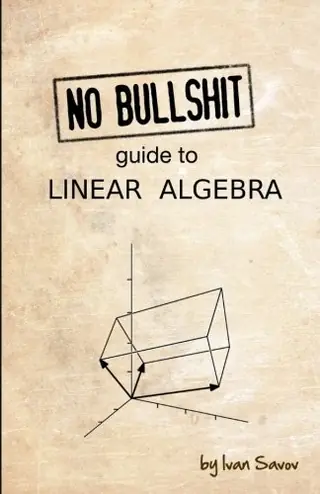
No bullshit guide to linear algebra
Ivan Savov
Recommended by 15 · mentioned by 1915 recommend · 19 mention15 recommend · 1915 recommend
Mathematics
A. D Aleksandrov
Recommended by 26 · mentioned by 3026 recommend · 30 mention26 recommend · 3026 recommend
 2008–2025
Mathematics
Andrei Nikolaevich Kolmogorov, M. A. Lavrentʹev, A.D Alexsandrov
Recommended by 12 · mentioned by 1512 recommend · 15 mention12 recommend · 1512 recommend
 2009–2026
Basic Mathematics
Serge Lang
Recommended by 22 · mentioned by 2722 recommend · 27 mention22 recommend · 2722 recommend
 2008–2026
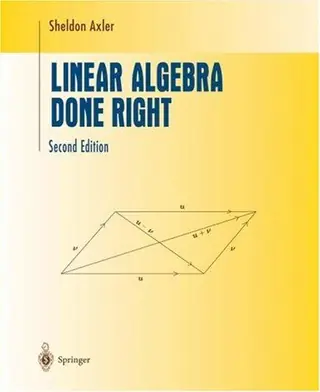
Linear Algebra Done Right
Sheldon Jay Axler
Recommended by 130 · mentioned by 179130 recommend · 179 mention130 recommend · 179130 recommend
 2010–2025
Who is Fourier?
Transnational College of Lex
Recommended by 15 · mentioned by 1615 recommend · 16 mention15 recommend · 1615 recommend
 2007–2026
How to prove it
Daniel J. Velleman
Recommended by 78 · mentioned by 10478 recommend · 104 mention78 recommend · 10478 recommend
 2012–2024
Mathematical Analysis
Tom M. Apostol
Recommended by 6 · mentioned by 96 recommend · 9 mention6 recommend · 96 recommend
I'm working my way through Ivan Savov's "No bullshit guide to math & physics" - https://www.goodreads.com/book/show/22876442-no-bullshit-gui... Would recommend it to anyone whose maths needs a bit of a brush up, or anyone who's interested in basic mechanics! Oh and I'm using Khan Academy for extra practice, which I can warmly recommend as well.
on “Ask HN: What kind of math do you study in your free time?” ↗I was asking a similar question a few years ago and found Ivan Savov’s “No Bullshit Guide to Math & Physics” to be really helpful.
on “Ask HN: I suck at math, where to start?” ↗Shameless self-plug about my book that covers calculus and mechanics in 300pp flat. No bullshit guide to math and physics: http://noBSgui.de/to/MATHandPHYSICS/
on “Ask HN: Books with a high signal to noise ratio?” ↗Yes, textbook pricing is totally out of whack. Also, the need to legitimize the higher sticker prices forces publishers to make books that are bloated, repetitive, and waaay too long. Who has time to read 1000+ pages? The textbook racket and bad quality of explanations is precisely why I started a publishing company: we make science textbooks that don't suck. [1] No bullshit guide to math & physi
on “A Brief History of the College Textbook Pricing Racket” ↗From the fist paper: If you want to learn more university-level math and physics, I invite you to check out my book, the No bullshit guide to math and physics I just wanted to pop in and say this book has been excellent. These papers are brief and therefore a bit cryptic, but the book is eminently readable. https://www.amazon.com/No-bullshit-guide-math-physics/dp/099...
on “What Math Do You Need for Physics?” ↗BTW, whoever wants a really concise "zero-to-hero" level PHYS 101 book read "No bullshit guide to math and physics" by Ivan Savov.
on “Books and lectures don't work” ↗…each topic is covered in much detail. Still cool though, as it would take years to learn about this stuff from different books. Speaking of math books, I wrote a math/phys text for adults called the No bullshit guide to math and physics http://noBSgui.de/to/MATHandPHYSICS/ It covers a lot of topics, starting from high school, going to first year calculus and mechanics. Worth checking out for anyone interested in the exact sciences…
on “The Princeton Companion to Applied Mathematics” ↗I have struggled with the same thing (and continue to do so). One thing I have found to be very helpful is Ivan Savov's "No bullshit guide to math & physics". It helps that it's written by a person who does a lot of tutoring, unlike the authors of many frightening ex-cathedra maths books. It basically builds its way up to calculus, in a way that's mostly easy to grok and in a way that's useful and
on “A Programmer’s Introduction to Mathematics” ↗All these years we had the buzzwords quantum and cloud separately. Today the buzzwords can finally merge to bring you quantum in the cloud. OMG, I predict the tech journalist will go crazy on this!! A very similar quantum circuit simulator (in JS): http://www.davyw.com/quantum/?example=Grover%27s%20Algorithm And now a shameless plug: If you want to learn quantum mechanics and quantum computing,
on “IBM Wants Everyone to Try a Quantum Computer” ↗That's a great list. The only thing that's missing would be a linear algebra course. The OP mentions it in passing, but a good understanding of LA goes a long way. I did UGRAD in engineering, and when I switched to physics everything was over my head, but my knowledge of LA still managed to keep me afloat. Also, matrix quantum mechanics is essentially straight up linear algebra (vectors, unitaries
on “So You Want to Learn Physics” ↗I have quite a few adult readers using my book to refresh and re-learn basic calculus and mechanics. You might consider checking it out[1]. It's not free, but very affordable. [1] https://www.amazon.com/dp/0992001005/noBSguide preview: https://minireference.com/static/excerpts/noBSguide_v5_previ...
on “Georgia Tech's free math textbook collective” ↗I have just the book for you: the essentials of high school math for adults: http://www.lulu.com/shop/ivan-savov/no-bullshit-guide-to-mat... If you like this one, you can followup with the MATH&PHYS book which covers mechanics (PHYS101) and calculus. And if you like that one, you can follow up with the liner algebra book. All along the way, I recommend you try solving exercises and problems usi
on “Ask HN: How to self-learn math?” ↗Ha, I came here to shamelessly self-promote, but I see my book has already been mentioned! Here is a direct link to the preview: https://minireference.com/static/excerpts/noBSguide_v5_previ... I won't claim that Chapter 1 is complete and detailed review of all of high school math, but I did my best to cover all the essential topics needed for mechanics and calculus so that the book will be self-
on “Mathematics for the Adventurous Self-Learner” ↗The best way to understand the Fourier transformations is to think of them as change-of-basis operations, like we do in linear algebra. Specifically a change from the "time basis" (normal functions) to the "frequency basis" (consisting of a family of orthonormal functions). Here is the chapter on Fourier transforms from my linear algebra book that goes into more details: https://minireference.com
on “Ask HN: What scientific phenomenon do you wish someone would explain better?” ↗Check out my No bullshit guide to math and physics: http://minireference.com/ [$33], it covers all of high school math, mechanics, derivatives, and integrals. An excellent free alternative is Calculus Made Easy by Silvanus P. Thompson, which is very good and also funny http://www.gutenberg.org/ebooks/33283
on “Why there is no Hitchhiker’s Guide to Mathematics for Programmers” ↗