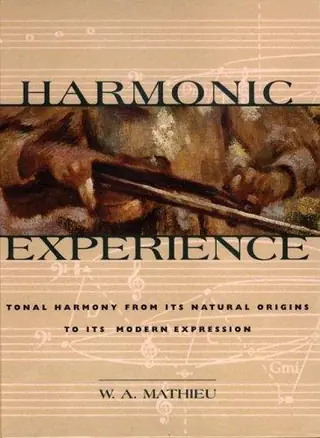
Harmonic Experience
by W. A. Mathieu · first published 1997
78% recommend22% neutral
Why HN recommends it
Explains tonal harmony from the harmonic series and low prime frequency ratios, helping readers see why chords like I, IV and V work; suited to working musicians wanting embodied understanding of intervals.
Summarised by Claude from recommending comments
_Harmonic Experience_ offers a comprehensive view of music that reconciles the ancient harmonic system of just intonation with the modern system of 12-tone equal temperament. Saying that “the rules of music were not formed in our brains but in the resonance chambers of our bodies,” W.A. Mathieu recognizes the pronounced need for an experiential kind of teaching that reconnects the way we _think_ music with the way we do music. Mathieu provides over a thousand musical examples and diagrams to illustrate the ideas he presents, allowing readers to reach a deeper level of response, to hear existin
Affiliate links. As an Amazon Associate I earn from qualifying purchases.
Mentions per year
What Hacker News says
Related books
 2008–2022
Musimathics
Gareth Loy
Recommended by 14 · mentioned by 1514 recommend · 15 mention14 recommend · 1514 recommend
 2008–2026
The nature of order
Christopher Alexander
Recommended by 25 · mentioned by 4025 recommend · 40 mention25 recommend · 4025 recommend
 2007–2026
House of Leaves
Mark Z. Danielewski
Recommended by 59 · mentioned by 13959 recommend · 139 mention59 recommend · 13959 recommend
 2007–2026
A pattern language
Christopher Alexander, Sara Ishikawa, Murray Silverstein, Max Jacobson
Recommended by 110 · mentioned by 226110 recommend · 226 mention110 recommend · 226110 recommend
 2007–2026
Infinite Jest
David Foster Wallace
Recommended by 145 · mentioned by 421145 recommend · 421 mention145 recommend · 421145 recommend
 2007–2026
Gödel, Escher, Bach
Douglas R. Hofstadter
Recommended by 505 · mentioned by 1,055505 recommend · 1,055 mention505 recommend · 1,055505 recommend
If anyone has interest in harmonic theory and why I/IV/V progressions are so pervasive, I highly recommend "The Harmonic Experience" by W.A. Mathieu. He really gets into the harmonic series, and how intervals are really low prime ratios. I read this book after being a professional musician for 15 years and it was an ear opening…
on “Chord progressions of 25,000 songs” ↗…https://www.amazon.com/Semiology-Graphics-Diagrams-Networks-... https://medium.com/@karlsluis/before-tufte-there-was-bertin-... Interestingly another relatively unknown book I like (and bought/read 20 years ago) is also about harmony: https://www.amazon.com/Harmonic-Experience-Harmony-Natural-E... I would say there's two kinds of harmony: harmony in equal temperament, and "alternative" harmonies based on physics, and this is about the latter. I can't tell from the link what…
on “Ask HN: What are the best unknown books you have read?” ↗…that we associate with sadness is simply the reciprocal nature of the ratio - the more complicated prime is in the denominator (as opposed to the overtonal nature of the M7 above) Short answer: read Harmonic Experience by W.A. Mathieu
on “Music theory for nerds (2016)” ↗I've mentioned this before, but for me, the definitive work on this vast subject is "The Harmonic Experience" by W.A. Mathieu. He really gets into low prime ratios, why they sound good to us, and also why the building blocks of modern western harmony are approximations of those ratios, rather than the real thing.…
on “Harmony Explained: Progress Towards a Scientific Theory of Music” ↗…notation isn't better than every other system according to every metric we could use to compare such things. Gary Garrett has more lattice demos on Youtube. Here's one that's an animation of an example in Harmonic Experience by W. A. Mathieu (which uses lattices extensively to explain harmony and is the best reference I know of for explaining how to understand them): https://www.youtube.com/watch?v=I49bj-X7fH0 A 3-5 lattice…
on “Get started making music” ↗Perhaps Harmonic Experience by W.A. Mathieu.
on “Coltrane Pitch Diagrams: Wrapping notes around a torus” ↗I don't have any good web links, but a couple of books that I've found useful are The Science of Musical Sound by John R. Pierce and Harmonic Experience by W. Mathieu. (The former is more focused on sound and scientific theory, whereas the latter is more focused on understanding music in a way that would be useful to a musician or composer.) On the…
on “Music Theory: An Education from First Principles” ↗I'm really looking forward to checking out these books, thanks for recommending! My favorite Math/Music text is "The Harmonic Experience", by W.A. Mathieu.
on “How the brain perceives rhythm” ↗I'd highly recommend the "singing against a drone" exercises in "the harmonic experience" by W.A. Mathieu. You can do them with an acoustic guitar, and they will improve your ear immensely. The first exercise is simple: singing exactly in tune with an open string.
on “It's Never Too Late to Learn Guitar” ↗Yes. See Harmonic Experience: Tonal Harmony from Its Natural Origins to Its Modern Expression by W.A. Mathieu https://www.goodreads.com/book/show/114365.Harmonic_Experien...
on “Older Adults' Forgetfulness Tied to Faulty Brain Rhythms in Sleep” ↗Mathieu's Harmonic Experience. Definitive book on reconciling just & equal temperament and how to develop embodied understanding of the relationships between notes.
on “Awesome Music Theory: books, links, videos, research, visuals, composition” ↗…https://www.garygarrett.me/?p=103 https://www.garygarrett.me/?p=1253 I also like this book which Gary recommends, although it's very challenging and I never made it all the way through: https://www.amazon.com/Harmonic-Experience-Harmony-Natural-E...
on “The Tonnetz” ↗Which book are you reading, out of curiosity? I recently bought Harmonic Experience, the physical book, and thought it was funny that it is even offered in the Kindle format. (By the way, it's not at all an introductory or comprehensive music theory book. It's about the history of harmony,…
on “College Students Prefer Reading Print Books to E-Readers” ↗I'm usually fairly cognizant of ligatures when I'm reading, but obviously I can only comment on the things I have read with my imperfect memory. The book I'm reading now (Harmonic Experience by Mathieu) is certainly what I would consider to be professionally typeset, and it does not use the "fi" ligature. Godel, Escher, Bach, on the other hand, does use it from what I remember. The Lifebox,…
on “The Beauty of LaTeX (2011)” ↗A book that I came across the other day (via a recommendation from YT-ber Adam Neely): "Harmonic Experience" by W.A. Mathieu. It's a little expensive as a first dive into this stuff, but it does look like a very natural way to lead you into and through the actual experience of western tonal harmony, often by…
on “My Procedurally Generated Music Is Awful” ↗