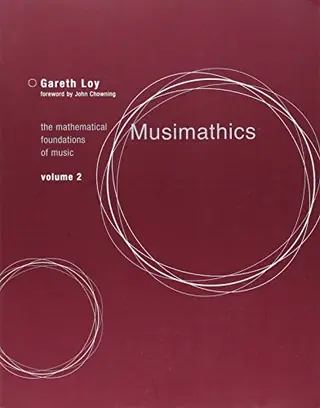
Musimathics
by Gareth Loy · first published 2011
93% recommend7% neutral
Why HN recommends it
Builds music theory from acoustics and math, taking very little for granted. It is more useful than standard theory books, especially for programmers and math-minded readers.
Summarised by Claude from recommending comments
Affiliate links. As an Amazon Associate I earn from qualifying purchases.
Mentions per year
What Hacker News says
Related books
 2009–2024
Mathematics and music
David Wright
Recommended by 3 · mentioned by 43 recommend · 4 mention3 recommend · 43 recommend
 2010–2026
Tuning, timbre, spectrum, scale
William A. Sethares
Recommended by 9 · mentioned by 119 recommend · 11 mention9 recommend · 119 recommend
 2014–2025
Harmonic Experience
W. A. Mathieu
Recommended by 7 · mentioned by 97 recommend · 9 mention7 recommend · 97 recommend
The audio programming book
Richard Charles Boulanger
Recommended by 4 · mentioned by 94 recommend · 9 mention4 recommend · 94 recommend
A geometry of music
Dmitri Tymoczko
Recommended by 9 · mentioned by 119 recommend · 11 mention9 recommend · 119 recommend
 2009–2026
The scientist and engineer's guide to digital signal processing
Steven W. Smith
Recommended by 46 · mentioned by 4946 recommend · 49 mention46 recommend · 4946 recommend
Also recommended: two-volume set "Musimathics" by Gareth Loy.[1] The work's topics are, mostly, independent so I find it enjoyable to pick up and read a chapter from time to time. He tries to cover the math of everything musical from scales and…
on “Math and Music: The Deeper Links (1982)” ↗I liked this book http://www.amazon.com/Understanding-Digital-Signal-Processin... Also the 2nd volume of "Musimathics" by Gareth Loy has a good introduction to DSP in the context of music and audio. http://www.amazon.com/s/ref=nb_ss_b?url=search-alias%3Dstrip...
on “Ask HN: Digital Signal Processing” ↗That's a funny video - thanks. However, nearly all music with "scales" is mathemagical to a large extent. Anyone who is interested in this sort of thing should check out the 2-volume book "Musimathics" by Gareth Loy.
on “What's Wrong with Western Music? Part III. "Passacaglia in Cm"” ↗Have some DSP resources: Richard G. Lyons, Understanding Digital Signal Processing [0] Gareth Loy, Musimathics: The Mathematical Foundations of Music (volume 2) [1] r8brain-free-src (high quality sample rate conversion algorithms) [2] KVR's DSP forum, frequented by actual pro audio developers [3] [0] https://www.amazon.com/Understanding-Digital-Signal-Processi...…
on “Beamforming in PulseAudio” ↗It doesn't contain code, but "Musimathics" by Gareth Loy was way more useful to me than any vanilla theory book. I think most other musically ignorant programmers would agree.
on “My Procedurally Generated Music Is Awful” ↗…luxury of collaborating with their idols, or pay homage to them like artists do. Programming != art :-(" P.S. If you just want to escape computing and take a few weeks off, get yourself a book called "Musimathics" and meditate .. -- [1] I don't usually tweet ideas, only rants.
on “Introduction to Pyjamas” ↗…on mathematics (see book list below); here at the latest, your assumption is likely to be correct, but hardly in general. Book list: Mathematics and Music - Composition, Perception, and Performance Musimathics Volume 1 and 2 Music and Mathematics - From Pythagoras to Fractals Mathematical and Computational Modeling of Tonality - Theory and Applications
on “Music theory for nerds (2016)” ↗BTW, please read something like "Musimathics", it'll be better than trying to learn music theory from Wikipedia.
on “Music theory for nerds” ↗Fundamentals is great. And the two Musimathics books neatly complement the DSP analysis of music, by approaching music generatively, as a product of math and physics: https://www.amazon.com/Musimathics-Mathematical-Foundations-...
on “A curated list of Music DSP and audio programming resources” ↗For anyone interested in that kind of stuff: read "Musimathics", volume I especially.
on “Mathematical explanation of music and white/black notes in a piano” ↗…The scientific stuff in Schoenberg's Theory of Harmony is mostly garbage though. If you're interested in reading more about the modern understanding of the physical properties of music I'd recommend "Musimathics: The Mathematical Foundations of Music," and Benson's "Music: A Mathematical Offering." For an attempt to look at musical structure in terms of its cognition, I enjoyed "The Cognition of Basic Musical…
on “The distinction between music and noise is mathematical form” ↗…useful to describe the various music styles, elements that make up these styles, and the ways to compose these elements. That would be using math in a descriptive way. I like for example the 2 book series "Musimathics" (http://www.musimathics.com/). In the end, nobody knows how much of music can be understood by viewing it through the mathematical lens. I suspect quite a lot, if not all.
on “Harmony Explained: Progress Towards a Scientific Theory of Music” ↗If you want a series of books that constitute "music theory for nerds" -- building up music theory from a solid foundation of acoustics, and math -- try "Musimathics" by Gareth Loy. It is a great read. It takes very little for granted. Now, sometimes you have to say "this is just the way it turned out" to explain Western music, but the best way to do so is to show…
on “Music theory for nerds” ↗https://ccrma.stanford.edu/~jos https://www.dspguide.com https://www.willpirkle.com/about/books Musimathics Volumes 1 and 2
on “Ask HN: How to get started with audio programming?” ↗…material, particularly focusing on short animations to develop better visual intuition along with working code examples of the material in the books. Books covered (with a notebook for each chapter): * Musimathics volumes 1 & 2 by Gareth Loy * Introduction to the DFT by Julius Smith * Introduction to Digital Filters by Julius Smith * Physical Audio Signal Processing by Julius Smith also a couple not directly…
on “Ask HN: How to get started with audio programming?” ↗