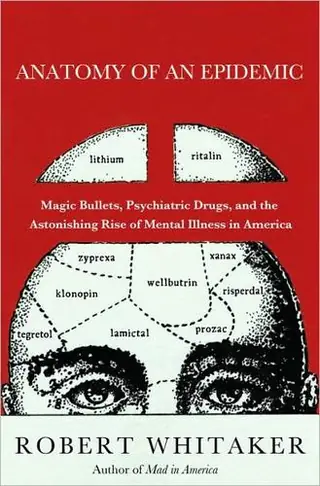
Anatomy of an Epidemic
Magic Bullets, Psychiatric Drugs, and the Astonishing Rise of Mental Illness in America
by Robert Whitaker · first published 2010
59% recommend37% neutral4% critical
Why HN recommends it
Well-cited history of research on antidepressants, benzos and neuroleptics, arguing long-term drug treatment may worsen outcomes as mental illness rates rose. Suits readers questioning the chemical imbalance model.
Summarised by Claude from recommending comments
In this astonishing and startling book, award-winning science and history writer Robert Whitaker investigates a medical mystery: Why has the number of disabled mentally ill in the United States tripled over the past two decades? Every day, 1,100 adults and children are added to the government disability rolls because they have become newly disabled by mental illness, with this epidemic spreading most rapidly among our nation's children. What is going on? Anatomy of an Epidemic challenges readers to think through that question themselves. First, Whitaker investigates what is known today about t
Affiliate links. As an Amazon Associate I earn from qualifying purchases.
Mentions per year
What Hacker News says
Related books
 2014–2023
Mad in America
Robert Whitaker
Recommended by 3 · mentioned by 93 recommend · 9 mention3 recommend · 93 recommend
 2010–2023
The Emperor's New Drugs
Irving Kirsch
Recommended by 3 · mentioned by 53 recommend · 5 mention3 recommend · 53 recommend
 2012–2018
Overdosed America
John Abramson
Recommended by 4 · mentioned by 44 recommend · 4 mention4 recommend · 44 recommend
 2010–2024
What you can change-- and what you can't
Martin Elias Pete Seligman
Recommended by 5 · mentioned by 65 recommend · 6 mention5 recommend · 65 recommend
 2011–2025
Crazy like us
Ethan Watters
Recommended by 9 · mentioned by 109 recommend · 10 mention9 recommend · 109 recommend
 2007–2022
The Truth about Drug Companies
Marcia Angell
Recommended by 3 · mentioned by 113 recommend · 11 mention3 recommend · 113 recommend
Love in the Time of Cholera
Gabriel García Márquez
Recommended by 9 · mentioned by 189 recommend · 18 mention9 recommend · 189 recommend
The book you should read on this is Robert Whitaker's Anatomy of an Epidemic. Whitaker's book goes the history of academic studies on antidepressants (as well as benzos and neuroleptics), and after extensive analysis of these studies concludes that over the long term antidepressants…
on “Depression, Burn Out and Writing Code” ↗…Paul Stamets, Hamilton Morris, and Will Hall. Then I started asking more questions and found writers like Johan Harri, Michael Pollan, and Robert Whitaker. Following Whitaker's work after reading his Anatomy of an Epidemic, I also suggest watching the "Medicating Normal" movie.
on “California bill would decriminalize psychedelics” ↗Anatomy of an Epidemic by Robert Whitaker. Also check out this blog post of his that summarizes the largest longterm studies of the mainstay psych drugs: http://www.madinamerica.com/madinamerica.com/Home/AB86250A-A... You…
on “The Hidden Cost of Smart Drugs (2008)” ↗Yes, of course. Read Anatomy of an Epidemic, The Emperor's New Drugs, etc. Robert Whitaker's blog is also really great, although you wouldn't necessarily have all the information you'd need to read it unless you've already read the book.
on “On Depression & Getting Help” ↗…we shouldn't reject its conclusion as on-face impossible Some examples: http://m.theatlantic.com/magazine/archive/2010/11/lies-damne... Also you could look at, for psychiatry, Robert Whitaker's book Anatomy of an epidemic.
on “Medicaid kills? "Causality is the first casualty."” ↗…for so long they now argue that it's not unethical because everyone else is doing it, it's just the standard practice. Robert Whitaker has a great explanation of the implications of this in his book Anatomy of an Epidemic, which is one of the three books this article is reviewing.
on “The Epidemic of Mental Illness: Why?” ↗This is not new news, but thankfully it is finally getting more attention. I highly recommend a book to anybody who's interested in the topic of mental illness: Anatomy of an Epidemic by Robert Whitaker. A very well-researched and interesting read. Lays out the evidence that research actually supports that antidepressants and antipsychotics (neuroleptics) actually cause worse long…
on “Anti-depressant study results 'disturbing'” ↗There are plenty of reasons to believe that drugs are actually making it worse. Robert Whitaker's Anatomy of an Epidemic was the first to make this point. Burden of mental illness has doubled while the antidepressant treatment has been made common place. We have no long term studies showing SSRIs help in the long term.…
on “Drugs alone won't fix our epidemic of depression” ↗Worth pointing out Robert Whitaker's book Anatomy of an Epidemic. https://en.wikipedia.org/wiki/Anatomy_of_an_Epidemic. It goes in depth into the conflicting paradox of a dramatic increase in amount of mental health care and the paradoxical increase in the burden of…
on “Mental illness: is there a global epidemic?” ↗…pill, consider also reading another book, written in a different mood, mode, and format by Robert Whitaker, an American journalist and author, who writes primarily about medicine, science, and history. Anatomy of an Epidemic: Magic Bullets, Psychiatric Drugs, and the Astonishing Rise of Mental Illness in America https://www.goodreads.com/book/show/7799587-anatomy-of-an-ep... During the past fifty years, when investigators…
on “The Enigma of Gloom: On George Scialabba’s “How to Be Depressed”” ↗…etiology and pathogenesis. Research on the influence of gut bacteria and intestinal dysbiosis on anxiety and depression has been coming out since at least 2013 [1]. After reading Robert Whitaker's 2010 Anatomy of an Epidemic [2], I'm convinced that future generations will look back on this era of psychiatric treatment with the same critical eye that our generation points at Moliere's 17th-century leeches or George Washington's…
on “The cause of depression is probably not what you think” ↗Anatomy of an Epidemic: http://www.amazon.com/Anatomy-Epidemic-Bullets-Psychiatric-A... About how there has been an enormous rise in the rates of mental illness over the last 50 years. And despite the fact that the APA says…
on “Ask HN: Best book you read in 2010 and briefly why” ↗My favorite book was Robert Whitaker's Anatomy of an Epidemic. The book is about how, for a confluence of reasons, psychotropic drugs like antipsychotics and antidepressants actually, long-term, exacerbate the mental illness they're trying to cure. What I love…
on “Ask HN: What are your favorite books of 2010?” ↗…medication"), Wil has a pretty good chance of having a poor outcome. Especially because his medical advice seems to include the deeply problematic "chemical imbalance' theory. Reading Whitaker's "The Anatomy of an Epidemic" (https://en.wikipedia.org/wiki/Anatomy_of_an_Epidemic) should be required for anyone considering long-term use of neuroleptics, benzodiazepines, or anti-depressants. And for those who care for them.
on “The Other Side of Depression” ↗> Are you referring to a single major depressive episode? Yeah if you read Anatomy of an Epidemic, Robert Whitaker has a good research review of all the large scale NIMH/NIH studies.
on “Toward a Predictive Theory of Depression” ↗