
Crazy like us
The Globalization of the American Psyche
by Ethan Watters · first published 2010
90% recommend10% neutral
Why HN recommends it
Argues that mental illness is shaped by culture, showing how Western diagnoses and attitudes spread abroad; an anthropology-leaning starting point for people questioning how psychiatric conditions are understood.
Summarised by Claude from recommending comments
The most devastating consequence of the spread of American culture across the globe has not been our golden arches or our bomb craters, but our bulldozing of the human psyche itself. American-style depression, post-traumatic stress disorder, and anorexia have begun to spread around the world like contagions, and the virus is us. Traveling from Hong Kong to Sri Lanka to Zanzibar to Japan, acclaimed journalist Ethan Watters witnesses firsthand how Western healers often steamroll indigenous expressions of mental health and madness and replace them with our own. In teaching the rest of the world t
Affiliate links. As an Amazon Associate I earn from qualifying purchases.
Mentions per year
What Hacker News says
Related books
 2012–2023
Nail It then Scale It
Nathan Furr, Paul Ahlstrom
Recommended by 14 · mentioned by 1814 recommend · 18 mention14 recommend · 1814 recommend
 2010–2023
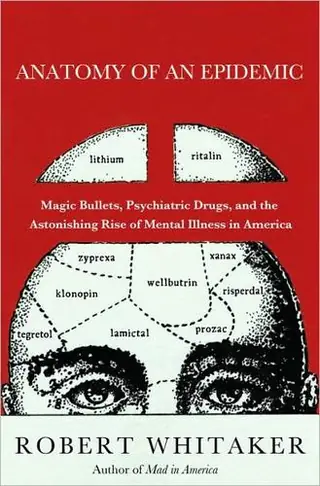
Anatomy of an Epidemic
Robert Whitaker
Recommended by 16 · mentioned by 2716 recommend · 27 mention16 recommend · 2716 recommend
 2008–2026
Chaos
James Gleick
Recommended by 45 · mentioned by 6345 recommend · 63 mention45 recommend · 6345 recommend
 2016–2026
The Body Keeps the Score
Bessel van der Kolk
Recommended by 90 · mentioned by 14290 recommend · 142 mention90 recommend · 14290 recommend
…the theory behind the disorder before publication. There is a summary of this here: http://www.vva.org/archive/TheVeteran/2005_03/feature_Histor... Although the history of PTSD in Ethan Watters book Crazy Like Us is better written.
on “Does everyone who suffers trauma have PTSD?” ↗Thank you so much for posting this. Are there any good sources for this type of information? I'm specifically interested in psychological/neurological differences between cultures. A similar example is Crazy Like Us [1]. It's fascinating how culture seems to thwart a full comprehension of psychology. 1: http://www.amazon.com/Crazy-Like-Us-Globalization-American/d...
on “Human Brains Are Wired to Blame Rather Than Praise” ↗“Crazy Like Us: The Globalization of the American Psyche” by Ethan Watters. I have been chronically depressed since I was 6 years old. I have had suicidal tendencies as long as I can recall being sentient. I would…
on “Ask HN: What are some of the best books you have read in 2022?” ↗If anyone wants to know more about why the subjectiveness of the DSM is problematic, check out Crazy Like Us by Ethan Watters, and then also this Wired article: http://www.wired.com/magazine/2010/12/ff_dsmv/ I realize this is only a book review and not an attempt to fully explain the issues, but even still…
on “The Illusions of Psychiatry” ↗…experience of depression, I don't think it's just sadness and I'm absolutely sympathetic toward those who with depression. But... My thinking about mental illness changed a lot after reading a book called Crazy Like Us [1]. It doesn't talk about depression specifically - it's a collection of case studies on how different mental illnesses have been experienced/handled/treated by different societies around the world,…
on “We Need to Have Sympathy for Those With Depression. It is an Illness” ↗Recommended reading: "Crazy Like Us" by Ethan Watters. I'm not sure about the validity of this article, but the Watters book presents a fair amount of evidence that mental disorders are in many ways socially constructed by individual cultures.…
on “How Japan came to believe in depression” ↗…have worsened. I'm not sure I agree either, but is that so hard to gleam from TFA? Here's a book that adds to this point that mental illness "spreads" in a social contagion sense: https://www.amazon.com/Crazy-Like-Us-Globalization-American/...
on “Prozac Nation Is Now the United States of Xanax” ↗I'm not so sure. It depends what you mean by "depression". If you mean exactly what's written in the DSM then you should be sceptical. See "Crazy like us" by Ethan Watters: a great book, only part of it about depression. Remember that when Freud was active the main psychiatric ailment was "hysteria". Did hysteria exist? Does it still exist? To what extent…
on “A new form of brain stimulation relieved severe depression in a small study” ↗If you are interested in this topic, I recommend "Crazy Like Us" by Ethan Watters - it describes how mental illnesses get exported by media coverage and cultural attitudes from Western countries, and how cultural expectations shape the manifestation of mental illness.…
on “TikTok trend that makes teens believe they have serious mental disorders” ↗…sociological reasons for depression was much more effective at helping me than learning about the biological or pharmacological aspects. If you are in a similar position, I cannot recommend enough reading Crazy Like Us: The Globalization of the American Psyche by Ethan Watters as a starting point.
on “The serotonin theory of depression: a systematic review of the evidence (2022)” ↗…here: http://news.ycombinator.com/item?id=2622912 Perhaps most notably that the author of this piece is the former editor of the New England Journal of Medicine. In addition to the three books reviewed, Crazy Like Us is definitely also worth a read. It's a more anthropological look at mental illness so it's maybe not quite as good as Anatomy of an Epidemic as the first of these books to read, but it's still incredibly…
on “The Epidemic of Mental Illness: Why?” ↗…think that the line delineating "psychiatric pathology" is not as clear as you imply. Many such pathologies are arguably socially constructed and sometimes even contagious in similar ways (see the book "Crazy Like Us"). I think "being vulnerable to social contagion to an extent that leads you to literally inflict harm on yourself" is definitely within the scope of being classified as a psychiatric pathology, even…
on “The teen mental illness epidemic is international (2023)” ↗…environments, but in higher stress environments it basically becomes permanent. I think that Ethan Watters discusses why it is that people in poor countries do better due to social factors in his book Crazy Like Us, and Robert Whitaker discusses the role of anti-psychotics in Anatomy of an Epidemic. In terms of social factors though, I vaguely remember that in poor countries families are more likely to let people…
on “My son is schizophrenic. The ‘reforms’ that I worked for have worsened his life.” ↗Further reading on this subject: https://astralcodexten.substack.com/p/book-review-crazy-like... > In Crazy Like Us, Ethan Watters sounds the alarm about falling psychiatric biodiversity. Along with all the usual effects of globalization, everyone is starting to have the same mental illnesses, and to understand them…
on “Teen Girls Are Developing Tics. Doctors Say TikTok Could Be a Factor” ↗Ethan Watters looks at how mental illness is to some extent determined by culture in "Crazy like us", though he looks at Japan rather than China. Do you know that book?
on “The Cult of Sigmund Freud” ↗