
Mad in America
by Robert Whitaker · first published 2001
23mentions
3recommended by
9HN commenters
2014–2023first – last mentioned
33% recommend67% neutral
In Mad in America, medical journalist Robert Whitaker reveals an astounding truth: Schizophrenics in the United States currently fare worse than patients in the world's poorest countries, and quite possibly worse than asylum patients did in the early nineteenth century. With a muckraker's passion, Whitaker argues that modern treatments for the severely mentally ill are just old medicine in new bottles, and that we as a society are deeply deluded about their efficacy. Tracing over three centuries of "cures" for madness, Whitaker shows how medical therapies have been used to silence patients and
Affiliate links. As an Amazon Associate I earn from qualifying purchases.
I absolutely agree with this. For anyone curious about how psychiatry is bought and paid for by pharmaceutical companies, read the book "Mad in America" by Robert Whitaker. He looks at studies of the long-term outcomes for schizophrenia patients who are treated with drugs versus those who aren't given drugs. What he finds is that schizophrenics who never…
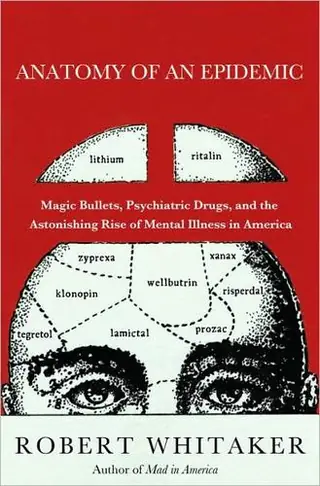
on “Living with Schizophrenia: Coffee and Friends” ↗> no books by journalists, unless it’s about journalism Charles Mann's 1491 and 1493 remain the best books on the topic. Robert Whitaker's Mad in America and Anatomy of an Epidemic likewise.
on “Rules for Choosing Nonfiction Books” ↗Thanks for the quote. This was part of an essay, Cargo Cult Psychiatry, posted at the Mad in America Foundation's website: https://www.madinamerica.com/2022/06/cargo-cult-psychiatry/ I found Robert Whitaker's books invaluable for helping me understanding the mental health industry's mindset. Mad in…
on “Cargo Cult Science by Richard P. Feynman (1974) [pdf]” ↗…https://en.wikipedia.org/wiki/Neuroactive_steroid#Role_in_an... There are some good articles in the Boston Globe's archives about Prozac, circa 2000. "Prozac, Revisited", etc [2]. Robert Whitaker [3] worked for the Boston Globe, before he wrote Mad in America and Anatomy of an Epidemic. [2] http://www.narpa.org/prozac.revisited.htm (the boston globe's official archives site is not so easy to use, but I've previously verified that these stories exist) [3]…
on “Extreme side-effects of antidepressants” ↗…been diagnosed as ADHD in college. This was not a biological problem, but that I didn't care about my classes. Stimulants might have helped me focus better, but ... why? Robert Whitaker [1], author of Mad in America and Anatomy of an Epidemic, has looked into these matters, and concluded that the medications make people's conditions worse. [1] http://www.madinamerica.com/
on “Amphetamine use in America's workforce” ↗> Robert Whitaker [1], author of Mad in America and Anatomy of an Epidemic, has looked into these matters, and concluded that the medications make people's conditions worse. Sure, I agree that the school isn't making it any better but lashing out…
on “Amphetamine use in America's workforce” ↗Robert Whitaker chronicles the deteriotation of mental health treatment in Mad In America. The Quakers had asylums for people who had 'episodes'. The clients were fed 4 meals a day and kept safe. 80-90% recovered to the point where they could leave the asylum. Non-quaker asylums were much…
on “Newsom proposes to force some homeless people into treatment” ↗…on people, we ought to help them while we’re at it. But the system I’ve observed over these past few months is little more than a haphazard collection of poor practices. Robert Whitaker [3], author of Mad in America, does a good job of heckling the status quo, but they haven’t reached a threshold where they can demonstrate dramatically better strategies for helping people through their mental problems. [3] http://www.madinamerica.com/robert-whitakers/
on “Apply HN: Hacking Mental Health” ↗…is covered in more depth: case studies, as cause of juvenile bipolar disorder, hiding the evidence, risks/side-effects, and silencing dissent. More information about this book can be found through the Mad In America link above; I directly linked to its information page in another comment. People tend to like the stimulants. They tend to hate the sedatives. Some stimulant users end up being forcibly sedated with…
on “Amphetamine use in America's workforce” ↗> This is more a site that advocates for a particular policy point of view than a site that neutrally reviews the latest methodologically careful research. Mad in America was the title of investigative journalist Robert Whitaker's first book. Whitaker's second book, Anatomy of an Epidemic, proposes that there is not and has never been any evidence that commonly used psychiatric…
on “Withdrawal from Antidepressants” ↗…reviewed by Paul McHugh, M.D.: The Doctor Isn’t In - https://www.commentarymagazine.com/articles/the-doctor-isnt-... The practices of conventional Psychiatry have been pretty well repudiated by the Mad in America crew, led by investigative journalist Robert Whitaker. Today's essay is Has Psychiatry Gone Uniquely Astray? - https://www.madinamerica.com/2017/07/has-psychiatry-gone-uni... edit: this essay has a interesting…
on “What Does the New York Times Have Against Psychiatry?” ↗…effective, but on closer examination is not helping patients in any long-term way and may actually be killing them." Robert Whitaker discusses the old "humane" treatments for the mentally ill in his book, Mad in America [0]. The Quakers had "asylums" where patients were kept safe and provided 4 meals a day. Most patients recovered well enough to leave the asylum after a while. [0] https://books.google.com/books?id=Cw6MlCXhN5MC…
on “The Psychopharmacology of Everyday Life” ↗…https://news.ycombinator.com/item?id=27993001 > OK, so they're ranting specifically about US prescribing practices, the DSM, and the US drug industry. They're focused on anti-psychotics. The essence of Robert Whitaker's books, Mad in America, Anatomy of an Epidemic, and Psychiatry Under the Influence, is that Psychiatry got idealogically-captured by the drug industry, and how psychiatric drugs arguably take episodic conditions and make them…
on “Perceptual distortions in late-teens predict psychotic symptoms in mid-life” ↗…bloodletting, calomel (mercury poisoning) and the routine extraction of tonsils in the dustbin of medical history. [1] I just learned about Soviet use of Haldol for torture from Robert Whitaker's first book, Mad in America. My observations confirm that 'Haldol' really is a terrible drug. [2] https://en.wikipedia.org/wiki/Lobotomy Robert Whitaker's foundation is sort-of a clearing house for the Resistance: https://www.MadInAmerica.com/
on “How can you treat someone who doesn’t accept they are ill?” ↗…field's long history of harmful treatment: Lobotomies, water torture, palliative medications, [edit: electrocution], etc. Robert Whitaker examined the predicament of the "mentally ill" in his first book, Mad in America: https://books.google.com/books?isbn=0786723793 The tragedy of the situation is that the Quakers figured out how to compassionately care for people while they had mental episodes (Ref: Whitaker's book).…
on “How Well Do We Understand Probabilities in Medicine? (2016)” ↗