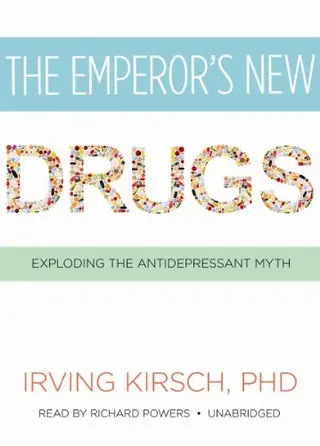
The Emperor's New Drugs
by Irving Kirsch · first published 2009
14mentions
3recommended by
5HN commenters
2010–2023first – last mentioned
60% recommend40% neutral
Affiliate links. As an Amazon Associate I earn from qualifying purchases.
Mentions per year
What Hacker News says
Related books
 2012–2018
Overdosed America
John Abramson
Recommended by 4 · mentioned by 44 recommend · 4 mention4 recommend · 44 recommend
 2007–2022
The Truth about Drug Companies
Marcia Angell
Recommended by 3 · mentioned by 113 recommend · 11 mention3 recommend · 113 recommend
 2010–2023
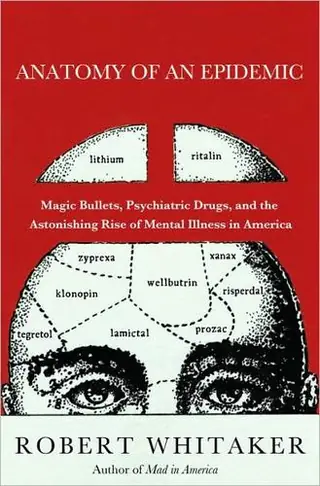
Anatomy of an Epidemic
Robert Whitaker
Recommended by 16 · mentioned by 2716 recommend · 27 mention16 recommend · 2716 recommend
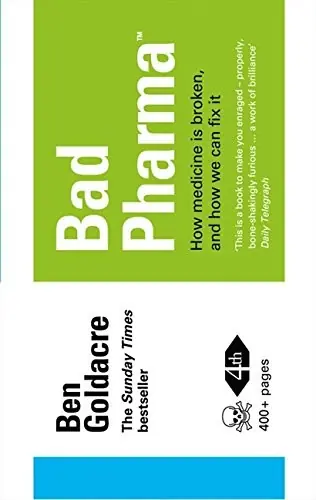 2012–2025
Bad Pharma
Ben Goldacre
Recommended by 42 · mentioned by 6442 recommend · 64 mention42 recommend · 6442 recommend
You might like Irving Kirsch's book The Emperor's New Drugs. It's all about the placebo effect as it relates to antidepressants, but also more generally. I know with depression specifically the difference between placebo treatment and no treatment is actually…
on “Evolution could explain the placebo effect” ↗I'd recommend Irving Kirsch's __Emperor's new drugs: Exploring the antidepressant myth__ as an accessible introduction to this topic. The book goes beyond statistics and draws attention to "clinical significance" that is crucial to keep in mind when evaluating…
on “Psychologists Welcome Analysis Casting Doubt on Studies” ↗…in the placebo group due to very noticeable side effects. It's been mentioned in other comments, but I really recommend the work of Irving Kirsch on this; he's a brilliant scientist and his book The Emperor's New Drugs is a real eye-opener.
on ““No convincing evidence” that depression is caused by low serotonin levels” ↗…depression) is because the study that found that made the mistake of relying only on published research. (Which the authors of that study apparently acknowledged later on.) In Irvin Kirsch's book The Emperor's New Drugs he goes over this at length.
on “It’s time all clinical trial results are reported” ↗Yes, of course. Read Anatomy of an Epidemic, The Emperor's New Drugs, etc. Robert Whitaker's blog is also really great, although you wouldn't necessarily have all the information you'd need to read it unless you've already read the book.
on “On Depression & Getting Help” ↗…mostly placebo, but don't have any good criticisms to levy against double blind studies of antidepressants with placebos." Because maybe he assumes you aren't too stupid to do a simple Google search. Both Emperor's New Drugs and Anatomy of an Epidemic are extraordinarily well written, it's well worth reading both, and there are all sorts of other good books on mental illness as well. This is exactly why HN has become like…
on “Depression lies” ↗…Prescription To End Confusion (IOM) http://books.nap.edu/openbook.php?record_id=6121 - IOM Workshop: Antiomicrobrial Resistance - Issues and Options Books: Anatomy of an Epidemic (Mental health) The Emperor's New Drugs (Mental health) Crazy Like Us (Mental health) The Truth About Drug Companies (Pharma) Overdosed America (Pharma) Health Behavior Change and Treatment Adherence: Evidence-based Guidelines for Improving…
on “How to Get Startup Ideas” ↗…anti-depressant trials, but somehow the poor blinding of anti-depressant trials is almost never mentioned as a serious methodological problem. This is discussed in more detail in Irving Kirsch's The Emperor's New Drugs.
on “Ecstasy for PTSD: Not Ready for Prime Time” ↗Irving Kirsch, psych professor at Harvard, wrote a book called "The Emperor's New Drugs" which argues that antidepressants are basically just placebos. I haven't read the book but I have seen a lot of interviews and articles on his research and it's pretty damning.
on “Even when we know they’re “fake,” placebos can tame our emotional distress” ↗…something to be clinically significant means the difference between the two groups is large enough to have noticeable health effects or impact one's decision-making about medical issues. In the book The Emperor's New Drugs, about the efficacy of anti-depressants (or lack thereof), Kirsch gives the example that if you had a group of 500,000 people and found that smiling frequently increases life expectancy by 10 seconds…
on “Father’s Age Is Linked to Risk of Autism and Schizophrenia” ↗This is what the book The Emperor's New Drugs is about. The idea of the book is that there was some well-known research showing that anti-depressants are effective for severe depression, but not mild or moderate cases. But if you actually only look…
on “The Placebo Effect Doesn’t Apply Just to Pills” ↗…published at all, and of the few that were published, most were described in the journal articles as showing positive results -- despite the fact that the FDA had concluded that they had not." Source: The Emperor's New Drugs, p. 67 Drug companies consider the raw data a trade secret, so they are never going to give it to you themselves.
on “FDA wants 55 years to process FOIA request over vaccine data” ↗…studies showing negative results remain unpublished, and short of making official enquiries to government agencies, their data are unavailable to researchers, doctors and the public at large." Source: The Emperor's New Drugs, p. 39 "The fact that what gets published are the trials with positive results was most convincingly shown by a group of researchers at the Oregon Health and Science University, who followed up on our…
on “Ecstasy for PTSD: Not Ready for Prime Time” ↗…25 per cent of them showed favourable results for the product of a competing company. In studies that are not sponsored by a drug company, the success rate is approximately 50 per cent." Source: The Emperor's New Drugs, p. 62, describing <a href="http://journals.cambridge.org/action/displayAbstract;jsessio... between drug company funding and outcomes of clinical psychiatric research</a> See also: http://jama.jamanetwork.com/article.aspx?articleid=202867…
on “Ecstasy for PTSD: Not Ready for Prime Time” ↗