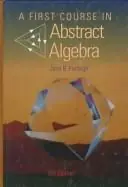
A first course in abstract algebra
by John B. Fraleigh · first published 1967
67% recommend33% neutral
Why HN recommends it
Gentle, well-motivated introduction to groups, rings and fields that explains why each structure is studied before giving definitions. Suited to self-study and to students newer to proof-based math.
Summarised by Claude from recommending comments
Affiliate links. As an Amazon Associate I earn from qualifying purchases.
Mentions per year
What Hacker News says
Related books
 2019–2026
A Walk Through Combinatorics
Miklos Bona
Recommended by 4 · mentioned by 44 recommend · 4 mention4 recommend · 44 recommend
 2015–2025
Introduction to Smooth Manifolds
John M. Lee
Recommended by 5 · mentioned by 85 recommend · 8 mention5 recommend · 85 recommend
 2017–2024
Contemporary Abstract Algebra
Joseph A. Gallian, Joseph Gallian
Recommended by 7 · mentioned by 97 recommend · 9 mention7 recommend · 97 recommend
 2010–2026
Topology
James R. Munkres
Recommended by 11 · mentioned by 1911 recommend · 19 mention11 recommend · 1911 recommend
Proofs
Jay Cummings
Recommended by 8 · mentioned by 98 recommend · 9 mention8 recommend · 98 recommend
A Book of Abstract Algebra
Charles C. Pinter
Recommended by 25 · mentioned by 2725 recommend · 27 mention25 recommend · 2725 recommend
Real Analysis
Jay Cummings
Recommended by 10 · mentioned by 1010 recommend · 10 mention10 recommend · 1010 recommend
 2008–2025
Topics in algebra
I. N. Herstein
Recommended by 10 · mentioned by 1110 recommend · 11 mention10 recommend · 1110 recommend
I loved "A First Course in Abstract Algebra" by Fraleigh. It was a while ago, so I don't quite remember whether it had solutions for the exercises or not. [edit]: There's also Michael Artin's "Algebra" which is somewhat dense (certainly without…
on “SICP - summary of 10 months working through the entire book” ↗goofy suggestion. those are both either grad or senior undergrad books depending on where you are. much better suggestion is A Book of Abstract Algebra by Pinter (really gentle) or A First Course in Abstract Algebra by Fraleigh
on “Ask HN: How to self-study mathematics from the undergrad through graduate level?” ↗My favourite abstract algebra textbook is Fraleigh's A First Course in Abstract Algebra. Unlike the article here, which just dumps you a bunch of definitions, the book introduces each structure with proper motivation. It's not a CS approach though. https://www.amazon.com/First-Course-Abstract-Algebra-7th/dp/...…
on “A Brief Guide to a Few Algebraic Structures” ↗…Finite-Dimensional Vector Space (Paul Halmos) 2. Linear Algebra Done Right (Steven Axler) Real Analysis 1. Real Mathematical Analysis (Charles Pugh) 2. Introduction to Analysis (Maxwell Rosenlicht) Algebra 1. A first course in abstract algebra (John Fraleigh) These books are better for self-directed reading compared to some of the classics like Rudin or Herstein. These should keep you busy for a while.
on “Ask HN: Good Reading/Immersion in Mathematics” ↗…theory. The only complaint one could make is that it's written for mathematicians. A more appropriate book for "lower level" students (in terms of mathematical maturity) would be John B. Fraleigh's "A First Course In Abstract Algebra".
on “Ask HN: Recommendations for a great introductory text on Abstract Algebra?” ↗…through the following books entirely, however I've used them when needed to learn or clarify a concept: > Group Theory - I would look for a good abstract algebra book that also covers groups, such as A First Course in Abstract Algebra, Fraleigh or Basic Algebra, Knapp. Another popular recommendation is Abstract Algebra, Dummit and Foote. > Topology I think you should first look at a real analysis course and understand metric space…
on “Ask HN: Mathematicians, what textbooks are best for learning these math topics?” ↗Maybe "A first course in Abstract Algebra" by Fraleigh available on Kindle for less than $10. https://www.amazon.com/dp/0201763907 (It's not focused on Monoids. It also covers groups, rings, and fields from a mathematical point of view.…
on “Fast Fibonacci numbers using Monoids” ↗…a reference instead of a primary text, because the idea of reading it through from start to finish scares me. That tome scared me too. If you want to self-study abstract algebra, either Fraleigh's "A First Course in Abstract Algebra" or Paulsen's "Abstract Algebra: An Interactive Approach" is a better choice IMHO. Both are more accessible, come with detailed explanations, and the Paulsen book is even accompanied by SageMath code…
on “Chicago undergraduate mathematics bibliography (1999)” ↗…Stewart, Concepts of Modern Mathematics - Herrmann, Sally, Number, Shape, and Symmetry - Baylis, What is Mathematical Analysis? - Feil, Krone, Essential Discrete Math for Computer Science - Rotman, A First Course in Abstract Algebra with Applications - Banjamin, Chartrand, Zhang, The Fascinating World of Graph Theory - Zou, Mult-Variable Calculus: A First Step - Hubbard, The World According to Wavelets - Sayama, Introduction…
on “Higher Math for Beginners (1987)” ↗Gilbert Strang - linear algebra A First Course in Abstract Algebra - rotman
on “Ask HN: How do you decide what to learn next?” ↗Thank you. I am actually a self- learner and have only take calculus, linear algebra, probability, statistics. Currently learning bayesian statistics and reading “first course in abstract algebra” by John B Fraleigh. I am guessing I should do Real Analysis and then the Munkres book to get an idea of topology ?
on “Elementary Applied Topology (2014)” ↗When I was around 10 in the mid 90s, I started trying to read my mom's copy of John Fraleigh's "A First Course in Abstract Algebra". It gave me the same feeling of realizing the sheer depth of how little I knew, and was one of the things that piqued my interest in math and physics. As long as parents keep interesting books in their…
on “HAKMEM (1972) [pdf]” ↗> Group Theory i still have a copy of Fraleigh -- a first course in abstract algebra. not sure if it is the best, but it did the job. I really enjoyed the two real analysis & functional analysis courses when i attended university, but alas, the reading material for these courses were…
on “Ask HN: Mathematicians, what textbooks are best for learning these math topics?” ↗…you're talking about an algebra book for self-study? Gallian's "Contemporary Abstract Algebra" is a common suggestion for a more accessible algebra book, and people also sometimes suggest Fraleigh's "A First Course in Abstract Algebra", but I can really only speak to what it's like to work on this stuff with a teacher --- since my students are by definition not self-studying the things I'm working on with them, my suggestions might…
on “A Gentle Introduction to the Art of Mathematics” ↗…software. The careful definition of the various number systems and proofs of their properties is standard material in a college math course in abstract algebra. The course I took used R. E. Johnson, A First Course in Abstract Algebra. Might also consider texts by I. Herstein or S. Lang. But there are no doubt still more. To jump just ahead, the main properties of the number systems that get proved in such texts are identities:…
on “Ask HN: How to learn mathematical proofs from scratch?” ↗