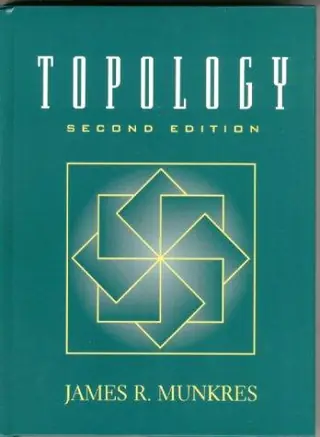
Topology
by James R. Munkres · first published 1988
58% recommend37% neutral5% critical
Why HN recommends it
Rigorous, abstract introduction to point-set and general topology, suited to students moving into proof-based mathematics. It is regarded as the standard reference and a strong first topology text.
Summarised by Claude from recommending comments
This book provides a convenient single text resource for bridging between general and algebraic topology courses. Two separate, distinct sections (one on general, point set topology, the other on algebraic topology) are each suitable for a one-semester course and are based around the same set of basic, core topics.
Affiliate links. As an Amazon Associate I earn from qualifying purchases.
Mentions per year
What Hacker News says
Related books
 2010–2024
Real Mathematical Analysis
Charles Chapman Pugh
Recommended by 8 · mentioned by 98 recommend · 9 mention8 recommend · 98 recommend
 2022–2023
Proof and the Art of Mathematics
Joel David Hamkins
Recommended by 3 · mentioned by 33 recommend · 3 mention3 recommend · 33 recommend
 2015–2025
Introduction to Smooth Manifolds
John M. Lee
Recommended by 5 · mentioned by 85 recommend · 8 mention5 recommend · 85 recommend
 2012–2024
College algebra
James Stewart
Recommended by 2 · mentioned by 42 recommend · 4 mention2 recommend · 42 recommend
 2010–2026
Understanding Analysis
Stephen Abbott
Recommended by 31 · mentioned by 3831 recommend · 38 mention31 recommend · 3831 recommend
 2012–2024
Mathematical Analysis
Tom M. Apostol
Recommended by 6 · mentioned by 96 recommend · 9 mention6 recommend · 96 recommend
 2014–2023
Aha! Insight
Martin Gardner
Recommended by 4 · mentioned by 64 recommend · 6 mention4 recommend · 64 recommend
 2008–2024
A first course in abstract algebra
John B. Fraleigh
Recommended by 10 · mentioned by 1510 recommend · 15 mention10 recommend · 1510 recommend
…extremely rewarding for the people who take the time and effort to go through it. I'd recommend the following three books to similarly cover the three main areas of higher mathematics (analysis, algebra, and topology): 1. Principles of Mathematical Analysis by Rudin (http://www.amazon.com/Principles-Mathematical-Analysis-Inter...) 2. Algebra by Artin (http://www.amazon.com/Algebra-2nd-Featured-Titles-Abstract/d...)…
on “Ask HN: Math books like SICP?” ↗I got started on "real" math with Spivak's Calculus. Some people start with Topology by Munkres, which is not a difficult book but is very abstract and rigorous so makes a good introduction. If you feel like you have ok calculus chops, maybe Real Mathematical Analysis by Charles Pugh.…
on “Ask HN: How or where to begin learning mathematics from first principles?” ↗I strongly second the recommendation of Munkres' Topology. It's basically the gold standard. However, I think don't think it's accessible to junior/senior undergraduates unless they've taken a prior course in analysis. Technically Munkres' Topology has no formal…
on “Elementary Applied Topology (2014)” ↗…good about your linear algebra; just don't feel like you have to complete every exercise. Also, I'm a sucker for order theory, so if you're up for something a little less algebraic, pick up Munkres' Topology. I'm consistently surprised at how often topological and order-theoretic intuitions come up in software development. There's a close connection between topology and logic, so perhaps I shouldn't be so…
on “Ask HN: What are you learning?” ↗This is terrible advice. Apart from the last sentence. A better advice would be to specify which subject to learn. For example, (since I don't really have much time) 1. Topology (book by Munkres) 2. Real Analysis and Measure Theory (book series by Stein Shakarchi) 3. Algebra (book by Aluffi) 4. Linear Algebra (book by Friedberg Insel) 5. Measure Theoretic Probability (book…
on “Ask HN: How to self-study mathematics from the undergrad through graduate level?” ↗…recommend studying the following before tackling Lie groups (if you haven't yet): -multivariate calculus (any text will do) -differential geometry (Manfredo DoCarmo's diff. geom. in 3D) -introduction to topology (Munkres) Multivariate calculus gives you the language to tackle surfaces in terms of their shape, which is what differential geometry studies. Topology gives you more language to study surfaces in…
on “The Geometry of Reflection Groups (2015) [pdf]” ↗Another notable book missing from that list is "Topology" by Munkres.
on “Math Books Organized by Area of Mathematics” ↗Armstrong - Groups and Symmetry is accessible. Munkres - Topology also doable. Vector Calculus by Marsden/Tromba was my intro calculus book however im not sure if calculus is ever going to be very interesting. not a bad book though.
on “Ask HN: High-Quality Online Degree for Mathematics?” ↗…rudin, these ones are more elementary textbooks) Core Senior level courses that you take if you want to get good at math: Analysis sequence (1 year on baby Rudin) Algebra sequence (1 year on artin) Topology (munkres) Electives: Probability (can be done after multivariable calc) Linear optimization (after linear algebra + multivariable calc) Logic (compactness completeness godel etc whatever, can be done…
on “Ask HN: Mathematicians, what textbooks are best for learning these math topics?” ↗As far as the canonical texts of math goes, Dummit and Foote is excellent. I'm also fond of the first half of Munkres' Topology.
on “Ask HN: Math books that made you significantly better at math?” ↗I really like the Munkres book (just called "Topology").
on “Topology looks for the patterns inside big data” ↗…might be ready for this after Spivak's Calculus, but it can be rough. If you can't reproduce a proof of irrationality after reading through the first few pages, work through Tao's Analysis I first. 3. Topology Topology, by Munkres is the absolute gold standard. You should be comfortable with calculus (and hopefully analysis) before tackling this. 4. Linear Algebra Linear Algebra Done Right, by Axler This…
on “Ask HN: Mathematicians, what textbooks are best for learning these math topics?” ↗In my university, the "official" book for topology is https://www.amazon.com/Topology-2nd-James-Munkres-dp-0131816... It's quite advanced and assumes you have taken a few math courses, but it not centered in curves.
on “Ask HN: What's a resource to teach Topology without reference to curves?” ↗…exams. At some point I ran across the spaced repetition idea (maybe from the Wired SuperMemo article [0]) and I gave it a try. I ended up using it to memorize large portions of baby Rudin and Munkres' Topology, as well as some algebra and a bunch of qualifying exam questions. The qualifying exams were difficult until I reached some "critical mass" of knowledge. Then I could regurgitate proofs and even attack…
on “Spaced repetition can allow for infinite recall” ↗I used Mnemosyne to memorize baby Rudin, Munkres’ Topology and large swaths of Dummit and Foote. Perfect scores on analysis and topology qualifying exams… good enough on algebra haha. I had always been reluctant to use memorization but I found it helped immensely.…
on “To remember everything you learn, surrender to this algorithm (2008)” ↗