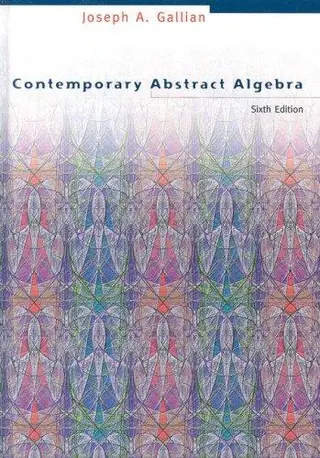
Contemporary Abstract Algebra
by Joseph A. Gallian, Joseph Gallian · first published 1986
78% recommend11% neutral11% critical
Why HN recommends it
Accessible introduction to abstract algebra with many applications, including cryptography. It builds intuition and suits self-study or a first course in the subject.
Summarised by Claude from recommending comments
This book is primarily intended for an abstract algebra course whose main purpose is to enable students to do computations and write proofs. The text stresses the importance of obtaining a solid introduction to the traditional topics of abstract algebra, while at the same time presenting it as a contemporary and very much an active subject which is currently being used by working physicists, chemists, and computer scientists.
Affiliate links. As an Amazon Associate I earn from qualifying purchases.
Mentions per year
What Hacker News says
Related books
Geometry and the imagination
David Hilbert
Recommended by 7 · mentioned by 107 recommend · 10 mention7 recommend · 107 recommend
 2008–2024
A first course in abstract algebra
John B. Fraleigh
Recommended by 10 · mentioned by 1510 recommend · 15 mention10 recommend · 1510 recommend
 2009–2026
Concepts of modern mathematics
Ian Stewart
Recommended by 12 · mentioned by 1212 recommend · 12 mention12 recommend · 1212 recommend
 2014–2026
Methods of mathematics applied to calculus, probability, and statistics
Richard Hamming
Recommended by 6 · mentioned by 96 recommend · 9 mention6 recommend · 96 recommend
Seven Sketches in Compositionality
Recommended by 20 · mentioned by 2620 recommend · 26 mention20 recommend · 2620 recommend
 2010–2025
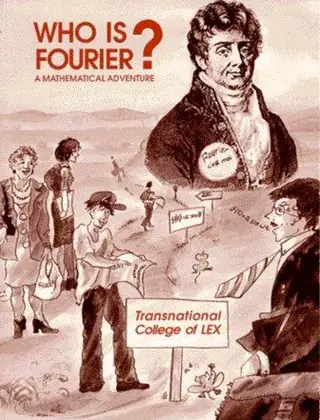
Who is Fourier?
Transnational College of Lex
Recommended by 15 · mentioned by 1615 recommend · 16 mention15 recommend · 1615 recommend
A Book of Abstract Algebra
Charles C. Pinter
Recommended by 25 · mentioned by 2725 recommend · 27 mention25 recommend · 2725 recommend
Mathematics
A. D Aleksandrov
Recommended by 26 · mentioned by 3026 recommend · 30 mention26 recommend · 3026 recommend
Gallian's Contemporary Abstract Algebra is the book I used. I really loved the subject. I had an awesome teacher that did a lot to inspire, but this was a good book. https://www.amazon.com/Contemporary-Abstract-Algebra-Joseph-...
on “Abstract Algebra (2016) [pdf]” ↗…fireworks going on there it will reward you with a very strong intuitive understanding of a lot of practical mathematics. The key goal of this book was to teach insight and it totally hits the mark. 2/ Contemporary Abstract Algebra by Gallian. This helped me learn more of the language of modern mathematics, so I could be more comfortable approaching recent developments in my field. It is an approachable, not-excessively-rigorous…
on “The Best Textbooks on Every Subject” ↗…- Sayama, Introduction to the Modeling and Analysis of Complex Systems - Darst, Introduction to Linear Programming: Applications and Extensions - Sourin, Making Images with Mathematics - Gallian, Contemporary Abstract Algebra And many others. Of course, all such lists are completely arbitrary. Once I get familiar with a certain topic, elaborate explanations seem redundant and I feel like shouting, "Get to the point already!"…
on “Higher Math for Beginners (1987)” ↗…discusses about figurative numbers amoung several other beautiful topics. 3) "Stories About Maxima and Minima", V. M. Tikhomirov has some beautiful anecdotes and interesting applications of calculus. 4) "Contemporary Abstract Algebra", by Joseph Gallian is an algebra textbook that goes beyond just teaching material. It has quotations, biographies, puzzles and interesting applications of algebra.
on “Ask HN: Recommend a maths book for a teenager?” ↗> - Gallian, Contemporary Abstract Algebra That is an amazing book. I will also recommend "A walk through combinatorics" by Miklos Bona for simple explanations and well made exercises with solutions present in the book itself.
on “Higher Math for Beginners (1987)” ↗If you're looking for an accessible introduction/overview, try Contemporary Abstract Algebra by Joseph A. Gallian. It also includes lots of applications, some of which are relevant to cryptography.
on “Ask HN: Good intro to group theory book” ↗I assume you're talking about an algebra book for self-study? Gallian's "Contemporary Abstract Algebra" is a common suggestion for a more accessible algebra book, and people also sometimes suggest Fraleigh's "A First Course in Abstract Algebra", but I can really only speak to what it's like to work on…
on “A Gentle Introduction to the Art of Mathematics” ↗My undergraduate Abstract Algebra course used Gallian’s “Contemporary Abstract Algebra.” Unfortunately if you are truly looking for an introduction assuming no mathematics, you will need to learn high school algebra and a bit about sets and proofs first.
on “A monad is a monoid in the category of endofunctors, what’s the problem?” ↗…teaching would be preparatory for the later class. Similar situations occur with 6-12 mathematics education preparation. This continues well into 200-level and even 300-level college mathematics. Gallian's Contemporary Abstract Algebra spends a lot of time exploring groups of the form a + b√n without explaining why. In general, it seems like math education should step back and read John Dewey and stop teaching mathematics as inert…
on “Will it rot my students' brains if they use Mathematica? (2002)” ↗