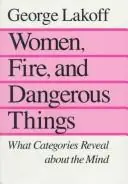
Women, fire, and dangerous things
what categories reveal about the mind
by George Lakoff · first published 1987
56% recommend44% neutral
Why HN recommends it
Argues that human categories are built from embodied experience and metaphor rather than strict definitions. For anyone interested in how language shapes cognition and how people think about categories.
Summarised by Claude from recommending comments
Focusing on studies of how humans categorize objects and ideas, this book examines the new understanding of human thought which proposes that human reason is imaginative, metaphorical, and intrinsically linked with the human body.
Affiliate links. As an Amazon Associate I earn from qualifying purchases.
Mentions per year
What Hacker News says
Related books
 2011–2025
You are not so smart
David McRaney
Recommended by 7 · mentioned by 87 recommend · 8 mention7 recommend · 87 recommend
 2009–2026
Metaphors We Live By
George Lakoff, Mark Johnson, Lakoff
Recommended by 56 · mentioned by 8156 recommend · 81 mention56 recommend · 8156 recommend
 2013–2026
Surfaces and Essences
Emmanuel Sander
Recommended by 14 · mentioned by 1814 recommend · 18 mention14 recommend · 1814 recommend
 2008–2026
Gödel's proof
Ernest Nagel, James Roy Newman
Recommended by 30 · mentioned by 3930 recommend · 39 mention30 recommend · 3930 recommend
 2008–2026
The goal
Eliyahu M. Goldratt, Jeff Cox, Ensemble cast, Dwight Jon Zimmerman
Recommended by 85 · mentioned by 12085 recommend · 120 mention85 recommend · 12085 recommend
 2010–2026
Simulacra and Simulation
Jean Baudrillard
Recommended by 25 · mentioned by 8425 recommend · 84 mention25 recommend · 8425 recommend
 2007–2026
Cosmos
Carl Sagan
Recommended by 58 · mentioned by 12458 recommend · 124 mention58 recommend · 12458 recommend
 2007–2026
I Am a Strange Loop
Douglas R. Hofstadter
Recommended by 101 · mentioned by 204101 recommend · 204 mention101 recommend · 204101 recommend
…think about things. Benjamin Bergen's Louder than Words is an excellent start, and virtually anything from Lakoff's long list of publications is worth reading—Metaphors We Live By is the classic, but Women, Fire, and Dangerous Things in particular is excellent from his more recent work.
on “George Orwell, “Politics and the English Language” (1946)” ↗…http://www.amazon.com/Metaphors-We-Live-George-Lakoff/dp/022.... "Where Mathematics Come From: How The Embodied Mind Brings Mathematics Into Being": http://www.amazon.com/Where-Mathematics-Come-Embodied-Brings.... "Women, Fire, and Dangerous Things" http://www.amazon.com/Women-Fire-Dangerous-Things-Lakoff/dp/....
on “Ask HN: Is "Gödel, Escher, Bach" still worth reading?” ↗…http://www.amazon.com/Metaphors-We-Live-George-Lakoff/dp/022... "Where Mathematics Come From: How The Embodied Mind Brings Mathematics Into Being": http://www.amazon.com/Where-Mathematics-Come-Embodied-Brings... "Women, Fire, and Dangerous Things" http://www.amazon.com/Women-Fire-Dangerous-Things-Lakoff/dp/...
on “The Man Who Would Teach Machines to Think” ↗…theory. Good luck. EDIT to add: For a wonderful overview of the problems with the naive Aristotelian view of definition (easily captured by predicate logic) in the real world, see George Lakoff’s book “Women, Fire and Dangerous Things: What Categories Reveal About the Mind”.
on “Math is an insurance policy” ↗Lakoff's stuff is seriously mind-bending. Women, Fire, and Dangerous Things by George Lakoff http://www.amazon.com/Women-Dangerous-Things-George-Lakoff/d...
on “How to Frame a Brain : Kawasaki - Lakoff” ↗…of the SWH is "language cuts the grooves in which our minds move." http://en.wikipedia.org/wiki/Linguistic_relativity Lakoff has made this more popular and accessable to non-linguist with books like "Women, Fire and Dangerous Things" (which I recommend reading, and the author mentioned briefly). http://en.wikipedia.org/wiki/George_Lakoff
on “How Does Our Language Shape The Way We Think?” ↗Make sure to follow up "Metaphors We Live By" with a read of Lakoff's "Women, Fire and Dangerous Things", which explains how meaning is constructed by ultimately relating sounds to body experiences, a must-read for the interested student of linguistics (amateur or professional). Lakoff himself talking…
on “Metaphors we learn to program by” ↗Not a business book, but "Women, Fire, and Dangerous Things" by George Lakoff is a great guide to how humans think about categories and other related topics rather than how as computer professionals we're trained to represent those relationships.
on “Ask HN: What books to read on developing mental models and increasing cognition?” ↗…some with varying degrees of specificity. I see nothing special about the 'programmer' category. Anyone interested in how categories and language relate to cognition should check out George Lakoff's "Women, Fire, and Dangerous Things".
on “"Programmer" is an Overgeneralization” ↗A great book that discusses this and a lot of other cognitive categories is George Lakoff's _Women, Fire, and Dangerous Things_. Highly recommended for everyone that makes things that use categories, tags, criteria, &c.: https://en.wikipedia.org/wiki/Women,_Fire,_and_Dangerous_Thi...
on “How many colours were there in a medieval rainbow?” ↗…lot, like just how much humans have to know to understand this stuff. You have to know about everything just to understand one word! Best example I know of this: see the chapter on 'over' in Lakoff's Women, Fire and Dangerous Things. 2. It sounds a bit like - music! Maybe you could use music for that? Hmm well no. But maybe look at Deryck Cooke's The Language of Music, which is a remarkable attempt to spell out explicitly what the…
on “Let's create the language of the internet” ↗The only book I've ever bought judging by the cover (well, the title) only was George Lakoff's Women, Fire, and Dangerous Things. It wasn't what I expected (what did I expect??), but it was insightful and thought provoking. One of the first books I've come across that shows you that the world is much, much more complicated than…
on “Ask HN: What books changed the way you think about almost everything?” ↗"women, fire, and dangerous things" by Lakoff for the meta on categories in general :)
on “Ask HN: Which non-fiction books had the biggest impact on you?” ↗> Lakoff has written other fascinating books... Favorite fascinating George Lakoff book: Women, Fire, and Dangerous Things: What Categories Reveal About the Mind
on “Why use metaphors in conflicts? Because understanding is remembering in disguise (2009)” ↗…which could write poetry/jokes. I quickly realized it would have to know everything about the world.[0] But still, actually trying was very valuable, gave me some vivid lessons. [0] e.g. see in Lakoff's Women, Fire and Dangerous Things the chapter about the dozens of different meanings of the word over and how they're related.
on “Newspapers and Thinking the Unthinkable (2009)” ↗