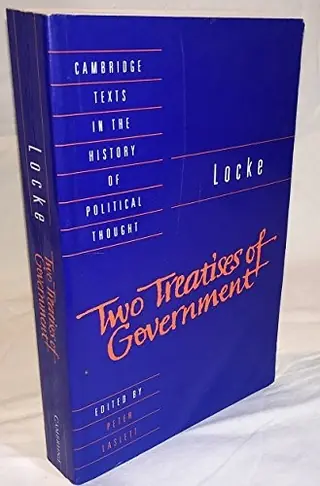
Two Treatises of Government
by John Locke · first published 1965
25% recommend75% neutral
The “Two Treatises of Government” is about the former false principles and foundation of sir Robert Filmer and his followers. They are detected and overthrown. The latter is an essay concerning the true original extent and end of civil government.Please Note: This book is easy to read in true text, not scanned images that can sometimes be difficult to decipher. The Microsoft eBook has a contents page linked to the chapter headings for easy navigation. The Adobe eBook has bookmarks at chapter headings and is printable up to two full copies per year. Both versions are text searchable.
Affiliate links. As an Amazon Associate I earn from qualifying purchases.
Mentions per year
What Hacker News says
Related books
 2011–2026
The Social Contract
Jean-Jacques Rousseau
Recommended by 9 · mentioned by 279 recommend · 27 mention9 recommend · 279 recommend
 2009–2026
Second Treatise of Government
John Locke
Recommended by 5 · mentioned by 205 recommend · 20 mention5 recommend · 205 recommend
 2007–2024
The Logic of Scientific Discovery
Karl Popper
Recommended by 15 · mentioned by 2615 recommend · 26 mention15 recommend · 2615 recommend
 2010–2026
A treatise of human nature
David Hume
Recommended by 12 · mentioned by 2512 recommend · 25 mention12 recommend · 2512 recommend
 2009–2026
Democracy in America
Alexis de Tocqueville
Recommended by 27 · mentioned by 7627 recommend · 76 mention27 recommend · 7627 recommend
 2009–2026
Human Action
Ludwig von Mises, Bettina Bien Greaves
Recommended by 26 · mentioned by 4026 recommend · 40 mention26 recommend · 4026 recommend
 2008–2026
Capitalism and freedom
Milton Friedman
Recommended by 22 · mentioned by 5022 recommend · 50 mention22 recommend · 5022 recommend
 2008–2026
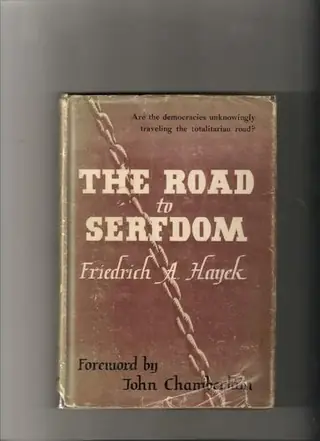
The Road to Serfdom
Friedrich A. von Hayek
Recommended by 59 · mentioned by 12959 recommend · 129 mention59 recommend · 12959 recommend
> Do you believe in property rights? Not the OP, but I think a lot more people nowadays should read (or re-read) Locke's "Two Treatises of Government". That book is famous mostly for the second part, where Locke actually intellectually imposes private property as a thing in the Western world, but I found the first part equally interesting, where Locke…
on “Income inequality is not the problem, it's a symptom” ↗These are important books but obviously not a comprehensive list. * John Locke's Two Treatises of Government - It's political philosophy but it's hard to understand Classical Liberalism without having read some Locke. * Adam Smith's Wealth of Nations - He and Locke are the two main guys to read for a solid…
on “Ask HN: What are the must-read books about economics/finance?” ↗…fluid. BTW, our modern understanding of the word commonwealth comes from Hobbes, the book's full title is: Leviathan or The Matter, Forme and Power of a Common Wealth Ecclesiasticall and Civil. 7 & 8. Two Treatises of Government | An Essay Concerning Human Understanding—John Locke Locke is an English empiricist Enlightenment philosopher, his ideas had a strong influence on governance structures in the U.S. Locke was an early…
on “Philosophy of Science: Suggested Core Readings and Background Texts [pdf]” ↗…start with wikipedia entries on them, or other sources, but reading the texts themselves is useful! Plato: The Republic Aristotle: Nichomachean Ethics; and Politics Thomas Hobbes: Leviathan John Locke: Two Treatises of Government Rousseau: The Social Contract Montesquieu: The Spirit of the Laws De Toqueville: Democracy in America Karl Marx: The Communist Manifesto; and Das Kapital. JS Mill: On Liberty (the classic Utilitarian…
on “Show HN: A political news aggregator you can comment on” ↗…House of Saud Durant The Lessons of History Hackworth Lessons Learned, Vietnam Primer Quigley Tragedy & Hope: A History of the World in Our Time EDIT: Just remembered two more Hobbes Leviathan Locke Two Treatises of Government
on “PG's Rarely Asked Questions” ↗…political culture is derivative of a property-rights focused political philosophy. One of the biggest influences on the Bill of Rights and it's explicit protection of property rights was John Locke's Two Treatises of Government. John Locke argues that a defining purpose of government is in the protection of property (life, liberty and property). Americans therefore, view wealth as at least in some part meritocratic and rich,…
on “Analysis: Health care CEOs hauled in $4B last year as inflation pinched workers” ↗> "I want stuff without having to pay for it" I don't want to rationalize stuff, but I've just finished reading Locke's "Two Treatises on Government", one of the guys that started all this "the only true freedom is the protection of property"-thingie, and I just want to add that irrespective of the fact that one might agree or not with Locke's views…
on “Access denied” ↗…Revolution had made Parliament ascendent in England, and the phrase "life, liberty, and the pursuit of happiness" is a turn of Locke's phrase "life, liberty, and estate" which he published in the 1689 "Two Treatises of Government" in the aftermath of the Glorious Revolution. 17th century England was a fairly different place than is commonly taught in school. E.g (https://en.wikipedia.org/wiki/Dr._Bonham%27s_Case). Consequently,…
on “Hackers vs. suits: Why nerds become leakers” ↗…they believe it is a credible restriction instituted by a legitimate authority. Governments that rely on violence may be perceived as legitimate by force but they frequently lack credibility. Locke's _Two Treatises of Government_ is one of the earlier sources for this model, but it's a common theme in liberal political theory.
on “The New York Times Calls for Marijuana Legalization” ↗See also, Cory Doctorow, "Terra Nullius": In 1660, John Locke published his Two Treatises of Government, where he set out to resolve the seeming conflict between individual property rights (which he valorized) and the Bible (ditto), which set out the principle that God had created the Earth and its bounty…
on “Terra Nullius” ↗…the question as to whether this disservices those who have suffered under such institutions. The alternate definition of freedom I proposed was that of John Locke. He used it to derive a principle in Two Treatises on Government for detecting when governance is illegitimate and may be overthrown. I believe adopting such a position regarding freedom will help further your goal of opposing authoritarian groupthink more so than…
on “Stallman: "Facebook is an international parasitism project."” ↗…to be dictated to by the majority. But that meant nothing, — they were the minority. ⁂ The idea of limited government I described, which is fundamental to liberalism, comes essentially from Locke's Two Treatises of Government in 01689. Rousseau responded in 01762 with the idea you so ably summarize, the absolute sovereignty of the "will of the people", in The Social Contract, calling it "the general will": https://www.marxists.org/reference/subject/economics/roussea....…
on “The EARN IT act is back, and it’s more dangerous than ever” ↗…the famous argument etiamsi daremus (non-esse Deum), that made natural law no longer dependent on theology. John Locke incorporated natural law into many of his theories and philosophy, especially in Two Treatises of Government. Locke turned Hobbes' prescription around, saying that if the ruler went against natural law and failed to protect "life, liberty, and property," people could justifiably overthrow the existing state…
on “Htmx is part of the GitHub Accelerator” ↗"Every man has a Property in his own Person" (John Locke, Two Treatises on Government). As a libertarian, self-ownership is a central principle. Most people don't have any assets, save their own bodies. People should have the legal right to sell their bodies for medical school research,…
on “The cadaver market: Death, where is thy bling?” ↗This runs contrary to how modern governments claim the origin of their power (at least the USA). It's largely based on the work done by John Locke in "Two Treatises of Government", as well as other enlightenment thinkers. The theory is that one man has no absolute domain over another in a state of nature because one can always find a way to kill anyone else, even if we have to…
on “Privacy Protects Bothersome People (2013)” ↗