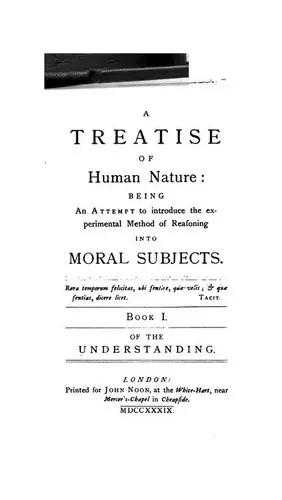
A treatise of human nature
by David Hume · first published 1739
48% recommend48% neutral4% critical
Why HN recommends it
Hume's inquiry into human understanding, useful as a starting point in philosophy. It makes a case against inductive proof and presents the is-ought gap (Book 3). Reading it alongside commentary is a suggested approach.
Summarised by Claude from recommending comments
The eighteenth-century Scottish philosopher's classic work on human understanding and morals.
Affiliate links. As an Amazon Associate I earn from qualifying purchases.
Mentions per year
What Hacker News says
Related books
 2007–2026
An enquiry concerning human understanding
David Hume
Recommended by 18 · mentioned by 2418 recommend · 24 mention18 recommend · 2418 recommend
 2018–2020
Ethical Intuitionism
Michael Huemer
Recommended by 2 · mentioned by 32 recommend · 3 mention2 recommend · 32 recommend
 2007–2024
The Logic of Scientific Discovery
Karl Popper
Recommended by 15 · mentioned by 2615 recommend · 26 mention15 recommend · 2615 recommend
 2015–2025
Language, truth and logic
A. J. Ayer
Recommended by 5 · mentioned by 95 recommend · 9 mention5 recommend · 95 recommend
 2008–2025
The Law
Frédéric Bastiat
Recommended by 17 · mentioned by 2417 recommend · 24 mention17 recommend · 2417 recommend
Revolt of the Masses
José Ortega y Gasset
Recommended by 8 · mentioned by 138 recommend · 13 mention8 recommend · 138 recommend
 2010–2026
The Problems of Philosophy
Bertrand Russell
Recommended by 17 · mentioned by 2617 recommend · 26 mention17 recommend · 2617 recommend
Meditations by Marcus Aurelius Essays by Michel de Montaigne Self Reliance by Emerson Theory of Moral Sentiment by Adam Smith A Treatise of Human Nature by Hume And the memoir of my vote for the most interesting man who ever lived, Humphry Davy's Consolations in Travel
on “Ask HN: What are your favorite books or essays written at least 100 years ago?” ↗Gonna go ahead and recommend Hume's Treatise of Human Nature on top of this, which underlines the complete impossibility of inductive proofs—not deductive, recursive proofs, but inductive proofs based on incomplete knowledge of state available. This is not because…
on “Philosophy of science books every computer scientist should read” ↗…wondering which other books have you read that have had the most impact on you professionally or even personally?" Professionally: Peter F. Drucker's books. Personally: "Meditations" by Marcus Aurelius, "A Treatise of Human Nature" by David Hume, "The Law" by Frédéric Bastiat, "Autobiography" by Benjamin Franklin, "Common Sense" by Thomas Paine, "Gespräche mit Goethe" by Johann Peter Eckermann, "The Old Regime and the Revolution"…
on “Ask HN: Non-tech books that have helped you grow professionally?” ↗…in general here are some sources off the top of my head: Adam Smith - The Wealth of Nations [1] John Locke - Two Treatises of Government[2] Friedrich Hayek - The Road to Serfdom[3] david Hume - A Treatise of Human Nature[4] Austrian school of economics[5] Chicago school of economics[6] [1] https://en.wikipedia.org/wiki/The_Wealth_of_Nations [2] https://en.wikipedia.org/wiki/Two_Treatises_of_Government [3] https://en.wikipedia.org/wiki/The_Road_to_Serfdom…
on “A Response to Paul Graham's “How to Make Wealth” (2012)” ↗A Treatise of Human Nature by David Hume Representations by Jerry Fodor A number of essays published by Chomsky over the years (a recent, small compilation book called What Kind of Creatures Are We? is a handy start).
on “Ask HN: What books fundamentally changed the way you think about the world?” ↗…genius writer and mathematician A.N Whitehead that worked with Bertrand Russell on Principia Mathematica. 2) Aristotle, The Metaphysics 3) Kant, Prolegomena to Any Future Metaphysics 4) David Hume's: A Treatise of Human Nature and/or An Enquiry Concerning Human Understanding 5) Nietchze, The gay science (meaning "the joyful science") 6) Ludwig Wittgenstein, Philosophical Investigations 7) Existentialism Is a Humanism, Sartre…
on “Ask HN: Learning about philosophy” ↗A Treatise of Human Nature by David Hume (especially Book 3, Part 1) https://www.earlymoderntexts.com/authors/hume
on “Ask HN: What book changed your life?” ↗Yeah, David Hume has some good works. I recommend you read Treatise of Human Nature if you can, and follow along with commentary rather than trying to parse it all on your own, I took a class on modern philosophy where we covered it.
on “Ask HN: Concepts that clicked only years after you first encountered them?” ↗…me it seems, there are a bunch of people in this community who enjoy a good book too and I would be interested in what is in your library. Maybe as a start a short list of books I really enjoyed: * A Treatise of Human Nature; David Hume, 1739 * Meditations; Marcus Aurelius, 161-180 * The Wealth of Nations; Adam Smith, 1776 * Crime and Punishment; Fyodor Dostoyevsky, 1866 * War and Peace; Leo Tolstoy, 1865 * Debt - The first…
on “Ask HN: What Is in Your Library?” ↗I'm not sure, but it sounds like something biocentrism adjacent. My reference to Hume is the fact you are jumping from what is to what ought without justifying why. _A Treatise of Human Nature_ is a good place to start.
on “Claude's New Constitution” ↗…economists (Adam Smith et al.) Read Popper, Wittgenstein, Sartre, Heidegger, Rawls, Kripke, Kuhn, Habermas, etc. I guess if I were to recommend a starting point, I'd start with Book One of David Hume's A Treatise of Human Nature. Be sure to heed the title of the book--it's a discussion of human nature, not of the world as-is, as-was or as-will-be. And the first book explores how we understand the world (i.e. ideas) and the limits…
on “Ask HN: Learning about philosophy” ↗…aftermath of its decay. Philosophy not only has practical purposes but it's a fascinating subject. Then there are the books, some of the most significant and influential ever written, Republic, Leviathan, A Treatise of Human Nature, Social Contract, Critique of Pure Reason, Being and Nothingness, etc., etc. These are works of brilliant minds that have endured over the centuries—and they endured for so long for the very reason that…
on “Whither Philosophy?” ↗…minds If by "original" you mean, in response to Hume's earlier statements on the origins of the idea of time. :-) http://seop.leeds.ac.uk/entries/kant-hume-causality/ http://en.wikisource.org/wiki/Treatise_of_Human_Nature/Book_...
on “‘time’ is created by human beings to make sense of gravity [TED Video]” ↗…Jonathan Steinberg, "Little Book of Common Sense Investing" by John C. Bogle, "A Random Walk Down Wall Street" by Butron Malkiel, "Liberalismus" by Ludwig von Mises, "Meditations" by Marcus Aurelius, "A Treatise of Human Nature" by David Hume, "Thinking, Fast and Slow" by Daniel Kahneman, "The Law" by Frédéric Bastiat, "Autobiography" by Benjamin Franklin, "Common Sense" by Thomas Paine, "Gespräche mit Goethe" by Johann Peter…
on “Ask HN: What's one book that changed your life?” ↗…individually if they lacked empiric evidence. Western society's assumption that objective Moral Facts existed in a material universe remained for some time until examined by David Hume in 1738 in his A Treatise of Human Nature. Here Hume observed the difficult reality of the relationship between facts (that which is) and values (that which we claim ought to be), concluding that we cannot assert prescriptive or normative values…
on “Panama Papers source issues statement” ↗