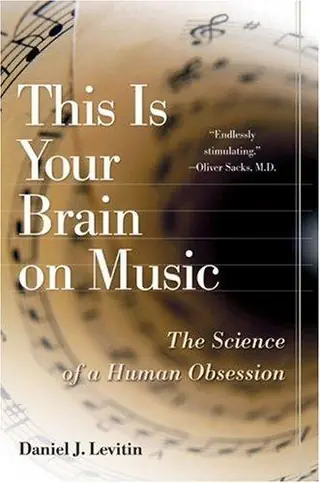
This Is Your Brain on Music
The Science of a Human Obsession
by Daniel J. Levitin · first published 2006
50% recommend45% neutral5% critical
Why HN recommends it
Accessible neuroscience-of-music book covering pitch, why certain note combinations sound pleasing, and how music shapes the brain; a good pick for readers without a science background and for music theory beginners.
Summarised by Claude from recommending comments
This book explores the connection between music and its performances, its composition, how we listen to it, why we enjoy it and the human brain.
Affiliate links. As an Amazon Associate I earn from qualifying purchases.
Mentions per year
What Hacker News says
Related books
 2010–2026
Tuning, timbre, spectrum, scale
William A. Sethares
Recommended by 9 · mentioned by 119 recommend · 11 mention9 recommend · 119 recommend
A geometry of music
Dmitri Tymoczko
Recommended by 9 · mentioned by 119 recommend · 11 mention9 recommend · 119 recommend
 2007–2026
A pattern language
Christopher Alexander, Sara Ishikawa, Murray Silverstein, Max Jacobson
Recommended by 110 · mentioned by 226110 recommend · 226 mention110 recommend · 226110 recommend
 2008–2026
The art of electronics
Paul Horowitz, Winfield Hill
Recommended by 153 · mentioned by 230153 recommend · 230 mention153 recommend · 230153 recommend
 2007–2026
Gödel, Escher, Bach
Douglas R. Hofstadter
Recommended by 505 · mentioned by 1,055505 recommend · 1,055 mention505 recommend · 1,055505 recommend
I highly recommend reading 'This is your brain on music' by Daniel J. Levitin if you're interested in learning more about the neuroscience side of music.
on “How Music Hijacks Our Perception of Time” ↗Daniel Levitin has also written a book (This is Your Brain On Music) that explains recent interesting discoveries dealing specifically with sound and music cognition. Awfully interesting stuff.
on “Universal Property of Music Discovered” ↗Read "This Is Your Brain On Music" by Daniel Levitin. Some interesting points/arguments that I remember from reading it several years ago: - In many languages, the word "sing" is the same as the word "dance". - It's relatively recently…
on “Why Does Music Feel So Good?” ↗This is the perfect minimalist introduction to music theory. A similarly good explanation is in Daniel Levitin's "This is Your Brain on Music". It's first few chapters explain music theory to beginners in a really elegant way. I previously thought music was composed without any rules.
on “Music Theory: An Education from First Principles” ↗…link to Schmidhuber too - I like this page on his site: https://people.idsia.ch/~juergen/creativity.html There's also a chapter about these sort of ideas in the context of music in Daniel Levitin's book This is Your Brain on Music. I'm still trying to make sense of this all myself - you've got Karl Friston's Free Energy Principle essentially saying that the brain is trying to minimise surprise. And yet if you look at the explore-exploit…
on “Information Is Surprise (2015)” ↗This Is Your Brain on Music -by Daniel Levitin --helped me understand why listening to music has such a varied and profound effect on me. Hallucinations -by Oliver Sack --piqued my interest in the brain and the notion that it…
on “Ask HN: Which non-fiction books had the biggest impact on you?” ↗It's not a typical intro to theory but the "pop psychology" book This Is Your Brain On Music by Daniel J. Levitin includes something like what you're asking for: What is pitch, why do our brains "like" certain combinations of pitches and dislike others, etc. It's a fascinating book in its own…
on “I need to grow away from these roots” ↗…preference on either side. Dr. Levitin has some really interesting research on music, but also has some great easier to read books for those of us without a neuroscience degree. My favorite is called this is your brain on music. The world in 6 songs was also a great read. http://daniellevitin.com/publicpage/
on “Deep Learning Techniques for Music Generation – A Survey” ↗Highly recommend the book "This is your brain on music", as it explores this question (among other interesting things). According to the author, having separate words for singing and dancing is a relatively new phenomenon in linguistics, and the concept…
on “Breaking Down OnlyFans' Economics” ↗Simple book rec: This is Your Brain on Music.
on “Ask HN: How to Become a Music Buff?” ↗…Criminal Tattoo Encyclopedia (Volume 1) -- primarily for research, but it's fascinating. - Dark Markets by Misha Glenny - How to Live on Mars by robert Zubrin - The Lightness of Being by Frank Wilczek - This is Your Brain on Music by Daniel Levitin - Towards a New Architecture by Le Corbusier - and Strange Things Happen by Stewart Copeland Technical- - Tangled Web (I saw someone else mention it, and it's really really good so…
on “Ask HN: What are you reading? What've you read lately?” ↗…it really develops and peaks around the age 14 E.g.: https://learning.blogs.nytimes.com/2011/05/25/is-14-a-magic-... https://www.nytimes.com/2018/02/10/opinion/sunday/favorite-s... I think the book "This Is Your Brain on Music" also talks about it, but I haven't read it yet. https://www.amazon.com/This-Your-Brain-Music-Obsession/dp/04... I have never dug deeper on it, but it rings very true for my own case and friends I talked…
on “Why we listen to new music” ↗…era distinctive: timbre was, in his opinion, the single most important factor That's a fascinating idea; I googled and found what might be the story you're looking for: [quote] In the best seller “This is your brain on music” by Daniel Levitin, he talks about John R. Pierce (inventor of the travelling wave vacuum tube and the first telecommunications satellite) who, interested to discover rock music, asked him to summarize…
on “Why does an A note sound different across instruments?” ↗The author did attempt to address this, by complaining that you "aren't really paying attention": * He notes that octaves are common across cultures (per Levitin, "This is Your Brain On Music") * He asserts that 12 tones represent a practical limit to harmony; more than 12 tones is more complex than the brain can handle in its "note-expectation engine". * He thinks other cultures could be…
on “Harmony Explained: Progress Towards a Scientific Theory of Music (2014)” ↗Levitin also points out in "This Is Your Brain on Music" that Only relatively recently in our culture [...] did a distinction arise that cut society in two, forming separate classes of music performers and music listeners. Throughout most of the world and…
on “The music moves us, but how? (2018)” ↗