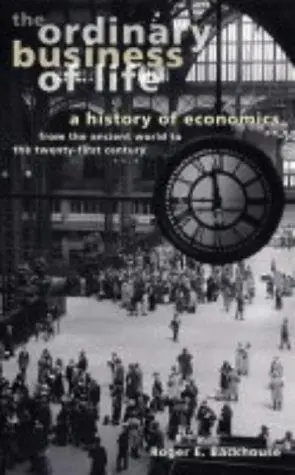
The Ordinary Business of Life
by Roger E. Backhouse · first published 2002
75% recommend25% critical
Affiliate links. As an Amazon Associate I earn from qualifying purchases.
Mentions per year
What Hacker News says
Related books
 2008–2024
The worldly philosophers
Robert L. Heilbroner
Recommended by 17 · mentioned by 1817 recommend · 18 mention17 recommend · 1817 recommend
 2013–2026
Four Futures
Peter Frase
Recommended by 5 · mentioned by 75 recommend · 7 mention5 recommend · 75 recommend
 2009–2024
The ascent of money
Niall Ferguson
Recommended by 42 · mentioned by 4942 recommend · 49 mention42 recommend · 4942 recommend
 2016–2026
Economics : the user's guide
Ha-Joon Chang
Recommended by 11 · mentioned by 1411 recommend · 14 mention11 recommend · 1411 recommend
 2009–2024
The affluent society
John Kenneth Galbraith
Recommended by 11 · mentioned by 2311 recommend · 23 mention11 recommend · 2311 recommend
 2009–2026
Human Action
Ludwig von Mises, Bettina Bien Greaves
Recommended by 26 · mentioned by 4026 recommend · 40 mention26 recommend · 4026 recommend
 2007–2026
Economics in One Lesson
Henry Hazlitt
Recommended by 107 · mentioned by 147107 recommend · 147 mention107 recommend · 147107 recommend
 2007–2026
The Wealth of Nations
Adam Smith
Recommended by 92 · mentioned by 40592 recommend · 405 mention92 recommend · 40592 recommend
This is not at all a serious syllabus on this topic. I cannot understand the inclusion of ChatGPT. If you want a nice, single-volume history try Roger backhouse’s “the ordinary business of life”, soon to come in a second edition. There is a much older book by schumpeter but it’s extremely dated as well as overly long.
on “My history of economic thought reading list” ↗…cunningly disguised treatise on the emergence of stock corporations, banking, and modern finance and capital), Niall Fergusson's The Ascent of Money (a less cunningly disguised version of same), and The Ordinary Business of Life which is dry as dust but still a wonderful exposition of 3000 years of economic thought. A book I've just heard of but haven't read is David Graeber's Debt: The First 5,000 Years. He's a radical anthropologist,…
on “Krugman on BitCoin” ↗…found in 25 years on economics. That, Niall Feguson's Ascent of Money (the guy is in many ways an ass, but this is a pretty good book), Nassim Taleb, Nouriel Rabini, Paul Krugman, Joseph Stiglitz, The Ordinary Business of Life: A History of Economics from the Ancient World to the Twenty-First Century (Roger Backhous) -- hardly a page-turner, but a very good compendium of 3000 years of economic thought, and Neal Stephenson's…
on “Lenovo CEO Gives His $3 Million Bonus to 10,000 Employees” ↗One to look into is Backhouse's The Ordinary Business of Life (2002). A good overview of the subject that incorporates ancient and modern perspectives.
on “US inflation jumps to 31-year high amid global supply chain crisis” ↗…We've been having what are fundamentally the same economic debates for 2000+ years, largely over fairness of pricing, wages, equity, and control, as a survey history such as Roger E. Backhouse's The Ordinary Business of Life details. In the 20th century, the three major challenges to free-market capitalism as espoused by Adam Smith and his followers have been the Great Depression of 1929-1940, the environmental and oil shocks…
on “Late Capitalism and the Ends of Sleep” ↗…development concepts. I happen to think his views have merits.) There are several books which cover the history of economic thought, from more and less inclusive perspectives. Roger Backhouse's The Ordinary Business of Life is extraordinarily dry, but reasonably encompasses the mainstream. http://www.worldcat.org/title/ordinary-business-of-life-a-hi... Heilbroner's The Worldly Philosophers is a classic: http://www.worldcat.org/title/worldly-philosophers-the-lives...…
on “Ask HN: What are the must-read books about economics/finance?” ↗…question, a large number of economic texts and papers still begin with this discussion, and it's been at the heart of economic thought for well over 2,000 years (see for example, Roger E. Backhouse, The Ordinary Business of Life, which covers, in an exceptionally dry fashion, much of this history). The question of how to value GDP over time isn't a trivial one, though I'll note that for most of history it's actually not particularly…
on “Economists Don't Understand the Information Age, So Their Claims Are a Joke” ↗…commodities: http://www.gutenberg.org/files/3300/3300-h/3300-h.htm#link2H... The longer discussion involves much of what is now called economic discourse prior to Smith, see generally Backhouse, The Ordinary Business of Life http://www.powells.com/biblio/62-9780691116297-1 In particular, the market can grossly overvalue items (bubbles), and it can put premiums on present consumption during times of crisis (e.g., burning…
on “The Ocean is Broken (2013)” ↗…way through various economic works, in a bit of a hop-scotch. There are a few good histories of thought -- The Worldly Philosophers, by Heilbronner, was popular in my uni days (1980s). Backhouse's The Ordinary Business of Life is more comprehensive, though exceedingly dry. I found Arnold Toynbee (the elder), Lectures on the Industrial Revolution, to be fascinating. I'm going through a bit of John Stuart Mill (both he and…
on “Is it unethical for me to not tell my employer I've automated my job?” ↗…capitalism" as a cover for monopoly mercantilistic rent-extraction. Having put a fairly considerable amount of study into the history of economic thought, back to Greek and Roman times (see Backhouse's The Ordinary Business of Life for a comprehensive, if dry, overview of mainstream economic thought), and with a strong focus on Smith to present, this problem is a pervasive one. The irony is that it's practiced quite ardently by…
on “UN Study Warns: Growing Economic Concentration Leads to “Rentier Capitalism”” ↗…are not generally addressed today. There are overviews and histories of economic thought and its development which should be useful. I've read Heilbroner (The Worldly Philosophers) and Backhouse (The Ordinary Business of Life), both of which provide a broad overview. Ha-Joon Chang has Economics: The User's Guide, which is a pretty good overview of various schools of thought. I'm particularly impressed currently by Steve…
on “Technology Change Not the Culprit in Wages Falling Behind US Productivity Gains” ↗