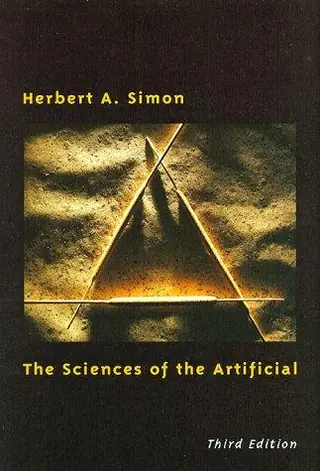
The sciences of the artificial
by Herbert Alexander Simon · first published 1969
52% recommend48% neutral
Why HN recommends it
Frames engineering and design as a science of reasoning about artificial systems, built on satisficing and a design-oriented view of computing. Foundational reading for engineers and computer scientists.
Summarised by Claude from recommending comments
Outlines a program to develop sciences for artifacts that are usually outside the ambit of natural sciences.
Affiliate links. As an Amazon Associate I earn from qualifying purchases.
Mentions per year
What Hacker News says
Related books
 2010–2011
Designerly Ways of Knowing
Nigel Cross
Recommended by 2 · mentioned by 22 recommend · 2 mention2 recommend · 22 recommend
 2009–2025
The logic of failure
Dietrich Dörner
Recommended by 15 · mentioned by 1715 recommend · 17 mention15 recommend · 1715 recommend
 2008–2026
Thinking and deciding
Jonathan Baron
Recommended by 6 · mentioned by 86 recommend · 8 mention6 recommend · 86 recommend
 2011–2025
It's not luck
Eliyahu M. Goldratt
Recommended by 9 · mentioned by 129 recommend · 12 mention9 recommend · 129 recommend
The unwritten laws of engineering
W.J King
Recommended by 13 · mentioned by 1913 recommend · 19 mention13 recommend · 1913 recommend
 2011–2024
Critical Chain
Eliyahu M. Goldratt
Recommended by 11 · mentioned by 2411 recommend · 24 mention11 recommend · 2411 recommend
 2011–2025
A City is Not a Tree
Michael W. Mehaffy, Christopher Alexander
Recommended by 15 · mentioned by 3215 recommend · 32 mention15 recommend · 3215 recommend
 2009–2026
An introduction to general systems thinking
Gerald M. Weinberg
Recommended by 24 · mentioned by 3124 recommend · 31 mention24 recommend · 3124 recommend
How about some books that aren't pop-sci / business books? I am kind of biased, since I love this area of psychology. - The Sciences of the Artificial by Simon - The Psychology of Problem Solving by Davidson & Sternberg - The Cambridge Handbook of Expertise and Expert Performance (Cambridge Handbooks in Psychology) by Ericsson, Charness, Feltovich…
on “Ask HN: What books to read on developing mental models and increasing cognition?” ↗…seems to be, so the more it's understandable, the more people tend to claim it isn't AI. I like how your comment pins this on the nature of designing -- Herb Simon gives a good definition of design in "sciences of the artificial" and this system seems to be designing. Not drawing, but designing.
on “We Let Machine Learning Design Logos” ↗…setting the stage for LISP and earning them a Turing award (McCarthy got his own). They were founders of AI and implemented some really neat software like the General Problem Solver. See Simon's "The Sciences of the Artificial" or his Nobel prize lecture, and "Unified Theories of Cognition" by Newell.
on “The Roots of Lisp” ↗Both inspiring: Doug Engelbart's 1962 "Augmenting Human Intellect: A Conceptual Framework" http://www.invisiblerevolution.net/engelbart/62_paper_top.ht... Herbert Simon's "The Sciences of the Artificial" http://www.amazon.com/Sciences-Artificial-Herbert-Simon/dp/0...
on “Ask HN: Reccomend essays to a young, inquiring mind” ↗For a design-studies take even more on the "how things work" side, I like Herb Simon's classic The Sciences of the Artificial, which conceives of design as a science of man-made artifacts. I also like Nigel Cross's stuff. His book Designerly Ways of Knowing (2006) is good but published in some absurdly expensive, for-libraries-only…
on “How to self-educate if you lack a formal design education” ↗…clean split (architecture in particular strongly combines the two), but some books are clearly more on one side or the other. For the engineering-design side, two good books, imo: Herb Simon's classic Sciences of the Artificial, which approaches design from the lens of an AI researcher trying to figure out what design really is, partly to develop it into a science of design, and partly with an eye towards formalizing a model…
on “Books For Learning to Design, The Hard Way” ↗…obvious in architecture (the kind involving buildings, but also software architecture / API design), which is as its core not primarily UX or visual design, though it has elements of both. Herb Simon's The Sciences of the Artificial is my favorite book in this area, though Donald Schön's The Reflective Practitioner is also a good book on design in this broader sense of producing human-usable artifacts out of materials.
on “Can't Code? Learn Design.” ↗Would add The Sciences of the Artificial by Herbert A. Simon [1] to the list. The current list is lacking a design science view, which is much more applicable to computer science than natural science books. [1] https://mitpress.mit.edu/books/sciences-artificial
on “Philosophy of science books every computer scientist should read” ↗It's been ~8 years since I read it, but I think "The Sciences of the Artificial" by Herb Simon might make my list. It's about design, engineering, intelligence (artificial or human), and building things.
on “Ask HN: What are your favorite books of all time, and why?” ↗Seconding the recommendation of Herbert Simon, especially Sciences of the Artificial.
on “Ask HN: Any recommended resources to develop system thinking?” ↗…Amos Tversky) - Thomas Ligotti "The Conspiracy against the Human Race" - Peter Wessel Zapffe "On the Tragic" & "The Last Messiah" - Sokal, Alan D "Intellectual Impostures" - Simon Herbert "A The Sciences of the Artificial" - Herbert Marcuse "One-Dimensional Man" - Schopenhauer "Parerga and Paralipomena" - Lewis Mumford "The Story of Utopias" - Michel Foucault "Discipline and Punish" - Edward S. Herman "Manufacturing…
on “Ask HN: What books changed the way you think about almost everything?” ↗The Sciences of the Artificial by Herbert A. Simon. Absolutely foundational.
on “Ask HN: Good books on philosophy of engineering?” ↗Also, consider reading The Sciences of The Artificial. This is in it, with so much more.
on “The Architecture of Complexity (1962) [pdf]” ↗I learnt the strategy of "satisficing" from Herbert Simons' "Sciences of the Artificial" book. It suggests not bothering to split hairs amongst alternatives once options have met some threshold for acceptance. https://en.wikipedia.org/wiki/Satisficing
on “People spend too much time on decisions with equally satisfying outcomes” ↗Going to plug a couple of relevant things here. - A book I saw recommended here called "The Sciences of the Artificial," which talks about the purpose and practice of modeling with computers. - An old post of mine, where I wrote that "creating knowledge is a philosophical act that businesses mostly didn't realize they…
on “To Know, but Not Understand: David Weinberger on Science and Big Data (2012)” ↗