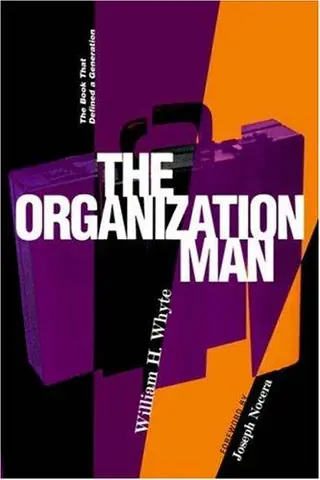
The Organization Man
by William Hollingsworth Whyte · first published 1956
30% recommend70% neutral
Why HN recommends it
A 1956 study of the postwar company man and the pull toward group conformity, cited for showing how organizations shaped work and family life, and for its personality testing sections. For business history readers.
Summarised by Claude from recommending comments
This book is about the organization man. If the term is vague, it is because I can think of no other way to describe the people I am talking about. They are not the workers, nor are they the white-collar people in the usual, clerk sense of the word. These people only work for The Organization. The ones I am talking about belong to it as well. They are the ones of our middle class who have left home, spiritually as well as physically, to take the vows of organization life, and it is they who are the mind and soul of our great self-perpetuating institutions. Only a few are top managers or ever w
Affiliate links. As an Amazon Associate I earn from qualifying purchases.
Mentions per year
What Hacker News says
Related books
 2008–2026
Systemantics
John Gall
Recommended by 45 · mentioned by 7545 recommend · 75 mention45 recommend · 7545 recommend
 2007–2023
The Art of the Start
Guy Kawasaki
Recommended by 48 · mentioned by 7948 recommend · 79 mention48 recommend · 7948 recommend
 2008–2026
Ulysses
James Joyce
Recommended by 46 · mentioned by 21946 recommend · 219 mention46 recommend · 21946 recommend
 2013–2026
Bullshit Jobs
David Graeber
Recommended by 159 · mentioned by 477159 recommend · 477 mention159 recommend · 477159 recommend
 2007–2026
Gödel, Escher, Bach
Douglas R. Hofstadter
Recommended by 505 · mentioned by 1,055505 recommend · 1,055 mention505 recommend · 1,055505 recommend
…introversion / introspection or something, and can force themselves to do decently in the "opposite" area. Kind of like how some of the important characters in Tolkien were half-breeds. The appendix of "The Organization Man" by William Whyte contains a guide to "cheating" on Myers-Briggs type tests, to get a score appealing to a large organization. I highly recommend reading the whole book but especially the cheating appendix…
…suggest that the quickest way to find anti-innovation sentiment is by looking at any large bureaucratic institution or company, not by looking at ethnicity or region. I recommend to you the book "The Organization Man" by William Whyte, particularly the chapter "The Fight Against Genius". You may find it resonates with your experiences.
on “The Computer Science Program in Singapore: Where innovation is marked down.” ↗…career paths but when i explain to her the impact it would have on things that are more important to me, she seems to understand. about a year ago, i was reminded of this in reading william whyte's "the organization man", in particular the chapters about family. right then and there i made a decision, i backed out of some job offers and have been pleased. take care of yourself, that's the most basic lesson of all, and…
on “Tips for work-life balance” ↗…if their understanding requires larger amount of time. It is difficult to think for oneself. I work in a management/economic consultancy and see this every day. How can "solitude" enter work? [1] The Organization Man by William Whyte, a classic management book from the 50s, is a relevant resource for a critical analysis of a workplace along these lines.
on “Solitude and Leadership (2010)” ↗Check out William H. Whyte's The Organization Man, a 1956 book describing American society's turn towards valuing the group and togetherness for its own sake. If you want the tl;dr, check out this 1982 interview with Whyte about that book: http://www.pbs.org/video/17759115/
on “Is Facebook’s Massive Open Office Scaring Away Developers?” ↗…testing in applications is hardly a new phenomenon. It was first popularized in the 50s, and has been resurging in lower paying or less technical industries for years to decades. William H Whyte's opus "The Organization Man" (1956) will be very informative to anyone looking to learn about why these tests are appearing in our jobs (especially with the current market), especially I think the fifth section, "The Organization…
on “I applied for a software role at FedEx and was asked to take a personality test” ↗…wondered what exactly happened to GE, and I love history books that speak to the modern corporate era we inhabit. My personal favorites of the genre are Titan (about Rockefeller and Standard Oil), The Organization Man (an anthropological study of the "company man" archetype from post-WW2 America), and Shoe Dog (much lighter reading than the other two, and a great read about the founding of Nike). Anyway, I just grabbed…
on “SEC charges VMware with misleading investors by obscuring financial performance” ↗…typically manifest as a simultaneous doublethink mix of low morale and unrealistic optimism. That's the pathology. Good personnel management is about leveraging this instead of fighting it. I recommend The Organization Man (1956) and Moral Mazes (1988) if you want to read on the topic and/or fall asleep fast but if somebody knows a more recent text on the topic, please suggest it.
on “US Government published guide to sabotage organizational productivity (1944)” ↗…more common in the past. You definitely get that impression reading about colonial America circa the revolution. I think maybe there was a brief post-war period where it was true? William Whyte's "The Organization Man" talks about the era.
on “Don’t Mistake Ambition for Entitlement” ↗Actually, there's reason to believe the shift started much earlier -- in The Organization Man, William Whyte describes how in the '50s we shifted away from fundamental research and into applied research, away from individual grants and towards group work. This focus on both consensus (which encourages…
on “Peter Thiel Says Computers Haven’t Made Our Lives Significantly Better” ↗…virtues, of course.) Wolf of Wall Street. On my list to read: Images of organization Paperback – Jan 1997 by Gareth Morgan (Author) https://www.amazon.ca/Images-organization-Gareth-Morgan/dp/0... The Organization Man by William H. Whyte http://a.co/2kRfJHA The above 2 books said to be consistent with The Gervais Principle: https://www.ribbonfarm.com/2009/10/07/the-gervais-principle-... Plus The Prince of War:…
on “Ask HN: Books about “unethical” behavior?” ↗Stories like this make The Organization Man by W. H. Whyte[0] seem prescient. And never forget Pournelle's iron law: >Pournelle's Iron Law of Bureaucracy states that in any bureaucratic organization there will be two kinds of people": >First,…
on “New Intel CEO rehiring retired CPU architects” ↗Corporate R&D never worked very well in the first place. William Whyte wrote about how relatively unproductive it was way back in 1956 in The Organization Man.
on “The rise and fall of corporate R&D” ↗This is a really outstanding quote. I had read William Whyte's "The Organization Man" which deconstructs the same situation from a sociological perspective, but I had overlooked this novel: sometimes there is more truth in fiction.
on “Articles, Ideas, Books and/or Concepts that have changed your life” ↗…language design is going to look like. That is to say, we probably can't expect anything at all in the way of progress. It's funny that there's a parallel between the conclusions in William Whytes' "The Organization Man" and "progress" in language design. Whyte concludes, one, that management in the abstract doesn't actually exist and, two, "management" taken as organizational oppressiveness and intrusion is actually…
on “Research in programming languages” ↗