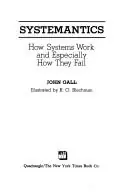
Systemantics
by John Gall · first published 1977
60% recommend39% neutral1% critical
Why HN recommends it
Witty, example-driven look at why large systems, bureaucracies and organizations fail, with aphorisms like complex systems evolving from simple working ones. Suits engineers and anyone designing or fixing systems.
Summarised by Claude from recommending comments
Affiliate links. As an Amazon Associate I earn from qualifying purchases.
Mentions per year
What Hacker News says
Related books
 2008–2026
The Systems Bible
John Gall
Recommended by 23 · mentioned by 3423 recommend · 34 mention23 recommend · 3423 recommend
 2018–2022
Systems thinking for social change
David Peter Stroh
Recommended by 3 · mentioned by 43 recommend · 4 mention3 recommend · 43 recommend
 2018
The Fifth discipline fieldbook
Peter M. Senge
Recommended by 3 · mentioned by 33 recommend · 3 mention3 recommend · 33 recommend
 2014–2018
Systems Practice
Ray Ison
Recommended by 2 · mentioned by 32 recommend · 3 mention2 recommend · 32 recommend
 2010–2026
Thinking in systems
Donella H. Meadows, Diana Wright
Recommended by 124 · mentioned by 163124 recommend · 163 mention124 recommend · 163124 recommend
 2010–2026
The existential pleasures of engineering
Samuel C. Florman
Recommended by 4 · mentioned by 54 recommend · 5 mention4 recommend · 54 recommend
 2009–2026
An introduction to general systems thinking
Gerald M. Weinberg
Recommended by 24 · mentioned by 3124 recommend · 31 mention24 recommend · 3124 recommend
Systemantics: How Systems Work & Especially How They Fail by John Gall. https://www.amazon.co.uk/Systemantics-Systems-Work-Especiall... The writing style is kind of unusual, but there is a lot of wisdom to be found…
on “Ask HN: Any recommended resources to develop system thinking?” ↗…dismiss it because it worked in the previous 99% of the time. People have trained themselves to trust the results so questioning it does not even enter their minds. It does remind me though of the book Systemantics: https://www.amazon.com/Systemantics-Systems-Work-Especially-... One of the core thesis in the book is : The system itself does not actually do what it says it is doing (The Operational Fallacy). This…
on “Introduction to the evidential presumption that computers are working correctly” ↗I'm halfway through John Gall's Systemantics and have been really enjoying it. What might I move on to next? I think I'm more interested in the real-world applications of systems theory (e.g. how we might go about fixing a massively complicated…
on “Ask HN: Best Books on Systems Theory?” ↗…that. The "P Literature" -- Parkinson's Law, the Peter Principle, Putt's Law, and Stephen Potter's Gamesmanship seem to form part of a core. I'd add the Jevons paradox, Gresham's Law, and John Gall's Systemantics as well https://en.wikipedia.org/wiki/Putt%27s_Law_and_the_Successfu... https://en.wikipedia.org/wiki/Systemantics Broken models and frames -- theory and ideology -- contribute hugely. I've been focusing…
on “'We're doomed': Mayer Hillman on the climate reality no one else dare mention” ↗Yep, my first thought upon reading this was that no discussion of this subject is complete without a perusal of Gall's Systemantics (https://en.wikipedia.org/wiki/Systemantics).
on “Systems that defy detailed understanding” ↗Just popped into my mind: do you know the book "Systemantics" (also known as "The Systems Bible") by John Gall? It's not on education but is very much in the space we're discussing. It's a brilliant (and hilarious) underground classic. I think you would like it.…
on “The Six-Lesson Schoolteacher” ↗Gall's book (Systemantics) is a brilliant and whimsical classic about the unpredictable nature of complex systems. It deserves to be far better known.
on “Gall's Law” ↗…difference between good and bad programmers, and focus your time on Software Engineering primarily. I highly recommend the book Rapid Development for a good starting point (in factg it may be all you need) and Systemantics for an interesting (and humorous) look at the fact that all complex systems operate in a (partial) state of failure, and why.
on “Ask HN: What is the advantage of a formal CS degree for an entrepreneur?” ↗I highly recommend that anyone who was surprised by this outage, or the description of the chain reaction of failures that lead to it, read Systemantics. It is a dry but amusing exploration of the seemingly universal fact that every complex system is always operating in a state of failure, but the complexity, failovers and multiple layers can hide this,…
on “AWS Service Disruption Post Mortem” ↗You need to read a book called Systemantics by John Gall. It's a hilarious and accurate look at how large systems fail. Although parts are somewhat dated, the principles are the same. In particular his material on bureaucracies is relevant: when…
on “The result would be a catastrophe (1985)” ↗- "General Systemantics" by John Gall ( https://en.wikipedia.org/wiki/Systemantics ) It's humorous but I'm being serious. He has such chestnuts as: "A complex system that works is invariably found to have evolved from a simple…
on “How to Be a Systems Thinker” ↗Systemantics by John Gall is worth a look, https://en.wikipedia.org/wiki/Systemantics
on “FAA Moves Toward Treating Drones and Planes as Equals” ↗…intuitively. "Business Dynamics" by Stermer was surprisingly good. "How we know what is not so" by Thomas Gilovich is a good tonic against arrogance (as is "Uncommon Sense" by Comer). I really like SystemAntics (John Gall - Good luck finding the original!) about, mostly, how our arrogance fails us when we try to define systems that are complex and include humans...
on “The next capitalist revolution” ↗I concur - "Systemantics" (now "The Systems Bible") is an excellent book. I had a boss turn me onto it in the 1980s, and to this day I still quote from it, and re-read it about once a decade just to keep the lessons fresh.
on “Egypt's Aswan Damn” ↗Systemantics/The Systems Bible, by John Gall, for a lighthearted, whimsical introduction through real-world examples across a range of industries. An Introduction to General Systems Thinking, by Gerald Weinberg, for…
on “Systems thinking as important as ever for new coders” ↗