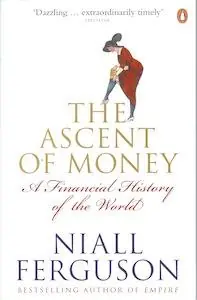
The ascent of money
by Niall Ferguson · first published 2008
86% recommend8% neutral6% critical
Why HN recommends it
Readable, story-driven history of money, banking, credit, bonds, insurance and limited liability; a gentle starting point for newcomers who want to see how the financial system arose without an econ textbook.
Summarised by Claude from recommending comments
Niall Ferguson follows the money to tell the human story behind the evolution of finance, from its origins in ancient Mesopotamia to the latest upheavals on what he calls Planet Finance.Bread, cash, dosh, dough, loot, lucre, moolah, readies, the wherewithal: Call it what you like, it matters. To Christians, love of it is the root of all evil. To generals, it's the sinews of war. To revolutionaries, it's the chains of labor. But in The Ascent of Money, Niall Ferguson shows that finance is in fact the foundation of human progress. What's more, he reveals financial history as the essential backst
Affiliate links. As an Amazon Associate I earn from qualifying purchases.
Mentions per year
What Hacker News says
Related books
 2010–2020
How to read the financial pages
Peter Passell
Recommended by 2 · mentioned by 22 recommend · 2 mention2 recommend · 22 recommend
Corporate Finance
Stephen Ross, Randolph Westerfield, Jeffrey Jaffe, Bradford Jordan
Recommended by 1 · mentioned by 21 recommend · 2 mention1 recommend · 21 recommend
 2019–2022
The cash nexus
Niall Ferguson
Recommended by 2 · mentioned by 22 recommend · 2 mention2 recommend · 22 recommend
 2011–2024
The Ordinary Business of Life
Roger E. Backhouse
Recommended by 3 · mentioned by 33 recommend · 3 mention3 recommend · 33 recommend
 2016–2025
Common Stocks and Uncommon Profits and Other Writings
Philip A. Fisher
Recommended by 3 · mentioned by 33 recommend · 3 mention3 recommend · 33 recommend
 2007–2020
Traders, guns & money
Satyajit Das
Recommended by 8 · mentioned by 88 recommend · 8 mention8 recommend · 88 recommend
 2016–2026
The long twentieth century
Giovanni Arrighi
Recommended by 2 · mentioned by 32 recommend · 3 mention2 recommend · 32 recommend
Niall Ferguson's the Ascent of Money and Cormac McCarthy's Blood Meridian. The former is extremely informative, the later is a work of art.
on “Ask HN: Read any good books lately?” ↗Economic historian Niall Ferguson beautifully describes fractional reserves as one of the greatest innovations of humankind in Ascent of Money. The miseries from bank runs and crashes are real, but even so, the total impact on human welfare from fractional reserves has been overwhelmingly positive. How do we know? There were holdouts in Europe…
on “Switzerland to vote on banning banks from creating money” ↗…happen to them too) by being economically weak. (You can also lose political sovereignty if you are poor, as you can't afford all the military hardware to fight off an enemy). I would urge you to read "The Ascent of Money" by Niall Ferguson. He makes excellent points as to why money, and innovations like bonds, stock and insurance actually drive countries forward. For example, the riskiness of the Dutch voyages to the…
on “Workers Leaving the Googleplex” ↗…just created. This money system was built into what it is now by the Medici: https://en.wikipedia.org/wiki/House_of_Medici Niall Ferguson wrote a great book which gives a detailed history called 'The Ascent of Money'(2008). Niall's other books are worth a read too.
on “Who Owns the US National Debt?” ↗…with the developments of structured and tradeable debt, invention of partial ownership and tradeable securities (share markets) and of pooled risk taking (insurance). I also recommend Niall Fergusons' 'Ascent of Money' for a good backdrop into how/why this is. http://www.amazon.com/Ascent-Money-Financial-History-World/d... Again, you might dislike the role that markets have, but pretending they are some sort of bolt-on…
on “Ask HN: How come so many of you know about stocks/finance ?” ↗Top of my list would be "the ascent of money", by Harvard Prof Niall Ferguson. It explains what money and financial instruments are, by telling the stories of their history. Hes a great story teller, and for each aspect of finance that he explains,…
on “Ask HN: What are the must-read books about economics/finance?” ↗…related inventions from swords to microchips. Specific areas after that... "Brilliant" by Brox on the history of lighting. "Salt" by Kurlansky. "The Master Switch" by Wu on telecoms and broadcasting. "Ascent of Money" by Ferguson has some critics, but it's got some great historical anecdotes on the history of financial tools, like fractional reserves and insurance, weirdly captivating. Those are all economic history...…
on “Nuclear fusion on brink of being realised, say MIT scientists” ↗…good feel for it. A lot of these concepts go back a long way - stock practices that developed through trading stock of the dutch east india company. For this reason, I'd recommend Niall Ferguson, _The Ascent of Money_. Das _Traders, Guns and Money_ is a good read. I couldn't follow all of it when I read it, but found it to be good for feel. There's a late 20th century writer John Kenneth Galbraith who wrote some…
on “Facebook Derivatives: Wall Street Goes Rogue-er” ↗Niall Ferguson's "The Ascent of Money" is pretty good: http://en.wikipedia.org/wiki/The_Ascent_of_Money It's a fairly readable history of money, credit and related topics (e.g. the bond market and insurance).
on “The Emerging Wisdom Revolution” ↗…liability there is a MUCH smaller incentive to start a company. There are plenty of good intros as to how the invention of limited liability really was the beginning of modern economic takeoff. I recommend Ascent of Money" by Niall Ferguson for a good intro.
on “Patent Troll Lodsys Settles for Nothing to Avoid Trial” ↗Since you mention studying the history of money, Niall Ferguson's Ascent of Money documentary is excellent: http://www.youtube.com/watch?v=4Xx_5PuLIzc
on “Why a Free Society Needs a Free Money” ↗>Economic historian Niall Ferguson beautifully describes fractional reserves as one of the greatest innovations of humankind in Ascent of Money. The miseries from bank runs and crashes are real, but even so, the total impact on human welfare from fractional reserves has been overwhelmingly positive. That doesn’t make any sense. Runs and crashes…
on “Switzerland to vote on banning banks from creating money” ↗…banknotes were issued by a number of different institutions until it was decided that these competing standards should be replaced by one with authority vested in and financially backed by the state. The Ascent of Money by Niall Ferguson is an easy book to get acquainted with the story and evidence supporting fiat currencies today.
I thought Niall Ferguson's The Ascent of Money to be an informative book the history of money if you're looking for more topical reading. > https://en.wikipedia.org/wiki/The_Ascent_of_Money
on “Shelling Out: The Origins of Money (2002)” ↗Ascent of Money - Niall Ferguson The Long and Short of It - John Kay A great place to look is the second hand study books for professional qualifications like the CFA, Chartered Banker and so on
on “Ask HN: Book recommendations for understanding financial systems?” ↗