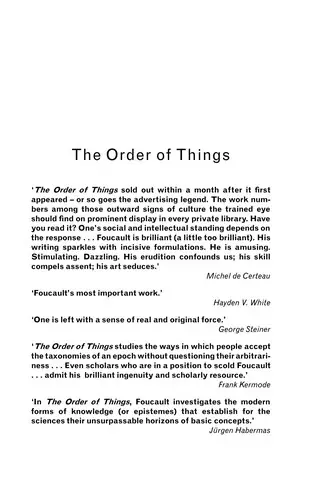
The order of things
36% recommend64% neutral
When one defines ""order"" as a sorting of priorities, it becomes beautifully clear as to what Foucault is doing here. With virtuoso showmanship, he weaves an intensely complex history of thought. He dips into literature, art, economics and even biology in The Order of Things, possibly one of the most significant, yet most overlooked, works of the twentieth century. Eclipsed by his later work on power and discourse, nonetheless it was The Order of Things that established Foucault's reputation as an intellectual giant.
Affiliate links. As an Amazon Associate I earn from qualifying purchases.
Mentions per year
What Hacker News says
Related books
 2007–2026
An enquiry concerning human understanding
David Hume
Recommended by 18 · mentioned by 2418 recommend · 24 mention18 recommend · 2418 recommend
 2008–2026
The Prophet
Kahlil Gibran
Recommended by 26 · mentioned by 3326 recommend · 33 mention26 recommend · 3326 recommend
Being and Time
Martin Heidegger
Recommended by 13 · mentioned by 4913 recommend · 49 mention13 recommend · 4913 recommend
 2008–2026
A History of Western Philosophy
Bertrand Russell
Recommended by 64 · mentioned by 11264 recommend · 112 mention64 recommend · 11264 recommend
 2009–2026
Metaphors We Live By
George Lakoff, Mark Johnson, Lakoff
Recommended by 56 · mentioned by 8156 recommend · 81 mention56 recommend · 8156 recommend
 2010–2026
Philosophical investigations
Ludwig Wittgenstein
Recommended by 42 · mentioned by 11442 recommend · 114 mention42 recommend · 11442 recommend
 2007–2026
Siddhartha
Hermann Hesse
Recommended by 138 · mentioned by 186138 recommend · 186 mention138 recommend · 186138 recommend
 2008–2026
Meditations by Marcus Aurelius
Marcus Aurelius, Meric Casaubon
Recommended by 184 · mentioned by 251184 recommend · 251 mention184 recommend · 251184 recommend
…that, as a fish swimming in the proverbial water, and say “yes, but our assumptions are actually true for real this time.” If you’re interested in this stuff and haven’t read it already I’d recommend The Order of Things by Michel Foucault. There are questions about his scholarship (do all the sources he cites say the things he says they say??) but if you read his work with an open mind, I think you’d agree those kind…
on “MonadGPT – What would have happened if ChatGPT was invented in the 17th century?” ↗Meditations by Marcus Aurelius - a wonderfully simple explanation of what is truly important in life. The Order of Things or Madness and Civilisation by Michel Foucault - a look at how our culture and time limit the horizons of our world view. Anna Karenina by Tolstoy - a complicated set of love stories set in 19C Russia…
on “Ask HN: What are the books that changed the perspective of your life?” ↗(Your reply brings to mind another book I should have mentioned - The Order of Things (Les Mots et Les Choses) by Michel Foucault.) If philosophy is the drive to understand the human condition, I don't think any philosopher can or should ignore the Bible. Athens, Rome and Jerusalem are…
on “Ask HN: Best Philosophical Books?” ↗…you have any suggestions on where to learn more about how this equation self-rectifies? Also, if not Foucault, who would you recommend for "economic insight?" Foucault's chapters on "Exchange" in "The Order of Things" are quite insightful, and if you read them and have any particular criticisms or disagreements I would much enjoy reading them.
on “Nassim Taleb says Bitcoin is an open Ponzi scheme and a failed currency” ↗…kinds of things that make it to the front page, and by how the comments often go deeper than the original article. There was even a sub-thread on this thread where people were bringing up Foucault's The Order of Things. Not bad for comments on a piece of naive pop-philosophy.
on “Is There a Limit to Scientific Understanding?” ↗…that, because we are not frequently trading castles, but we are frequently trading currency for bread and for sustenance and commodity-goods. I think one would benefit from reading Foucault's "The Order of Things" which explains that trade can only happen when there is a surplus beyond what is locally necessary, and this surplus is what gives rise to currency.
on “Nassim Taleb says Bitcoin is an open Ponzi scheme and a failed currency” ↗I've been reading Feyerband (Against Method), Latour (We Have Never Been Modern), and Foucault (The Order of Things) lately, I am so hopped up on postmodern criticism of science it isn't even funny. Also, invaluable in being an excellent scientist. Understanding the epistemology is great for destroying your illusions…
on “Why bad-tempered people earn more and live longer” ↗Likely the False Narrative myth at work in a similar fashion to attributing a narrative structure to the universe for example. As a counterpoint, Foucault's Order of Things offers up a historical “archaeology” of the sciences congruent with power structures.
on “Is There a Limit to Scientific Understanding?” ↗Ugh...episteme's a word that dates back to Plato, although the author seems to use it like Foucault does in 'The Order of Things.' That is--it's exceptionally NOT "coming up" with the word, assuming you mean to imply he's inventing the word for this article. I like your first sentence though ;)
on “The Meme Hustler - Tim O’Reilly’s crazy talk” ↗Science hasn't existed forever, and Foucault already smashed to bits of any sort of "evolution with direction" account of science in The Order of Things. The most disturbing thing appears to be that many folks aren't aware of Foucault's work.
on “The mathematics of science’s broken reward system” ↗…transformation between needs is in fact what money is for. And money is lost in the transformation due to friction. The computer age is impressive but easily overlooks advances in fields, like Foucault's Order of Things and his presentation of Economic theory. Such awareness would prevent such drastic oversimplifications imo
on “Peter Norvig's Economic Simulation (2018)” ↗…are numerous other paths to this insight, but for me it turned an intellectual understanding into a gut-level one. Foucault, for instance, penned this anecdote about Borges in his introduction to "The Order of Things" five years before he took acid out in death valley: “This book first arose out of a passage in [Jorge Luis] Borges, out of the laughter that shattered, as I read the passage, all the familiar landmarks…
on “We can no longer ignore the potential of psychedelic drugs to treat depression” ↗…theory, frame semantics, among others). What you mention as 'subjectology', would be just psychology. Foucault explains more or less clearly why this cannot be a science, and that's just fine (in The Order of Things). > You shouldn't believe that anything can be settled in the philosophy space. Philosophers can think they have settled things, but until science agreed and started empirical studies, it is just philosophers…
on “"They're made out of weights"” ↗