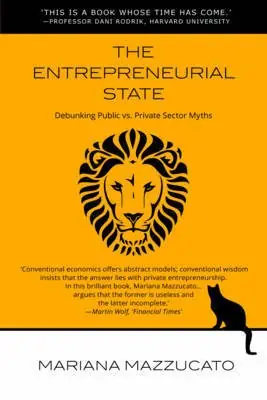
THE ENTREPRENEURIAL STATE
DEBUNKING PUBLIC VS. PRIVATE SECTOR MYTHS
by Mariana Mazzucato · first published 2011
61% recommend39% neutral
Why HN recommends it
Case studies of IT, biotech and nanotech argue that much high-risk innovation, from the internet to DARPA-backed work, was state-funded. Suits readers questioning the lumbering-state versus dynamic-private-sector story.
Summarised by Claude from recommending comments
The Entrepreneurial State: debunking public vs. private sector myths stirred up much-needed debate about the role of the state in fostering long-run innovation led economic growth. According to conventional wisdom, innovation is best left to the dynamic entrepreneurs of the private sector, and government should get out of the way. But what if all this was wrong? What if, from Silicon Valley to medical breakthroughs, the public sector has been the boldest and most valuable risk-taker of all? The book comprehensively debunks the myth of a lumbering, bureaucratic state versus a dynamic, inn
Affiliate links. As an Amazon Associate I earn from qualifying purchases.
Mentions per year
What Hacker News says
Related books
 2010–2026
Kicking away the ladder
Ha-Joon Chang
Recommended by 16 · mentioned by 2716 recommend · 27 mention16 recommend · 2716 recommend
 2008–2026
The Victorian Internet
Tom Standage
Recommended by 41 · mentioned by 4941 recommend · 49 mention41 recommend · 4941 recommend
 2016–2026
How Asia Works
Joe Studwell
Recommended by 36 · mentioned by 5136 recommend · 51 mention36 recommend · 5136 recommend
 2010–2026
The Idea Factory
Jon Gernter
Recommended by 94 · mentioned by 12194 recommend · 121 mention94 recommend · 12194 recommend
 2009–2026
The Dream Machine
M. Mitchell Waldrop
Recommended by 109 · mentioned by 131109 recommend · 131 mention109 recommend · 131109 recommend
 2014–2026
Zero to One
Peter A. Thiel, Blake Masters
Recommended by 166 · mentioned by 413166 recommend · 413 mention166 recommend · 413166 recommend
To be fair, most of innovation in America also comes from the public sector not the private one. Economist Mariana Mazzucato famously wrote about this and more in her book "The Entrepreneurial State: Debunking Public vs. Private Sector Myths" which I highly recommend if you're interested. I think it's a little misguided to say that China's innovation is solely due to corporate espionage. States…
on “Who Owns Huawei?” ↗…commodification and monopolizing of science (through ‘intellectual property’ systems)? Especially since most inventions are made possible/are funded by the state (see the work of Mariana Mazzucato and her book ‘The Entrepreneurial State’ for fully fleshed out arguments for this), as well as the actual labor being done by wage laborers (not the people owning these trade secrets and patents). It doesn’t necessarily need to be specifically…
on “Mantis shrimp inspires new breed of light sensors” ↗I also quite enjoyed Prof. Mazzucato's The Entrepreneurial State: "This book debunks the myth of a dynamic private sector vs. a sluggish public sector by providing a detailed account of the role of the public sector in taking on high-risk entrepreneurial investments,…
on “The Government Once Built Silicon Valley” ↗…this presentation by Steve Blank, or getting to the moon before the commies (Apollo program). See her Ted presentation at https://www.ted.com/talks/mariana_mazzucato_government_inves... or her book "The Entrepreneurial State"
on “"Secret" History of Silicon Valley (2008)” ↗You might enjoy the book "The Entrepreneurial State" by Mariana Mazzucato makes a similar argument that a lot of innovation is actually driven by the state, because they can afford to invest a lot in research without an immediate payoff. The author mentions…
on “The US Army spent millions developing giant, six-legged walking trucks in 1980s” ↗Mariana Mazzucato's book "The Entrepreneurial State" is a good read on the matter of public funding for innovation: https://www.indiebound.org/book/9781610396134
on “Eric Schmidt has applied to become a citizen of Cyprus” ↗This very concept is well explored by Mariana Mazzucato's Entrepreneurial State[1]: > the United States' economic success is a result of public and state funded investments in innovation and technology, rather than a result of the small state, free market doctrine that often receives…
on “Noam Chomsky – Startup Culture (2015) [video]” ↗"happened anyway" is always logic I see applied to government made advancements and not to private ones. A good read on the topic is "The Entrepreneurial State" by M. Mazzucato.
on “Why does so much government tech investment deliver so little?” ↗…lithium-ion batteries, etc all came from gov't research (I'm counting Bell Labs' gov't mandated monopoly + research funding as gov't) Economist Mariana Mazzucato wrote a great book about this called The Entrepreneurial State: Debunking Public vs. Private Sector Myths
…(http://www.youtube.com/playlist?list=PL734BAB2B716CC777) You may also be interested in the forces in society which make technological progress possible — and which kill it. Mariana Mazzucato wrote _The Entrepreneurial State_. David F. Noble wrote a couple books. Also anthropologist David Graeber's essay _Of Flying Cars and the Declining Rate of Profit_ (http://www.thebaffler.com/past/of_flying_cars) ; you may prefer his…
on “Ask PG/HN: Recommended reading on the history of technology” ↗If you're interested in this, I highly recommend work by the economist Mariana Mazzucato. In particular, her book "The Entrepreneurial State – Debunking Public vs. Private Sector Myths." http://www.amazon.com/Entrepreneurial-State-Debunking-Privat...
on “MIT-related work that has transformed computer science” ↗See the book The Entrepreneurial State by Mariana Mazzucato who covers this topic. "Her book comprehensively debunks the myth of a lumbering, bureaucratic state versus a dynamic, innovative private sector. In a series of case studies—including…
on “The merging of machine capability and human consciousness is already happening” ↗This article ties well to the excellent book "The Entrepreneurial State" by Mariana Mazzucato. Apple did an excellent job of bringing together a lot of existing technology into a viable consumer product, but it is still important to note that much of that tech was powered…
on “Who Invented the iPhone?” ↗If you're interested in the innovation policy aspects, see writings by Mariana Mazzucato, particularly her book "The Entrepreneurial State".
on “"Secret" History of Silicon Valley (2008)” ↗…positive and equitable? This implies _fundamental_ changes in those systems. To wit: publicly-funded R&D returning value to the public purse, and not just to private companies (see: Mazzucato's "The Entrepreneurial State"); effective and highly coordinated wealth / corporate tax regimes (see: Piketty's "Capital in the Twenty-First Century"); complete transformation of education and its relationship to both human psychology…
on “Research questions that could have a big social impact, organised by discipline” ↗