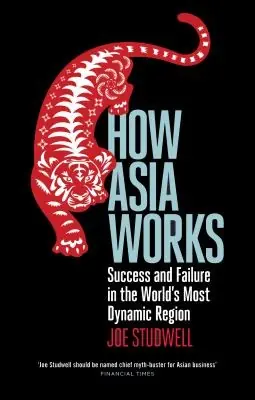
How Asia Works
by Joe Studwell · first published 2013
71% recommend29% neutral
Why HN recommends it
Case studies of why Japan, Korea, Taiwan and China industrialized while Malaysia, Thailand and the Philippines lagged, showing protectionism and export discipline done well. For readers doubting free-trade orthodoxy.
Summarised by Claude from recommending comments
A provocative look at what has worked - and what hasn't - in East Asian economics. It explores how policies ridiculed by economists created titans in Japan Korea and Taiwan, and are now behind the rise of China, while the best advice the West could offer sold its allies in south-east Asia down the economic river.
Affiliate links. As an Amazon Associate I earn from qualifying purchases.
Mentions per year
What Hacker News says
Related books
 2022–2023
How to Be Perfect
Michael Schur
Recommended by 3 · mentioned by 43 recommend · 4 mention3 recommend · 43 recommend
 2022–2023
Borne
Jeff VanderMeer
Recommended by 2 · mentioned by 32 recommend · 3 mention2 recommend · 32 recommend
 2022
Jade War
Fonda Lee
Recommended by 1 · mentioned by 21 recommend · 2 mention1 recommend · 21 recommend
 2022–2025
Upgrade
Blake Crouch
Recommended by 5 · mentioned by 85 recommend · 8 mention5 recommend · 85 recommend
Gambling on Development
Stefan Dercon
Recommended by 2 · mentioned by 22 recommend · 2 mention2 recommend · 22 recommend
Persuaders
Anand Giridharadas
Recommended by 2 · mentioned by 22 recommend · 2 mention2 recommend · 22 recommend
 2022–2023
Shards
Bret Easton Ellis
Recommended by 2 · mentioned by 22 recommend · 2 mention2 recommend · 22 recommend
For people interests in this topic, I really recommend the book How Asia Works by Joe Studwell. It focuses mostly on a subset of Asia that has great economic success in the 20th century, and only looks at a few contrasting countries to show perhaps why they didn't work as well.…
on “How do poor countries get rich?” ↗I think the notion of proliferation of broadly available technical knowledge is correct, but I'm not entirely convinced whether literature in particular was so relevant. In How Asia Works, a great book on industrial expansion in Asia, Studwell notes that when Taiwan was moderately prosperous and dominated by industry half of the workforce could not even read. What really benefited East-Asia…
on “Was Germany’s 19th century industrial expansion due to an absence of copyright?” ↗There's a similar book, "How Asia Works".[1] This has a good survey of industrial policy in Asia, what worked and what didn't. Summary: Step 1: Mechanize agriculture, to free up people for an industrial labor force Step 2: Support export-oriented…
on “Economists are now admitting that they were wrong about globalization” ↗…https://www.goodreads.com/review/show/4708765021 Another excellent book is Arbitrary Lines by Nolan Gray - which is a great book about zoning and why we should all be YIMBYs. My review is at : https://www.goodreads.com/review/show/4800787011 How Asia Works by Joe Studwell is a fascinating look at why Japan, South Korea and China have done so well. My review is at : https://www.goodreads.com/review/show/4806521204 Another book I really enjoyed was Firepower…
on “Ask HN: What are some of the best books you have read in 2022?” ↗…The most capitalist organizations on Earth at the time did a lot for art and architecture, but didn't start the Industrial Revolution early. For a different view, learn how the East got rich. Read "How Asia Works".[1] This is a good study of how some of the east Asian countries went from the 18th century to the 21st in a few decades. The early stages required some degree of central planning, and specific incentives.…
on “How the West Got Rich” ↗Seeing a lot of neo-liberal economics dogma here in the comments, and so would like to recommend this excellent book: https://www.amazon.co.uk/How-Asia-Works-Success-Failure/dp/1.... It has an excellent account of how manufacturing (supported by heavy protectionism from the state) was a crucial component of the Asian miracle in nearly all countries. IMO India…
on “Apple Not Able to Open Stores in India Without Selling 30% Locally Sourced Goods” ↗…be "a battle for last place". It often is, I agree, but is also one of the levers used by Korea (etc.) to develop. The book which changed my mind about this, which I highly recommend, is Joe Studwell, "How Asia Works", https://howasiaworks.wordpress.com . India, unfortunately, has a long record of getting this exactly wrong.
on “Apple has started production of iPhone SE in India” ↗Necessary but not sufficient and all that... In how Asia works, Studwell argued quite convincingly how land reforms in Japan, South Korea, etc. was a prelude to successful industrialization because it allowed creating financial surplus thanks to increase agricultural…
on “Work on these things” ↗…get swallowed up. At least in Korea. In less successful countries, domestic top dogs were simply protected, and were quite happy to keep making cars from the '50s. An excellent book on this story is "How Asia Works" by Joe Studwell. (On which I'd be interested to hear any opinions from actual Koreans.)
on “South Korea switching their 3.3M PCs to Linux” ↗…"Great British Railways". This is in the tradition of British "lemon socialism" - have the government run the troubled industries. In the 1950s, the government owned the steel, coal, and rail industries. "How Asia Works", by Joe Studwell, is worth reading. How East Asia moved into the 21st century is detailed, country by country. There were two startup phases: 1) Fix agriculture so it doesn't take most of the workforce,…
on “All Is Orwell” ↗…really wants it to and is competent in how it carries it out. I think the book on development I'd most recommend on development in general is Gambling on Development but for what exactly South Korea did How Asia Works has the details.
on “South Korea: the corruption that built its economy (2017)” ↗How Asia works by studwell. It’s also a Bill Gates book recommendation.
on “Small robots may kill the tractor and make farming efficient” ↗…economies, it's pretty much the default of countries for obvious reasons of protecting vested interests. The best explanation I've ever read for the rise East Asian export economies post WWII is in the book "How Asia Works" [1]. The title is a little misleading, it's only about East and SE Asia, but it has a good broad overview of what made Japan, Taiwan, South Korea, and China all rapidly industrialized 1945+, and why…
on “How the World Works (1993)” ↗- How Asia Works: Success and Failure in the World's Most Dynamic Region Changed the way I look at economic development and government's involvement in it. To make country's economy grow, it's not enough to just take…
on “Ask HN: What books fundamentally changed the way you think about the world?” ↗…Korea, Japan, Taiwan, China) used to get ahead, whereas the countries who followed the neoliberalist model of the west too closely (Malaysia, Thailand, Indonesia, etc) lagged behind. Suggest reading 'How Asia Works' by Joe Studwell.
on “China Blocks WhatsApp” ↗