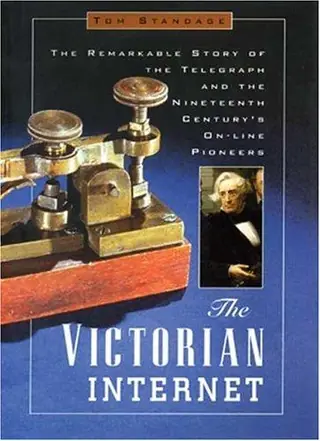
The Victorian Internet
the remarkable story of the telegraph and the nineteenth century's on-line pioneers
by Tom Standage · first published 1998
82% recommend16% neutral2% critical
Why HN recommends it
Short, approachable history of the telegraph told through the people involved, from operator culture to the first transatlantic cable. Shows how early hopes and upheaval mirror the modern internet; suits general readers.
Summarised by Claude from recommending comments
The Victorian Internet tells the story of the telegraph's creation and remarkable impact, and of the visionaries, oddballs, and eccentrics who pioneered it. From the eighteenth-century French scientist Jean-Antoine Nollet, whose experiments proved that electricity could be transmitted over great distances, to Samuel F. B. Morse, who developed the first practical electric telegraph in 1837, to Thomas Edison, who began his career in the telegraph business and proposed to his wife by tapping Morse code on her hand, Tom Standage tells a colorful tale of scientific discovery, technological cunning
Affiliate links. As an Amazon Associate I earn from qualifying purchases.
Mentions per year
What Hacker News says
Related books
 2009–2020
Stan Veit's History of the Personal Computer
Recommended by 2 · mentioned by 22 recommend · 2 mention2 recommend · 22 recommend
 2023
Edison
Edmund Morris
Recommended by 2 · mentioned by 22 recommend · 2 mention2 recommend · 22 recommend
 2014–2026
A Thread Across the Ocean
John Steele Gordon
Recommended by 7 · mentioned by 87 recommend · 8 mention7 recommend · 87 recommend
 2009–2025
Computing in the Middle Ages
Severo M. Ornstein
Recommended by 8 · mentioned by 108 recommend · 10 mention8 recommend · 108 recommend
 2015–2021
Wired love
Ella Cheever Thayer
Recommended by 2 · mentioned by 92 recommend · 9 mention2 recommend · 92 recommend
 2009–2020
Go to
Steve Lohr
Recommended by 3 · mentioned by 43 recommend · 4 mention3 recommend · 43 recommend
How the world was one
Arthur C. Clarke
Recommended by 7 · mentioned by 87 recommend · 8 mention7 recommend · 87 recommend
 2012–2026
Tubes
Andrew Blum
Recommended by 9 · mentioned by 159 recommend · 15 mention9 recommend · 159 recommend
…Whatsapp, etc, were symptomatic of the Internet's power to create freedom and social utopia. It's part of a persistent strain of technoutopianism. You might read Tom Standage's excellent 1998 book "The Victorian Internet", which talks about the adoption of the telegraph during the Victorian era. Many of the same things people said about the Internet's power to change society were said about the telegraph: https://www.amazon.com/Victorian-Internet-Remarkable-Ninetee...
on “Former Google and Facebook execs are sounding alarms about the power of tech” ↗Here's a 1901 version of the map: http://upload.wikimedia.org/wikipedia/commons/a/a5/1901_East... And somewhat related, a wonderful book called The Victorian Internet: http://www.amazon.com/dp/0802716040/ If you ever wondered whether the Internet really is a "series of tubes", here are the tubes: http://www.popsci.com/files/imagecache/article_image_large/f... That…
on “Submarine Cable Map” ↗The Victorian Internet is an interesting and fairly quick read. Check it out. http://en.wikipedia.org/wiki/The_Victorian_Internet
on “India to send last telegram” ↗This story sounds pretty believable after reading Tom Standage's The Victorian Internet, especially Chapter 8, "Love over the Wires". That's one of my favorite books (and finally available in a Kindle edition!). Don't take my word for it, read a few of the reviews: http://www.amazon.com/The-Victorian-Internet/dp/B002STNBKM/…
on “Wired Love: a novel from 1880 that could have been written last week ” ↗…substituting single words for common phrases. Obviously both parties needed to use the same code book, and unsurprisingly the telegraph companies tried to ban the practice. [1] I think this was in The Victorian Internet by Tom Standage. A very interesting read btw.
on “Belgium ends 19th-Century telegram service” ↗Author of this blog post here, thank you for mentioning The Victorian Internet. I’d read that years back, deeply enjoyed it, but didn’t think to reference it in this piece. I’d read Empire of the Air and Hello, everybody! along with a number of older radio-focused journals (thanks,…
on “Radio was the original overhyped technology” ↗I encourage any hacker to take a look some time at the beautiful 'bugs' still (!) made by Vibroplex [1]. I have wanted to learn Morse ever since I read The Victorian Internet by Tom Standage [2]. I know people use keyboards nowadays---and even software to read Morse and translate it automatically into text---but I want to learn to send it by hand. Do you recommend a straight…
on “Why I'm Learning Morse Code” ↗The book The Victorian Internet talks about this. A good read. https://en.wikipedia.org/wiki/The_Victorian_Internet
on “The Victorians had the same concerns about technology as we do” ↗…consequences, but it's also fairly certain that such industrial revolutions have always been accompanied by upheaval and uncertainty, as power players try to use new technologies for both good and bad. The Victorian Internet about the invention of the telegraph is an excellent read for an example of how the more things change, the more they stay the same.
on “The short list of jobs with high and rising pay” ↗…the telegraph was off and running. 2 years later there was 2,000 miles if wire, and another two years added another 10,000 miles. The government line proved to be irrelevant, not crucial. See "The Victorian Internet" by Tom Standage
on “Adam Smith and Inequality (2014)” ↗The Victorian Internet by Tom Standage is one of my favorites. It talks about how the telegraph brought near instantaneous communication and how that changed the world. He gives specific examples for finance, newspapers and…
on “Ask HN: Good Books on the History of Technology?” ↗…The Race to Wire the World and the Dawn of the Information Age by James M. Tabor (Author) About this telegraph cable, and all of the different attempts to lay it on the sea floor. I also recommend The Victorian Internet by Tom Standage (1998) if you want to learn more about telegraphs.
on “The First Transatlantic Telegraph Cable Was a Bold, Beautiful Failure” ↗Victorian Internet, Tom Standage http://www.amazon.com/Victorian-Internet-Remarkable-Nineteen...
on “Ask HN: Favorite true story tech book?” ↗Enjoyed this article. A similar theme (modern communication technology prefigured in earlier practices) can be found in Victorian Internet, by Tom Standage.
on “Twitter Updates, the 18th Century Edition” ↗Tom Standage's "The Victorian Internet" has a lot of great detail about the culture of the telegraph operator and how it compares to the internet culture today. "Wandering workers who went from job to job were known as 'boomers.' There were…
on “A Geek Of 1909” ↗