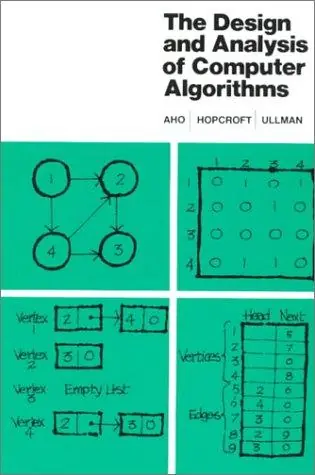
The Design and Analysis of Computer Algorithms
by Alfred V. Aho, John E. Hopcroft, Jeffrey D. Ullman · first published 1974
4mentions
2recommended by
4HN commenters
2010–2023first – last mentioned
50% recommend50% neutral
Affiliate links. As an Amazon Associate I earn from qualifying purchases.
Mentions per year
What Hacker News says
Related books
 2011–2021
Data structures and algorithms
Alfred V. Aho, John E. Hopcroft, Jeffrey D. Ullman
Recommended by 1 · mentioned by 51 recommend · 5 mention1 recommend · 51 recommend
 2007–2026
Introduction to Algorithms
Thomas H. Cormen, Charles E. Leiserson, Ronald L. Rivest, Clifford Stein
Recommended by 274 · mentioned by 712274 recommend · 712 mention274 recommend · 712274 recommend
 2007–2026
The art of computer programming
Donald Knuth
Recommended by 336 · mentioned by 1,125336 recommend · 1,125 mention336 recommend · 1,125336 recommend
…later). Also, even if you consider only books, they wrote nine books, and neither of the two mentioned as most influential is "the dragon book". The first mentioned is the book by Aho, Hopcraft and Ullman: Design and Analysis of Computer Algorithms (1974) > a classic in the field and was one of the most cited books in computer science research for more than a decade. It became the standard textbook for algorithms courses throughout the world when…
on “Turing Award goes to Aho and Ullman” ↗(edit) Their book, The Design and Analysis of Computer Algorithms, impressed me greatly for the clarity of the thinking and conciseness of explanation, not just compared to other algorithm books, but against anything I've read in any subject.
on “Advanced Data Structures” ↗They are both algorithm books and the initials are the last names of the authors. AHU is "The Design and Analysis of Computer Algorithms" by Aho, Hopcroft and Ullman. CLR is "Introduction to Algorithms" by Cormen, Leiserson and Rivest
on “Algorithms and Data Structures by N. Wirth [pdf]” ↗…big-Theta). In fact, one can also show that M(n) is O(D(n)) (where D(n) is the time needed to divide n bit numbers). So they really are big-theta of each other. (See Aho, Hopcroft, and Ullman, The Design and Analysis of Computer Algorithms, 1976, section 8.2)
on “Why is division so much more complex than other arithmetic operations?” ↗