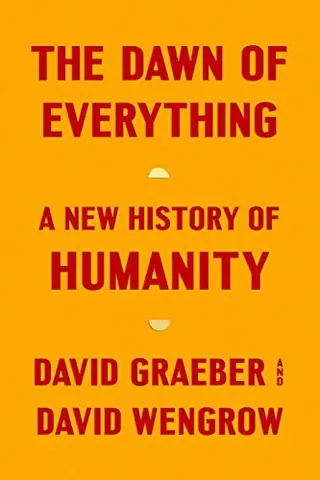
The Dawn of Everything
by David Graeber, David Wengrow · first published 2021
66% recommend26% neutral8% critical
Why HN recommends it
Draws on recent anthropology and archaeology to challenge assumptions that early humans lived in simple, linear stages and that hierarchy is natural. Suits readers wanting alternative social models.
Common criticism: Some say it overstates its evidence to support anarchist polemics
Summarised by Claude from recommending comments
The renowned activist and public intellectual David Graeber teams up with the professor of comparative archaeology David Wengrow to deliver a trailblazing account of human history, challenging our most fundamental assumptions about social evolution—from the development of agriculture and cities to the emergence of "the state," political violence, and social inequality—and revealing new possibilities for human emancipation For generations, our remote ancestors have been cast as primitive and childlike—either free and equal innocents, or thuggish and warlike. Civilization, we are told, could
Affiliate links. As an Amazon Associate I earn from qualifying purchases.
Mentions per year
What Hacker News says
Related books
 2011–2026
Debt
David Graeber
Recommended by 182 · mentioned by 303182 recommend · 303 mention182 recommend · 303182 recommend
 2017–2026
Against the Grain
James C. Scott
Recommended by 22 · mentioned by 3322 recommend · 33 mention22 recommend · 3322 recommend
 2021–2024
Opening the heart of compassion
Martin Lowenthal
Recommended by 2 · mentioned by 22 recommend · 2 mention2 recommend · 22 recommend
 2022–2023
Beautiful Country
Qian Julie Wang
Recommended by 2 · mentioned by 22 recommend · 2 mention2 recommend · 22 recommend
 2021–2022
Self-help
Samuel Smiles
Recommended by 1 · mentioned by 21 recommend · 2 mention1 recommend · 21 recommend
 2015–2026
Sapiens
Yuval Noah Harari
Recommended by 201 · mentioned by 376201 recommend · 376 mention201 recommend · 376201 recommend
 2014–2024
Il deserto dei Tartari
Dino Buzzati
Recommended by 3 · mentioned by 33 recommend · 3 mention3 recommend · 33 recommend
The new Graeber, Dawn of Everything Completely tears apart recent trendy anthro books like Sapiens for ignoring both old and very new research and tries to set a new framework for understanding humanity’s potential
on “Ask HN: What's the best book you read in 2021?” ↗Graeber’s new work, Dawn of Everything, is the latest fascinating read on this. It thoroughly discredits trendy tellings of human history like you’ll find in Sapiens, Jared Diamond, Fukuyama, which simply don’t reflect recent research (and…
on “Hallucinogens, alcohol and leadership strategies in the ancient Peruvian Andes” ↗…translation) by Stanisław Lem. It's the most hilarious science fiction I've read. It hits a special note with me, I actually immediately started reading it again from the start as soon as I finished it. × The Dawn of Everything by David Graeber & David Wengrow. An amazing rethinking of archeology, a denunciation of social orthogenesis and an invitation to dream of a better world Other mentions are long fantasy series, including…
on “Ask HN: What are some of the best books you have read in 2022?” ↗…learned that history -- even though it's been known for over a century. If you're genuinely interested here are maybe some places to start: https://www.amazon.com/dp/B0948GPBBH/ref=dp-kindle-redirect?... (Dawn of Everything by Graeber) https://historyofphilosophy.net/series/islamic-world https://www.amazon.com/dp/B06XXY491X/ref=dp-kindle-redirect?... (Orientalism by Said) edit: here's a popular article detailing an example…
To go deeper into a reexamination of the archeological record and challenging our Euro-centric and agro-civilization centric narratives, check out The Dawn of Everything: A New History of Humanity by David Graeber[1] [1] https://www.goodreads.com/book/show/56269264-the-dawn-of-eve...
on “Ancient Mesopotamian discovery transforms knowledge of early farming” ↗…me that there is indeed a direction for society to go beyond PostModernism, that is constructive and nuanced. Also explained why it is so rare for people to move into such a stage of development. The Dawn of Everything by David Graeber and David Wengrow. Showed all of the archaeological evidence for vast time periods where alternate governance models were put into practice, and how the history of progress that we are…
on “Ask HN: What book changed your life?” ↗…sometimes (at least from native American verbal history) this can happen because the people have experienced feudalist systems and realised how bad that turned out. I strongly recommend reading Graeber's The Dawn of Everything to start out.
on “Critique of Techno-Feudal Reason” ↗Graeber spends a lot of time arguing against exactly this assumption in The Dawn of Everything. I.e. that agriculture must come before civilization. Pretty persuasively, IMHO.
on “Ancient civilisation under eastern Turkey estimated to be 11k-13k years old” ↗Graeber’s last book, The Dawn of Everything, does a great job of dispelling a lot of these “brutal and short” notions as mostly ideological myths.
on “‘Mutual aid’ is a radical ideal. Some live its communal spirit” ↗A single example is difficult to evaluate, especially when the only context is a walled village, house plans and burials - no written records. However, if you are intrigued by this, read: The Dawn of Everything Graeber & Wengrow
on “China's ancient water pipe networks” ↗…and subsequently devoted a large chunk of her career towards studying the bone flute. Their enthusiasm during the tour was really captivating :) I also highly recommend adding the forthcoming book The Dawn of Everything: a New History of Humanity to your reading list. It is co-authored by David Graeber, a fantastic anthropologist who sadly died this year. Check out [this article](https://www.eurozine.com/change-course-human-history/)…
on “Prehistoric Horses: Exploring the meaning of Lascaux’s galloping herds” ↗I think you would enjoy the recently published book, "The Dawn of Everything" by David Graeber and David Wengrow. A point made early in the book is that Native American criticisms of European society, particularly its lack of freedom and mutual aid, led to the development of defensive…
on “Freedom is not a goal, but a direction” ↗Debt: The First 5000 Years and The Dawn of Everything are both better than Bullshit Jobs IMO. I'd start with "The Dawn of Everything." While I think Graeber makes the same "jump to conclusions based on your worldview" mistakes he criticizes others for, he…
on “Fashion, art cycles are driven by counter-dominance signals of elite competition” ↗I read Sapiens and its companion a few years ago. This year I read Dawn of Everything: A New History of Humanity' by David Graeber and David Wengrow [0]. And found it much more nuanced, interesting and believable. Harari's narrative is just too slick. [0] https://news.ycombinator.com/item?id=29316008
on “Ask HN: What's the best book you read in 2021?” ↗Graeber has a fresh take on Hobbes in his Dawn of Everything https://www.nytimes.com/2021/10/31/arts/dawn-of-everything-g...
on “Thomas Hobbes’s Leviathan shaped modern politics” ↗