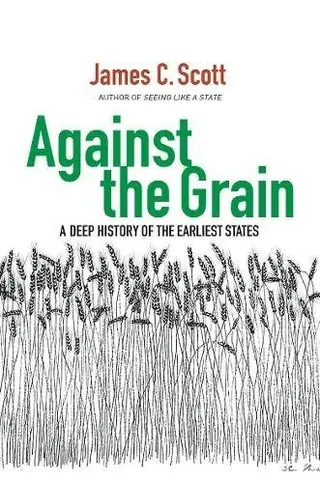
Against the Grain
A Deep History of the Earliest States
by James C. Scott · first published 2017
67% recommend30% neutral3% critical
Why HN recommends it
An archaeology-based challenge to the idea that farming and states meant progress: early states struggled to keep people from leaving, with grain, disease and writing's bookkeeping roots covered. Suits Sapiens readers.
Summarised by Claude from recommending comments
An account of all the new and surprising evidence now available for the beginnings of the earliest civilizations that contradict the standard narrative. Why did humans abandon hunting and gathering for sedentary communities dependent on livestock and cereal grains, and governed by precursors of today's states? Most people believe that plant and animal domestication allowed humans, finally, to settle down and form agricultural villages, towns, and states, which made possible civilization, law, public order, and a presumably secure way of living. But archaeological and historical evidence challe
Affiliate links. As an Amazon Associate I earn from qualifying purchases.
Mentions per year
What Hacker News says
Related books
 2020–2026
The Dawn of Everything
David Graeber, David Wengrow
Recommended by 111 · mentioned by 167111 recommend · 167 mention111 recommend · 167111 recommend
 2014–2024
Story of the Human Body
Daniel E. Lieberman
Recommended by 4 · mentioned by 64 recommend · 6 mention4 recommend · 64 recommend
 2009–2026
Ishmael
Daniel Quinn
Recommended by 48 · mentioned by 6548 recommend · 65 mention48 recommend · 6548 recommend
 2015–2026
Sapiens
Yuval Noah Harari
Recommended by 201 · mentioned by 376201 recommend · 376 mention201 recommend · 376201 recommend
 2009–2026
Seeing Like a State
James C. Scott
Recommended by 123 · mentioned by 263123 recommend · 263 mention123 recommend · 263123 recommend
 2016–2025
The Art of Not Being Governed
James C. Scott
Recommended by 9 · mentioned by 159 recommend · 15 mention9 recommend · 159 recommend
 2017–2025
Flour Water Salt Yeast
Ken Forkish
Recommended by 21 · mentioned by 2821 recommend · 28 mention21 recommend · 2821 recommend
 2007–2026
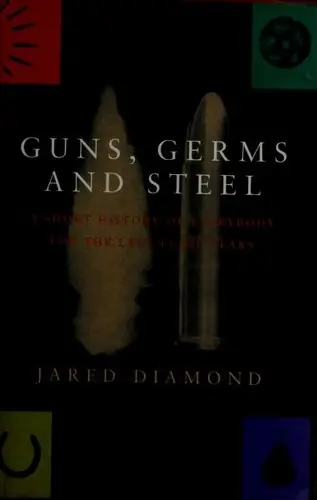
Guns, Germs, and Steel
Jared Diamond
Recommended by 214 · mentioned by 510214 recommend · 510 mention214 recommend · 510214 recommend
For evidence based narrative of the oldest known state like agricultural cultures I can't recommend enough James Scott's "Against the grain" https://www.amazon.com/Against-Grain-History-Earliest-States... All evidence at this time points that agriculture based city states were challenging to boot into a "proper civilization". If you raised…
on “Younger Dryas cosmic impact of 12,800 years ago (2018)” ↗…repeatedly through human history, since about ~11,000 years ago. (That said, it's an interesting question why exactly states formed; there's some reason to think it required rather unusual conditions. The book Against the Grain by James Scott tries to tackle this topic.) On the other hand, as the video describes it, a nation state is a state with a collective identity tied to a shared language, "race", and set of borders, usually…
on “National Identity Is Made Up [video]” ↗…with leisure time are not the same people. You can see this by looking at the economic stratification for every single agricultural society... ever? I would highly recommend reading James C Scott's 'Against the Grain' [0]. His thesis is that agriculture came in quite slowly, as part of a semi-sedentary hunter-gatherer society. It was only once the natural environment was depleted and agriculture became the only option…
on “If Sapiens were a blog post” ↗…All assertions were made with minimum citation, and couched in "relevatory" language that always makes me feel that the author is hiding something. If you want Sapiens but without these problems, try "Against the Grain" by James C. Scott. Covers much of the same material, but with many more citations from reputed journals and academics.
on “Clubhouse downloads are falling” ↗There is a great book which touches on this subject, Against the Grain: A Deep History of the Earliest States, by James C. Scott. It overturns many of the latent assumptions about early history, particularly in Mesopotamia. It's well argued, I recommend it. I listened to…
on “Scrap for cash: Bronze Age witnessed revolution in small change across Europe” ↗…alphabet), and much is available online: https://sites.utexas.edu/dsb/tokens/the-evolution-of-writing... The roots of writing seems to be in counting/tallying marks, i.e. accounting. Another great book, "Against the Grain" by James Scott, describes how both tallying and writing developed hand-in-hand with the state.
on “Who Invented the Alphabet?” ↗For more on peasants getting screwed since forever, see Against The Grain by James Scott. (also author of Seeing Like a State, mentioned elsewhere in this comment thread)
on “From South Korea to Malaysia, ‘smart cities’ turn to ghost towns” ↗Urbanization has been a hot mess of disease for the last 5000 years. And our biological evolution hasn't had time to catch up. See "Against the Grain", by James C. Scott (https://www.amazon.com/Against-Grain-History-Earliest-States...), and also "The Story of the Human Body", by Daniel E. Lieberman (https://www.amazon.com/Story-Human-Body-Evolution-Disease/dp...).…
on “Ask HN: Economy after coronavirus – what can we do?” ↗This idea is approached in an interesting way in the book “Against the Grain” by James C. Scott.
on “Animals changed by proximity to humans” ↗…also demons. - hench ; a normie uses Zersetzung against the alter egos of superheroes. It’s great - five decembers ; great read, and a clever take on the traditional noir genre Non fiction: - against the grain - pre industrial societies - the other face of battle I’m still chewing through “war from the ground up” and it’s very good, but for me at least, conceptually dense.
on “Ask HN: What's the best book you read in 2021?” ↗On a related tangent, I found the book Against the Grain, by James C Scott, to be very interesting. In it he discusses how farming existed long before cities, and how certain grain crops contributed to (and were leveraged for) the emergence of city states.…
on “Bread in the Middle Ages (2013)” ↗I always cite Jaynes' book as having the best title of all time. A good antidote to Sapiens, in particular, is "Against the Grain" by James Scott, who (as was Jaynes) is at Yale. It's a survey of recent archeology and anthropology that has great new evidence and novel interpretations of old evidence. Very accessible and highly recommended.…
on “How did people get to Britain 950k years ago?” ↗Against the Grain by James C. Scott. Eye opening take on early stages in history The entire Aubrey-Maturin series starting with Master and Commander. Exquisite writing, funny, interesting, deep characters and chock full…
on “Ask HN: Which books you have read till now that were worth investing time in?” ↗…centralized bureaucracy was a day's horseback ride - control degrades rapidly as one leaves the core. "Heaven is high and the emperor is far away", as the saying goes. Edit: With regards to the second note, "Against the Grain" by James C. Scott is a solid read.
on “Twitter now requires an account to view tweets” ↗You're working with the assumption that settling in large groups, creating a "state", and tending to agriculture represents progress for the people involved. I'd recommend checking out Scott's "Against the Grain: A Deep History of the Earliest States" for an alternative look at those assumptions. https://www.amazon.com/Against-Grain-History-Earliest-States...
on “Neolithic high mountain settlers were doing complex livestock/farming activities” ↗