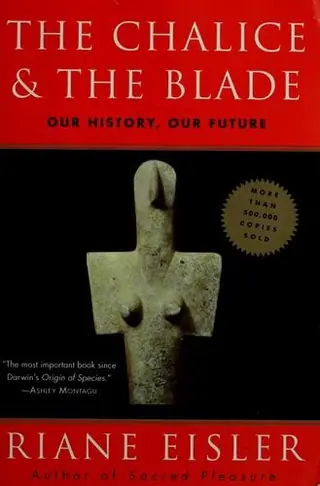
The chalice and the blade
by Riane Tennenhaus Eisler · first published 1987
29% recommend71% neutral
"In prehistorical times, Eisler argues, women and men lived together in egalitarian communities devoted to nurturance; with the imposition of male domination, female values gave way to creeds of hierarchy, aggression, power, obedience. Eisler, a futurist, posits a new society based on the recovery of more humane values."--Library journal (6/1/85).
Affiliate links. As an Amazon Associate I earn from qualifying purchases.
Mentions per year
What Hacker News says
Related books
 2020–2026
The Dawn of Everything
David Graeber, David Wengrow
Recommended by 111 · mentioned by 167111 recommend · 167 mention111 recommend · 167111 recommend
The Glass Bead Game
Hermann Hesse
Recommended by 51 · mentioned by 9351 recommend · 93 mention51 recommend · 9351 recommend
 2011–2026
Debt
David Graeber
Recommended by 182 · mentioned by 303182 recommend · 303 mention182 recommend · 303182 recommend
…same tribes, same consequences. TIL the privacy battle was fought, and lost, 50+ years ago. https://www.thelastarchive.com -- My first exposure to the idea of "misinformation" was Raine Eisler's "The Chalice and the Blade" https://www.amazon.com/Chalice-Blade-Our-History-Future/dp/0.... Eisler explains how victors didn't just write history, they actively rewrote it. Actively seeking out and obliterating any contrary narratives.…
on “The Incoming Currency War” ↗…societies that were built on participatory economies were completely destroyed by organizations that behaved based on domination patterns. This is well documented in Rianne Eisler’s seminal 1987 book “the chalice and the blade” and is also well described by the Strauss-Howe theory of the four turnings, etc. there’s plenty of documentation on this. I think what frustrates people is when they’re confronted with this type of…
on “Neolithic high mountain settlers were doing complex livestock/farming activities” ↗>Recently Riane Eisler in her important revisioning of history, The Chalice and the Blade, has advanced the important notion of “partnership” models of society being in competition and oppressed by “dominator” forms of social organization. These latter are hierarchical, paternalistic, materialistic,…
on “Why Are Psychedelics Illegal?” ↗Unpopular opinion: Hard times will come again, and masculine men will again become sexy. There is a constant battle between dominator/partnership societal subgroups (a distinction by Riane Eisler in Chalice and the Blade) which one naively could distinguish as patriarchal-masculine / matriarchal-feminine. The abundance of resources the past decades has rendered the traditional, masculine and competitive men obsolete,…
Eisler brings up that frame in "The Chalice and the Blade" -- it was often assumed in historical scholarship that non-patriarchial societies were matriarchial. Instead, she reframes it as "dominator" vs. "cooperator" societies. In other words, wrestling over…
…behind them a retinue of trusted aides ... shitting on the remnants of whatever came before them My first exposure to that idea was the process of re-mything after a regime change, as described in The Chalice and the Blade (Riane Eisler). Yesterday's godhead, deity, creation myth, ledger of debts was obviously deeply wrong. Appropriate, subvert, coopt, as able, all the narratives and levers of power. Utterly obliterate…
on “75% of the original Disney+ executive team is no longer at Disney” ↗…heavily influenced by the following books: Bullshit Jobs, Debt: The First 5000 Years, and The Dawn of Everything, all works of the anthropologist David Graeber; The Glass Bead Game by Hermann Hesse;[7] The Chalice and the Blade by sociologist Riane Eisler; The Origins of Political Order by Francis Fukuyama; The War Lovers by Evan Thomas; and The Swerve by Stephen Greenblatt.[8]
on “Interview: Francis Ford Coppola (2012)” ↗Also see: https://www.newyorker.com/books/book-currents/francis-ford-c... With comments from Coppola about Riane Eisler's The Chalice and the Blade, but also Cao Xueqin's The Dream of the Red Chamber, William Bolitho's Twelve Against the Gods, Cole and Chinoy's project Directors on Directing, and Goethe's Elective Affinities
on “Megalopolis is baffling and plainly nuts but worth it” ↗…of the establishment. Sure, I had read "1984", but this forgetfulness is not deliberate, it's not what Orwell described. Some people drive the process. Since forever, according to Riane Eisler in "The Chalice and The Blade". And some people benefit. But I now mostly think we do it to ourselves. It's intrinsically human. Not intentionally. I think forgetfulness is crucial to human ability to get along. Related to homophily…
on “Scientists use big data to sway elections, predict riots. Welcome to the 1960s” ↗…megafauna, but ultimately my claim is that was the loss of megafauna and resulting requirement to change society in the neolithic to domination based agrarianism Riane Eiseler documented most of this in Chalice and the blade
on “The coming long-run slowdown in corporate profit growth and stock returns [pdf] (2023)” ↗