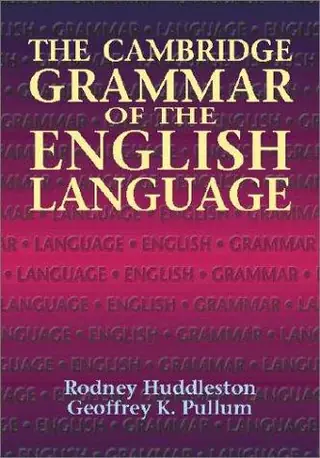
The Cambridge grammar of the English language
by Rodney D. Huddleston, Geoffrey K. Pullum · first published 2002
19% recommend81% neutral
Publisher description: This book presents a new and comprehensive descriptive grammar of English, written by the principal authors in collaboration with an international research team of a dozen linguists in five countries. It represents a major advance over previous grammars by virtue of drawing systematically on the linguistic research carried out on English during the last forty years. It incorporates insights from the theoretical literature but presents them in a way that is accessible to readers without formal training in linguistics. It is based on a sounder and more consistent descripti
Affiliate links. As an Amazon Associate I earn from qualifying purchases.
Mentions per year
What Hacker News says
Related books
 2010–2025
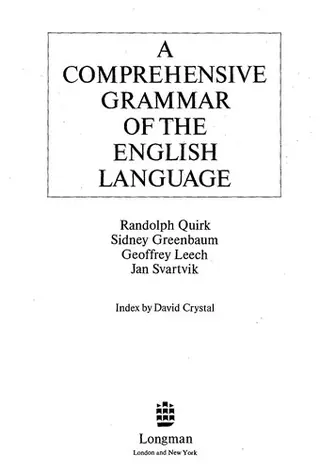
A Comprehensive grammar of the English language
Randolph Quirk, Sidney Greenbaum, Geoffrey N. Leech, Jan Svartvik
0 recommend · 3 mentioned0 recommend · 3 mention0 recommend · 30 recommend
 2008–2026
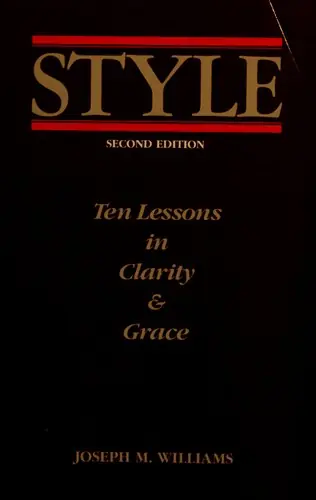
Style
Joseph M. Williams, Joseph Bizup, Gregory G. Colomb
Recommended by 38 · mentioned by 4238 recommend · 42 mention38 recommend · 4238 recommend
 2007–2026
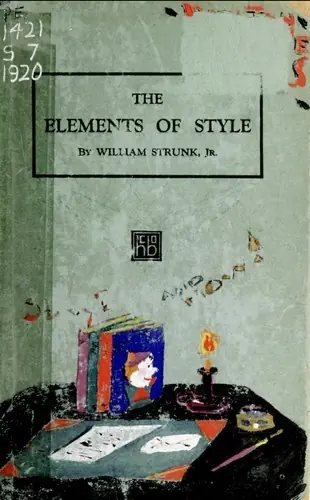
The Elements of Style
William Strunk, Jr., E. B. White
Recommended by 131 · mentioned by 231131 recommend · 231 mention131 recommend · 231131 recommend
 2008–2026
Politics and the English language
George Orwell
Recommended by 112 · mentioned by 210112 recommend · 210 mention112 recommend · 210112 recommend
 2010–2026
The Chicago manual of style
University of Chicago Press Editorial Staff
Recommended by 19 · mentioned by 11219 recommend · 112 mention19 recommend · 11219 recommend
 2007–2026
On Writing Well
William Zinsser
Recommended by 137 · mentioned by 170137 recommend · 170 mention137 recommend · 170137 recommend
It's not really deeply technical, it's just trying to be comprehensive and concise. If you want deeply technical, read Pullum's explanation of passives in Cambridge Grammar of the English Language.
on “The Passive in English (2011)” ↗Oh, certainly, as is the case for any language! In the case you mention, I note that Huddleston & Pullum in their Cambridge Grammar of the English Language specifically call ‘some’ an existential determiner. As is usual with them, this is an insightful observation: you use ‘some <noun>’ specifically in order to say that there exists some set of things drawn…
on “English: A vs. An” ↗…employed by the organization. For example, 'the policy of Microsoft [corp] is that…' is typically confused or confabulated with, say, those at Microsoft who determine policy'. Incidentally, I use The Cambridge Grammar of the English Language as my grammar reference, I purchased my copy of this 1800-plus page tome not long after it was published about two decades ago. It's the most authoritative reference to English grammar ever written, it's…
on “F-Droid interview featuring Sylvia von OS and Hans-Christoph Steiner [audio]” ↗…Luck," previously discussed on Hacker News.[1] The author is a renowned and very influential scholar of the English language, co-editor of the most authoritative grammar of the English language, the The Cambridge Grammar of the English Language. Alas, although Pullum is a very astute scholar of language (linguist), he is not a polyglot (learner of other languages) to any particular degree, and many of his points about the defects of English…
on “The Unsuitability of English (2015)” ↗The author of this essay is also the co-author of The Cambridge Grammar of the English Language http://www.cambridge.org/uk/linguistics/cgel/ Unfortunately, the author doesn't recommend a good alternative to Strunk & White's Elements of Style.
on “50 Years of Stupid Grammar Advice” ↗…are for you until you master the language. Quote: ------ Geoffrey K. Pullum is head of linguistics and English language at the University of Edinburgh and co-author (with Rodney Huddleston) of The Cambridge Grammar of the English Language (Cambridge University Press, 2002). ----- Ah, OK. That's the Cambridge Grammar of the English Language. (No, seriously, British English is different from... sorry, different than American English.)
on “50 years of bad grammar advice” ↗…of criticisms. http://www.lel.ed.ac.uk/~gpullum/50years.pdf Also see Language log, which has many posts on the wrongness of S&W. EDIT: If you're not familiar with Pullum, he's the co-author of the Cambridge Grammar of the English Language and probably the most respected grammarian alive today.
on “A blogging style guide” ↗…K. Pullum: http://chronicle.com/article/50-Years-of-Stupid-Grammar/2549... He "is head of linguistics and English language at the University of Edinburgh and co-author (with Rodney Huddleston) of The Cambridge Grammar of the English Language". But, go ahead and write like Strunk if you want to sound like a stiff 1890s dandy.
on “Ask HN: How do you write great sentences, paragraphs, or articles?” ↗…can be sure about here is that the grammatical sense of native speakers of English (or native speakers of Chinese, etc.) does NOT reflect some kind of underlying universal rule of human thought. The Cambridge Grammar of the English Language http://www.amazon.com/Cambridge-Grammar-English-Language/dp/... is an expensive reference book well informed by worldwide investigation of English as it is actually written and spoken. It is a useful…
on “What is the rule for adjective order?” ↗…about what the best set of rules is for describing what's correct. For instance, if you compare the famous "Comprehensive Grammar of the English Language" by Quirk and Greenbaum, and the more recent "Cambridge Grammar of the English Language" by Huddleston and Pullum, you'll find that their analyses are sometimes very different. Totally different rules, even though they're describing substantially the same language.
on “Ask HN: What's your speciality, and what's your "FizzBuzz" equivalent?” ↗…kindly submitted here is not a historian by occupation or training. He is a linguist who specializes in the study of the English language.[1] (He is a co-author of the definitive grammar of English, the Cambridge Grammar of the English Language.[2]) He writes "Let me state very clearly that I don’t intend any of this in triumphalist spirit" because that is the way that all scholars trained in linguistics write about language differences: languages…
on “English and Its Undeserved Good Luck” ↗Note that Geoffrey Pullum is a distinguished linguist, editor of the Cambridge Grammar of the English Language, and a frequent blogger at LanguageLog. The tone of this article should be taken as more light than many here are; this sort of thing is a frequent hobbyhorse for linguists and mostly just evinces love…
on “The Unsuitability of English (2015)” ↗…the best features of historical languages? like how programming languages take the good features from one another? Unlike programming languages, natural languages are really, really complicated. The Cambridge Grammar of the English Language, one of the most comprehensive treatise on the grammar of English (and probably one of the most comprehensive work on any human language), runs 1700+ pages, and that's considering mostly just syntax.…
on “Noam Chomsky and the Bicycle Theory” ↗…"Correct" are only the tip of a huge, wonderously complex iceberg. Here's an example of a more academic English grammar: https://en.wikipedia.org/wiki/The_Cambridge_Grammar_of_the_E... Note that The Cambridge Grammar of the English Language is almost 2000 pages long.
on “The Elements of Style [pdf]” ↗…doesn't have 'clean' rules, it's much messier and less consistent than say Latin, or French, or German, and I'd suggest that there's no one who comprehensively understands all its rules. I own a copy of The Cambridge Grammar of the English Language which, going on 1,900 pages of fine type, is testament to the fact. I've often thought this book should always be hidden from prospective learners of English for fear of giving them apoplexy: https://en.m.wikipedia.org/wiki/The_Cambridge_Grammar_of_the....
on “Who Invented the Alphabet?” ↗