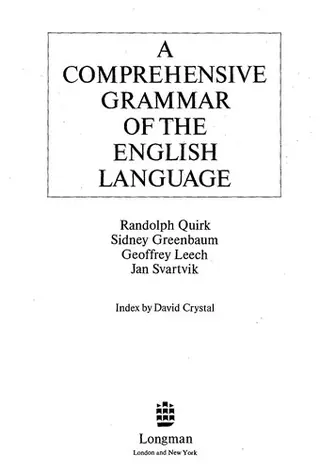
A Comprehensive grammar of the English language
by Randolph Quirk, Sidney Greenbaum, Geoffrey N. Leech, Jan Svartvik · first published 1985
100% neutral
From the time when we started collaborating as a team in the 1960s, we envisaged not a grammar but a series of grammars. In 1972, there appeared the first volume in this series, A Grammar of Contemporary English (GCE). This was followed soon afterwards by two shorter works, A Communicative Grammar of English (CGE) and A University Grammar of English (UGE), published in the United States with the title A Concise Grammar of Contemporary English. With A Comprehensive Grammar of the English Language, we attempt something much more ambitious: a culmination of our joint work, which results in a gram
Affiliate links. As an Amazon Associate I earn from qualifying purchases.
…http://en.wikipedia.org/wiki/Gender_in_English#Modern_Englis.... As third person singular personal pronouns, he and he/she are both acceptable in the dual gender case. If we're going to be strictly PC we should say gender-neutral, but A Comprehensive Grammar of the English Language was written in 1985, so I hope you let it pass. :)
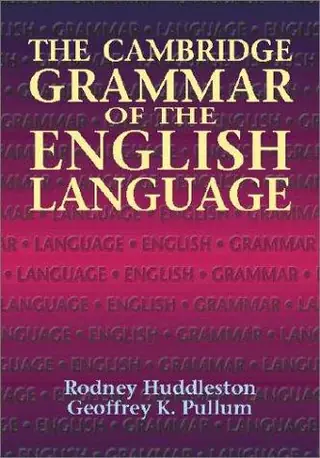
on “What a Programmer Sees When He Watches Inception” ↗…groups. Also, of course, there isn't universal agreement about what is and isn't correct, nor about what the best set of rules is for describing what's correct. For instance, if you compare the famous "Comprehensive Grammar of the English Language" by Quirk and Greenbaum, and the more recent "Cambridge Grammar of the English Language" by Huddleston and Pullum, you'll find that their analyses are sometimes very different. Totally different rules,…
on “Ask HN: What's your speciality, and what's your "FizzBuzz" equivalent?” ↗>CGEL Is probably either Comprehensive Grammar of the English Language from 1985 or The Cambridge Grammar of the English Language from 2002. I have no idea which.
on “Athena spacecraft declared dead after toppling over on moon” ↗