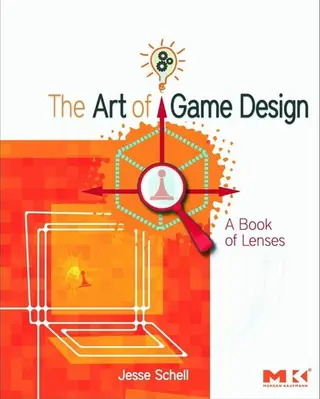
The Art of Game Design
by Jesse Schell · first published 2008
73% recommend27% neutral
Why HN recommends it
Game design primer built around 100+ lenses, questions for viewing a game from different angles such as emotion, economy and the toy. Useful to aspiring designers and to non-game people interested in design.
Summarised by Claude from recommending comments
Presents the fundamentals of game design from one of the world's top game designers. Exploring the unusual territory that is game design, the book demonstrates how the basic principles of psychology used in board games, card games, and athletic games also work in top-quality video games. The author gives readers 100+ sets of insightful questions to ask themselves to make their games better. These questions provide insight from fields as diverse as psychology, architecture, music, visual design, film, software engineering, theme park design, mathematics, puzzle design, and anthropology.
Affiliate links. As an Amazon Associate I earn from qualifying purchases.
Mentions per year
What Hacker News says
Related books
 2013–2026
Game Design Workshop
Tracy Fullerton
Recommended by 6 · mentioned by 86 recommend · 8 mention6 recommend · 86 recommend
 2009–2026
Game feel
Steve Swink
Recommended by 6 · mentioned by 86 recommend · 8 mention6 recommend · 86 recommend
 2021–2022
Game Mechanics
Ernest Adams, Joris Dormans
Recommended by 1 · mentioned by 21 recommend · 2 mention1 recommend · 21 recommend
 2010–2020
Rules of play
Katie Salen, Eric Zimmerman
Recommended by 3 · mentioned by 53 recommend · 5 mention3 recommend · 53 recommend
 2013–2022
Advanced Game Design
Michael Sellers
Recommended by 3 · mentioned by 53 recommend · 5 mention3 recommend · 53 recommend
 2011–2025
Challenges for game designers
Brenda Brathwaite
Recommended by 5 · mentioned by 55 recommend · 5 mention5 recommend · 55 recommend
 2009–2025
Theory of Fun for Game Design
Raph Koster
Recommended by 15 · mentioned by 1915 recommend · 19 mention15 recommend · 1915 recommend
 2013–2026
Designing Games
Tynan Sylvester
Recommended by 15 · mentioned by 1815 recommend · 18 mention15 recommend · 1815 recommend
…read the first time. That's because every few pages I couldn't resist putting it down and working on my designs because I was so overwhelmed with inspiration from its amazing wisdom. The book is the Art of Game Design, and it's one of my most prized books. https://www.amazon.com/Art-Game-Design-Lenses-Second/dp/1466... Another vitally important book about chasing your dream without getting bogged down in complexity…
on “Horrible Things I Found Out When I Made A Video Game” ↗…mistake to generalise too much from the success of a few companies, but if we're not trying to generalise at all, what hope do we have of improvement? I'd like to quote from a really fantastic book, The Art of Game Design by Jesse Schell, a section called "Waiting for Mendeleev": Unfortunately, at present, there is no “unified theory of game design,” no simple formula that shows us how to make good games. So what can…
on “On Business Madness” ↗This reminds me a lot of a chapter in Jesse Schell's awesome book, The Art of Game Design: A Book of Lenses.[1][2] He recommends occasionally thinking about a game as a toy. "The Lens of The Toy: To use this lens, stop thinking about whether your game is fun to play, and start thinking about…
on “Why Toys?” ↗…was worth the price of admission alone. A small segment of that is here: http://amberbaldet.com/uploads/little-harmonic-labrynth.html Another book which I did find truly transformative include "The Art of Game Design" by Jessie Schell. Also Anathem, by Neal Stephenson, is also a very worthwhile mind-broadening scientific read. A New Kind of Science by Wolfram is also quite a bit of fun. But by far my most prized…
on “Ask HN: Experiences with 'Gödel, Escher, Bach' (GEB)?” ↗Might be a bit advanced or too academic, but The Art of Game Design by Jesse Schell is a great resource that really goes into the art and science of designing "fun" experiences.
on “Ask HN: Resources for gameplay design?” ↗For me, I had a few that I really liked: * The Art of Game Design by Jesse Schell. Probably one of the best books I've read, even for people who don't want to make games, it was really good. * Business Model Generation by Osterwalder and Pigneur. One of the better…
on “Ask HN: Best book you read in 2011” ↗Yeah the book is The Art of Game Design: A Book of Lenses by Jesse Schell. It seems likely this principle was inspired by the book, the author recommends it on a different page. It’s a good book which would also be great as a set of prompt…
on “My bag of tricks – loose notes, design patterns, rules-of-thumb” ↗I must say The Art of Game Design by Jesse Schell http://artofgamedesign.com/bio/ If you think this talk http://g4tv.com/videos/44277/DICE-2010-Design-Outside-the-Bo... is good you should really read the book. Great stuff.
on “Ask HN: Best book you read in 2010 and briefly why” ↗Game design wise, the best are: - The Art of Game Design by Jesse Schell: http://amzn.to/zFOiEk It's pretty comprehensive, but I found it a bit "heads in the cloud" and not very hands on. The lenses give you some hands-on approach if you apply them though.…
on “Ask HN: Best book you read in 2011” ↗Jesse Schell's "the art of game design". It will give you a solid understanding of what game design is and how you can do it. Also, it's a very good read, which doesn't hurt when you're trying to learn something. I disagree strongly with…
on “GitHub Game Off” ↗I would put "The Art of Game Design" at the front of the bookshelf of anyone that does game design work: http://www.amazon.com/The-Art-Game-Design-lenses/dp/01236949.... To me, this is the most valuable book I have on my bookshelf. Every…
on “Books For Game Developers” ↗A bit of a classic, I found Jesse Schell's book, The Art of Game Design very helpful. The paradigm he constructs for how all the elements of game design fit together helped me approach game design from angles (or lenses as he calls them) I hadn't considered before.
on “Game Design Tips from Tom Hall (1994)” ↗…I don't think it's comprehensive or constantly referenced by those in the industry (it's almost forgotten about by modern designers, I bet). I think a closer fit to a 'bible of the field' would be The Art of Game Design: A Book of Lenses by Jesse Schell. Lots of good information about what to think about, and you can even buy a deck of tarot-sized cards that has a compiled list of all the questions the book invites you…
on “Ask HN: What book is considered the bible of your field/industry?” ↗…by which the player interacts with the world to achieve those objectives? * What makes the objectives, world and mechanics compelling to the player? Not to start with the development stack… [1] The Art of Game Design, by Jesse Schell
on “How I tried to get into game development and failed” ↗…you about the game loop, gfx, control, sound, ai etc subsystems that needs to work together to deliver an experience for your players. Also do read about game design. I personally liked Jessie Schell's Art of game design book with the 100 lenses that helps younalong the way.
on “Diablo creator David Brevik is back with a new game: It Lurks Below” ↗