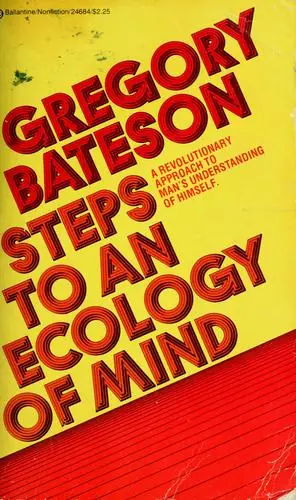
Steps to an ecology of mind
by Gregory Bateson · first published 1972
78% recommend22% neutral
Why HN recommends it
Collection of essays on cybernetics, mind and systems thinking; readers say re-reading it repays effort, and it helps connect ideas like map versus territory and evolution as a self-correcting process.
Summarised by Claude from recommending comments
Collected essays in anthropology, psychiatry, evolution, and epistemology.
Affiliate links. As an Amazon Associate I earn from qualifying purchases.
Mentions per year
What Hacker News says
Related books
 2011–2024
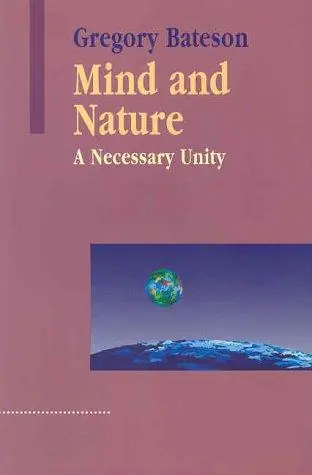
Mind and Nature
Gregory Bateson
Recommended by 6 · mentioned by 76 recommend · 7 mention6 recommend · 76 recommend
 2015–2026
An introduction to cybernetics
William Ross Ashby
Recommended by 7 · mentioned by 137 recommend · 13 mention7 recommend · 137 recommend
 2010–2026
The Human Use of Human Beings
Norbert Wiener
Recommended by 12 · mentioned by 3212 recommend · 32 mention12 recommend · 3212 recommend
 2007–2026
A new kind of science
Stephen Wolfram
Recommended by 44 · mentioned by 31644 recommend · 316 mention44 recommend · 31644 recommend
You might like a couple of books by Gregory Bateson, "Steps to an Ecology of Mind" and "Mind and Nature: A Necessary Unity" He explores the idea that evolution and thought are the same phenomenon, and that what we call "mind" is ambient.
on “Plants communicate, nurture their seedlings, and get stressed” ↗Gregory Bateson has a good piece in one of his books (it might have been "Steps to an Ecology of Mind") where he derives from cybernetic principals the result that Darwinian evolution works better than Lamarckian. The key insight is that we can think of meta-evolution driving the form of the "first-order"…
on “Can Darwinian Evolution Explain Lamarckism?” ↗…"Lamarckian" evolution not because the latter is impossible, but because there is adaptive advantage to the former. Gregory Bateson works this out from cybernetic first principles in one of his books. "Steps to an Ecology of Mind" I think. An evolving system of either kind will evolve to evince mostly Darwinian evolution. Another way to understand this is to consider that you cannot distinguish "Darwinian" vs. "Lamarckian" in…
on “Mathematics Shows How to Ensure Evolution” ↗…occultation of ideas is somewhat common in early cybernetics works. Needless to say, the vision of Wiener will be seen by many who understand it as supremely negative. An alternative is explored in 'Steps to an Ecology of Mind' by Bateson.
on “A Software Engineer’s Guide to Cybernetics” ↗…http://pespmc1.vub.ac.be/ASHBBOOK.html http://pespmc1.vub.ac.be/books/IntroCyb.pdf In re: paradigm shift, I don't really know of a single good source for that, but the works of Gregory Bateson, specifically "Steps to an Ecology of Mind" and "Mind and Nature: A Necessary Unity", were useful to me. https://en.wikipedia.org/wiki/Gregory_Bateson https://en.wikipedia.org/wiki/Steps_to_an_Ecology_of_Mind https://archive.org/details/mindnaturenecess00baterich
on “Programming Paradigms, Turing Completeness and Computational Thinking (2020)” ↗I would recommend reading Steps to an Ecology of mind. I have a great deal of disdain for the bateson name but i found this work very uplifting shortly after a concussion. If you'd like to talk about some of the exercises i undertook to serialize my stream…
on “Ask HN: I am stateless – trouble learning from feedback” ↗Steps to an Ecology of Mind - Gregory Bateson. I found it by reading the Wikipedia's article on map-territory relation, which I came to know by reading a blog post about Cyberpunk on RibbonFarm. I'm having a blast. The book is…
on “Ask HN: What are you reading this weekend?” ↗Science and Sanity - Alfred Korzybski Steps to An Ecology of Mind - Gregory Bateson
on “Ask HN: 2018 Summer Reading List?” ↗Steps to an Ecology of Mind by Gregory Bateson. Almost convinced my wife and me to get dolphin tattoos ; read the book and you will understand. https://en.m.wikipedia.org/wiki/Steps_to_an_Ecology_of_Mind
on “Ask HN: What books changed the way you think about almost everything?” ↗Gregory Bateson, "Steps to an Ecology of Mind" and "Mind and Nature: A Necessary Unity".
on “Paul Stamets on the interrelationship among mushrooms, consciousness, and nature” ↗…presented with e.g. axioms. Then I read Bateson's work, and got this strange feeling of dwelling around the same underlying concepts, but without a clear understanding of his main argument. I've read "Steps to an Ecology of Mind" quite a few times (I still re-read some chapters every once in a while) and always felt that a) I'm reading new material; and b) I'm not getting it all. Yet, I always get something new, and this is an…
on “Alan Kay's reading list” ↗…"now", and it is always "here". What you are seeing "in varying degrees in nature, in computers, and of course in people" is mind I think. Cf. Gregory Bateson, "Mind and Nature: A Necessary Unity" and "Steps to an Ecology of Mind" Lastly, "Godel Escher Bach" is an excellent book and was instrumental in my own process of coming to grips with consciousness. To wit: I think the closest we can come to modelling or describing consciousness…
on “Why Deep Learning surprises me” ↗…the same time in life, so intelligence should be ambient in Nature. (This is what Wolfram has been talking about with his "New Kind of Science" tome, etc. Gregory Bateson also talked about this in "Steps to an Ecology of Mind: Collected Essays in Anthropology, Psychiatry, Evolution, and Epistemology" and "Mind and Nature: A Necessary Unity (Advances in Systems Theory, Complexity, and the Human Sciences)".) Now, combine this…
on “On Having No Head: Cognition Throughout Biological Systems (2016)” ↗…intelligence because it made us. My own dabbling in evolving systems leads me to believe that we should expect intelligence to be ambient. Gregory Bateson basically identifies mind with evolution ("Steps to an Ecology of Mind", etc.) while Stephen Wolfram publishes his tome ("A New Kind of Science") about the ubiquity of computation in natural systems.
on “We Need Insects More Than They Need Us” ↗…to the global ecosystem. We can "fold in" that question with the problem of human subjective experience. Gregory Bateson speculated that evolution and thought are two aspects of the same process. ("Steps to an Ecology of Mind", "Mind and Nature: a Necessary Unity") Michael Levin's lab's work on the self-regulation of living forms points to ambient intelligence. The cellular machinery that neurons use to think is common to…
on “Can an Economy Feel Joy?” ↗