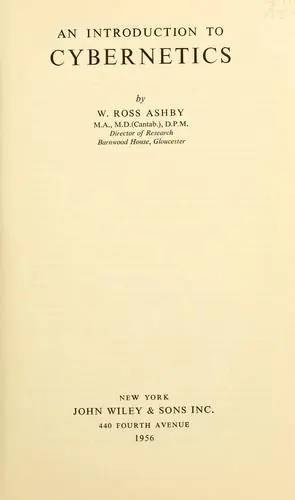
An introduction to cybernetics
by William Ross Ashby · first published 1956
54% recommend46% neutral
Why HN recommends it
Foundational introduction to cybernetics and systems theory, offering a short, accessible starting point. It covers feedback and control ideas and how the field relates to neural networks.
Summarised by Claude from recommending comments
Affiliate links. As an Amazon Associate I earn from qualifying purchases.
Mentions per year
What Hacker News says
Related books
 2018
The Fifth discipline fieldbook
Peter M. Senge
Recommended by 3 · mentioned by 33 recommend · 3 mention3 recommend · 33 recommend
 2014–2018
Systems Practice
Ray Ison
Recommended by 2 · mentioned by 32 recommend · 3 mention2 recommend · 32 recommend
 2018–2022
Systems thinking for social change
David Peter Stroh
Recommended by 3 · mentioned by 43 recommend · 4 mention3 recommend · 43 recommend
 2015–2026
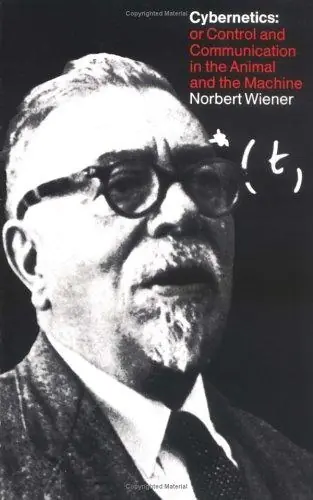
Cybernetics, or control and communication in the animal and the machine
Norbert Wiener, Doug Hill, Sanjoy Mitter
Recommended by 4 · mentioned by 104 recommend · 10 mention4 recommend · 104 recommend
 2015–2024
Design for a brain
William Ross Ashby
Recommended by 2 · mentioned by 52 recommend · 5 mention2 recommend · 52 recommend
 2011–2024
Mind and Nature
Gregory Bateson
Recommended by 6 · mentioned by 76 recommend · 7 mention6 recommend · 76 recommend
Augmenting human intellect
D. C. Engelbart
Recommended by 10 · mentioned by 2110 recommend · 21 mention10 recommend · 2110 recommend
 2008–2026
Brain of the firm
Stafford Beer
Recommended by 9 · mentioned by 129 recommend · 12 mention9 recommend · 129 recommend
"Introduction to Cybernetics" W. Ross Ashby http://pespmc1.vub.ac.be/ASHBBOOK.html > ... still the only real textbook on cybernetics (and, one might add, system theory). It explains the basic principles with concrete examples,…
on “Systems that defy detailed understanding” ↗…differentiation, … He was a student of Talcott Parsons Norbert Wiener, _Cybernetics: Or Control And Communication in the Animal and the Machine_ and _The Human Use of Human Beings: Cybernetics and Society_ _An Introduction to Cybernetics_ by W. Ross Ashby McCullogh and Pitts (You mention Minsky but not these dudes.) _A Logical Calculus of the Ideas Immanent in Nervous Activity_ Basically, most of https://en.wikipedia.org/wiki/Cyberneticist…
on “Alan Kay's reading list” ↗…Dummies" (I don't mean that in a bad way!) I can recommend "Feedback Control for Computer Systems" by Philipp Janert [2], but the real underlying treasure is understanding Cybernetics. For that, try "Introduction to Cybernetics" by W. Ross Ashby [3]. [1] https://en.wikipedia.org/wiki/Control_theory [2] http://shop.oreilly.com/product/0636920028970.do [3] PDF available from http://pespmc1.vub.ac.be/ASHBBOOK.html
on “The Best Textbooks on Every Subject” ↗Have you read "Introduction to Cybernetics" by Ashby? (PDF available here: http://pespmc1.vub.ac.be/ASHBBOOK.html ) Cybernetics might be the "missing link" for what you're talking about.
on “How to Build Good Software” ↗You can get a PDF copy of Ashby's book "Introduction to Cybernetics" from this site: http://pespmc1.vub.ac.be/ASHBBOOK.html I highly recommend it to anyone who's interested in the subject.
on “Cybersyn and Allende’s Semi-Automated Luxury Socialism” ↗I'm really sorry about that. No offense taken. In re: Cybernetics in general I always recommend "Introduction to Cybernetics" by W. Ross Ashby. It's a whole book but I find it to be the most direct and concrete exposition of Cybernetics. http://pespmc1.vub.ac.be/ASHBBOOK.html http://pespmc1.vub.ac.be/books/IntroCyb.pdf In…
on “Programming Paradigms, Turing Completeness and Computational Thinking (2020)” ↗…ifdef and macros aren't at stake Like I said, without metrics we're just trading subjective anecdotes. Metrics for complexity of machines is a subject I find fascinating, ever since I read Ashby's "Introduction to Cybernetics" wherein he asks the question "How can we measure the complexity of a machine?" in the context of a formal system for describing machines (Cybernetics.) There is also the concept of "Kolmogorov complexity" https://en.wikipedia.org/wiki/Kolmogorov_complexity…
on “The biggest threat to Rust's sustainability” ↗…etc). It was by far the most influential school of thought in the 20th century. It was a revolution at the time but nonetheless died out before its time. A good place to start would be W Ross Ashby's "An Introduction to Cybernetics", or Donella Meadows' "Thinking in Systems" for the systems theory side. FWIW, Stephen Hawking claimed the 21st century would be defined by complexity theory. I'm disappointed to say that's not yet been…
on “A man who tried to redeem the world with logic (2015)” ↗…want to investigate this IMO you're going to have to look at everything from near-field EM to Ramana Maharshi (who often taught in silence), you should study Cybernetics (by which I basically mean read "Introduction to Cybernetics" by Ashby), you should take high-speed video of people doing this and then analyze it for e.g. unconscious synchronization, etc...
on “Body Doubling” ↗…when talking about thought: They do not define the term. What is thought? (As an aside the only place I've seen that can begin to claim to have a concrete mathematical theory of intelligence amplification is "Introduction to Cybernetics" by Ashby.) Anyhow, the folks who have the goods on the structure of subjective experience work under the rubric of "Neurolinguistic Programming" (the other NLP). Unfortunately the school of thought…
on “How can we develop transformative tools for thought?” ↗…Information Retrieval - http://nlp.stanford.edu/IR-book/html/htmledition/irbook.html Information Theory, Inference, and Learning Algorithms - David MacKay. http://www.inference.phy.cam.ac.uk/itprnn/book.html Introduction to Cybernetics - William Ross Ashby. http://pespmc1.vub.ac.be/books/IntroCyb.pdf "Man-Computer Symbiosis" and "The Computer As A Communication Device" - J.C.R. Licklider. http://memex.org/licklider.pdf Design For…
on “Ask HN: What are your recommended reads that are available for free?” ↗…computer plus a proper algorithm will suffice. If you want to design a system that interacts with its environment and can achieve goals while maintaining homoeostasis, the name for that is Cybernetics. "Introduction to Cybernetics" by Ashby has been made freely available in PDF form by his estate. A great and noble service for which I commend them. http://pespmc1.vub.ac.be/ASHBBOOK.html
on “Software Update Destroys $286M Japanese Satellite” ↗If you are interested in systems theory, I would recommend Ross Ashby's Introduction to Cybernetics. It's a short book and free to download: https://archive.org/details/introductiontocy00ashb Much of the pioneering work in systems theory was done in the 1930-40's by different (but related) groups of…
on “Ask HN: Any recommended resources to develop system thinking?” ↗"Permaculture Designer's Manual" by Bill Mollison and "Introduction to Cybernetics" by Ashby Incorporate ecological and cybernetic principles in your designs.
on “Ask HN: Resources for engineers new to system design” ↗One of the main results of Cybernetics. You can get a PDF of Ashby's book "Introduction to Cybernetics" from here, as well as a lot of other information: http://pespmc1.vub.ac.be/ASHBBOOK.html\ (edit: Ha! I just realized it's the same Principia Cybernetica Web!)
on “Every good regulator of a system must be a model of that system (1970) [pdf]” ↗