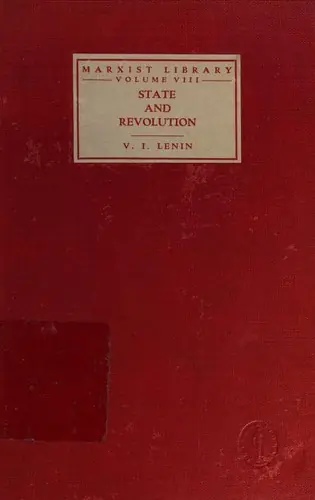
State and Revolution
by Vladimir Il’ich Lenin · first published 1900
41% recommend53% neutral6% critical
Why HN recommends it
A short, approachable summary of Marx's critique of the state. It serves as a starting point for Marxist theory and is easy to read, with insight into how Lenin framed the state and revolution.
Summarised by Claude from recommending comments
Lenin wrote ‘State and Revolution’ in 1917, while he was hiding from the Russian secret police. The book describes the inherent nature of the State as a tool for class oppression, a creation born of one social class’s desire to control all other social classes. Drawing on detailed quotes from Karl Marx and Friedrick Engels, Lenin lays down a Marxist view of the state, describes how a working-class revolution will overthrow it, and goes further in showing how social democracy is not enough—even in democratic republics such as those enjoyed by many western countries today, the ruling class is st
Affiliate links. As an Amazon Associate I earn from qualifying purchases.
Mentions per year
What Hacker News says
Related books
Reform or Revolution
Rosa Luxemburg
Recommended by 2 · mentioned by 22 recommend · 2 mention2 recommend · 22 recommend
Capital
Karl Marx, Paul Reitter, Paul North, Wendy Brown
Recommended by 31 · mentioned by 9631 recommend · 96 mention31 recommend · 9631 recommend
 2013–2026
The Tyranny of Structurelessness
Jo Freeman
Recommended by 43 · mentioned by 6943 recommend · 69 mention43 recommend · 6943 recommend
 2007–2026
Das Kapital
Karl Marx
Recommended by 40 · mentioned by 19140 recommend · 191 mention40 recommend · 19140 recommend
 2010–2026
Red Plenty
Francis Spufford
Recommended by 71 · mentioned by 9271 recommend · 92 mention71 recommend · 9271 recommend
Communist Manifesto
Karl Marx, Friedrich Engels
Recommended by 31 · mentioned by 20631 recommend · 206 mention31 recommend · 20631 recommend
 2007–2026
The Wealth of Nations
Adam Smith
Recommended by 92 · mentioned by 40592 recommend · 405 mention92 recommend · 40592 recommend
…pitiful state of the Left. You want actual evidence of what actual major socialist thinkers thought of the state during the time when socialism was most relevant, read Marx's 18th Brumaire or read Lenin's State and Revolution and come to your own conclusions.
on “Capitalism Made This Mess, and This Mess Will Ruin Capitalism” ↗…Ricardo, that'll make it much easier, too. For bonus points, read the short "Wages, price, and profit" by Marx, it's a bit easier of an intro than the book's. If you can fit in a second, I'd suggest "the State and Revolution" by Lenin. Marx identifies a problem and a crude solution, and Lenin provides a good solution. Those two will give you the most of it. Wikipedia, especially on the historical/dialectical materialism…
on “We Need a Basic Income Guarantee” ↗…others have said, "The Communist Manifesto" is the easiest entry point. My copy also has "The Eighteenth Brumaire of Louis Bonaparte" which some say is the work most descriptive of the US today. "The State and Revolution" by Lenin is a relatively easy and enlightening read as he talks about the nature of the capitalist state, the police, and other topics. "Reform or Revolution" by Rosa Luxemburg is also clarifying as…
on “Amazon deletes job listings for analysts to track ‘labor organizing threats’” ↗…antagonisms no longer exist, so I don't think there's much basis for the idea he believed in "command and control" other than at most in a transition. Ironically given his authoritarianism, Lenins The State and Revolution is one of the best summaries of Marx' criticism of the state, and even Lenin plaid lip-service to the notion of the withering away of the state to the point of arguing for an eventual society without…
on “Economists are revising their views on robots and jobs” ↗That's not even in Leninism, no. Read Lenin's "State & Revolution" and you will definitely come away with a different impression -- he speaks openly about the abolition of the authoritarian state and a radical democracy... just not a parliamentary one. Though clearly what happened in the USSR in the 20s was something different from what he wrote. What you saw in Russia in that period was a respon
on “Jack Ma steps out from the shadows with morale-boosting post” ↗The State and Revolution - Lenin
on “Ask HN: What are your favorite books or essays written at least 100 years ago?” ↗Try reading "The State and Revolution". It explains why democracy and capitalism are antagonistic forces. A 2014 landmark study showed that a basic assumption of the book, that the rich basically determine policy in a liberal democracy,…
State and Revolution is where I'd recommend people start for ML ;)
on “Experts recommend Machine Learning books” ↗…constrained in the wake of the USSR where Lenin advocated the idea of a vanguard party and due to their initial success, other communists modeled their revolutions on them. The idea Lenin expressed in "State and Revolution" was the idea of the wilting of the state into nothing as it becomes useless without class antagonisms to subdue. If you follow Marx, the only universal, the step that both China and the USSR skipped…
on “Young Chinese are sick of working long hours” ↗On the topic of Lenin, one can read The state and revolution where he defends the need of a strong state in a communist regime, and this quote: "the people don't want freedom, they want power. Freedom ? What would they do with it ?!"
on “No Kings: How Do You Make Good Decisions Efficiently in a Flat Organization?” ↗The selling of labor applies more to the greater bourgeois revolution (or humanity in general aspiring to it) than capitalism specifically (which is what the bourgeois revolution evolved to). This is why "people selling their labor" appears true for Adam Smith prior the state (and capitalism in general, in spite of what so many people think about Smith's time) being really formed; for Marx and En
on “Capitalism Made This Mess, and This Mess Will Ruin Capitalism” ↗…that what we normally mean by "own" is more or less the opposite of what it means in common ownership. This StackOverflow answer has more detail: > Communists who agree with what Lenin wrote in "The State and Revolution" and what Marx and Engels wrote, believe that the state will "wither away" when what Lenin calls "class antagonisms" vanish. The state emerged as a tool for class control, and they believe it will fade…
…of the socialist struggle, again a classless society where everyone works according to their capacity and receives according to their needs (see 'The Critique of the Gotha Program' by Marx, or Lenin's 'State and Revolution' where the distinction between the revolutionary transitional stage and the classless, stateless end-goal of Communism is clearly made. Yes, Lenin thought a society without any State at all was desirable).…
on “The freedom to drink coffee” ↗I had just reread "State and Revolution" a few months ago and do not remember this quote. Do you mind linking to me where you found it?
on “No Kings: How Do You Make Good Decisions Efficiently in a Flat Organization?” ↗My list: * Quantum theory * String theory * Lenin's works except The State and Revolution * Muqaddimah of Ibn Khaldun (by Ibn Khaldun) * Vienna Circle's works especially Language, Truth, and Logic (many skip this one)
on “Ask HN: What bits of fundamental knowledge are productivity multipliers?” ↗