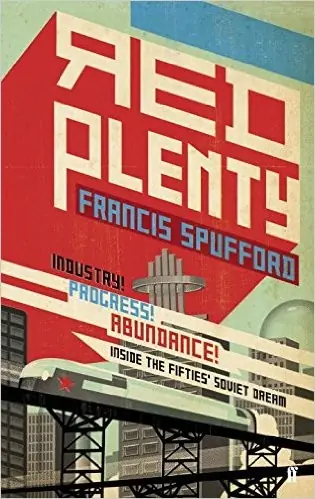
Red Plenty
by Francis Spufford · first published 2010
77% recommend22% neutral1% critical
Why HN recommends it
A lightly fictionalized, well-researched account of Khrushchev-era Soviet planning, when cyberneticians and mathematicians tried to optimize the economy with linear programming. For readers curious about economics.
Summarised by Claude from recommending comments
The Soviet Union was built on 20th-century magic called 'the planned economy', which was going to gush forth an abundance of good things that capitalism could never match. And just for a little while, in the late 1950s, the magic seemed to be working. This book is about that moment in history, and how it came, and how it went away.
Affiliate links. As an Amazon Associate I earn from qualifying purchases.
Mentions per year
What Hacker News says
Related books
 2014–2023
Towards a new socialism
W. Paul Cockshott
Recommended by 8 · mentioned by 158 recommend · 15 mention8 recommend · 158 recommend
 2012–2026
Cybernetic revolutionaries
Eden Medina
Recommended by 8 · mentioned by 138 recommend · 13 mention8 recommend · 138 recommend
 2019–2026
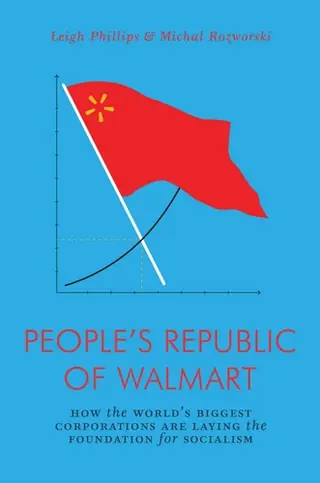
The People's Republic of Walmart
Leigh Phillips
Recommended by 12 · mentioned by 2312 recommend · 23 mention12 recommend · 2312 recommend
The use of knowledge in society
Friedrich A. von Hayek
Recommended by 16 · mentioned by 3116 recommend · 31 mention16 recommend · 3116 recommend
 2014–2023
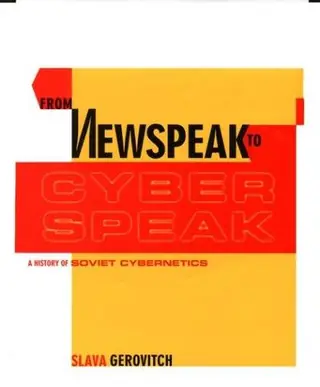
From Newspeak to Cyberspeak
Slava Gerovitch
Recommended by 3 · mentioned by 33 recommend · 3 mention3 recommend · 33 recommend
 2016–2026
How not to network a nation
Benjamin Peters
Recommended by 2 · mentioned by 62 recommend · 6 mention2 recommend · 62 recommend
 2012–2025
A Prayer for Owen Meany
John Irving
Recommended by 9 · mentioned by 119 recommend · 11 mention9 recommend · 119 recommend
 2010–2025
Backroom boys
Francis Spufford
Recommended by 7 · mentioned by 87 recommend · 8 mention7 recommend · 87 recommend
…consumer end market. Summarising a complex history, the USSR did have folks who argued for a cybernetic approach to production planning, but it was never tried. An entertaining semi-fictionalised account is Red Plenty. A drastically less entertaining but more scholarly read is Newspeak to Cyberspeak.
on “What Would the Father of Cybernetics Think About A.I. Today?” ↗Red Plenty is a fantastic and unusual book, I highly recommend it to everybody with even a cursory interest in mathematics, economics, logistics, information technology, politics, or history.
on “How communist Bulgaria became a leader in technology, robotics and sci-fi (2018)” ↗I'm interested in this. So far, the best resources I found are: - "Red Plenty" by Francis Spufford, a mix of fiction and non-fiction about planning experience in the USSR. It includes a rich bibliography and references to papers published over the past 70 years around this issue.…
on “Markets are efficient if and only if P = NP (2010)” ↗Francis Spufford is a brilliant English author who should be more widely known. For the HN crowd I would heartily recommend "Red Plenty" (2010). It's a semi-fictional novel about that brief moment in time around 1959 when the Soviets really thought that the dream of Communism was within reach. The characters (most of them real people)…
on “Ask HN: What are some great books that are relatively unknown in the US?” ↗…they failed because of systematic falsehoods being injected into the system by managers -- who were afraid to tell the truth (in the wake of Stalin's terror). This is covered by Francis Spufford's book, "Red Plenty". Review here: http://www.guardian.co.uk/books/2010/aug/08/red-plenty-franc...
on “The 2 Simple Reasons the Soviet Union Was Doomed to Fail” ↗…things the USSR did was reintroduce a form of serfdom -- workers were bonded to their enterprise and couldn't move without permission. A good pop-econ/narrative read on the history of Soviet economics is Red Plenty by Francis Spufford.
on “Google's Biggest Threat Is Google” ↗For a very good extended historical view on how this kind of mess-up kept on happening in communism, also see the book Red Plenty. ( http://www.amazon.co.uk/Red-Plenty-Francis-Spufford/dp/05712... )
on “The Well Intentioned Commissar” ↗There's a great novel, _Red Plenty_, by Francis Spufford, that touches on Soviet computing in the 50s and 60s as part of a broader exploration of Soviet economic planning. I wish more people would read it. It's a weird hybrid of reportage…
on “The Tangled History of Soviet Computer Science” ↗…basic mechanisms of social organization. If you want to get a feel for what the other side of things was like in Hayek's era, I recommend a curious book written a few years ago by Francis Spufford called Red Plenty [1], which illustrates (partly in fact, partly in fiction) the immense ambition of economists at Gosplan, and the even bigger task they faced, as they tried to modernize the Soviet economy of the 1950s…
on “Why China’s Economy Will Be Hard to Fix” ↗In case you don't know it already, I heartily recommend "Red Plenty" by Francis Spufford. It has also a dedicated website (http://www.redplenty.com/Red_Plenty/Front_page.html) so you can get an idea if this may be interesting for you.
on “How Not to Network a Nation: The Uneasy History of the Soviet Internet” ↗…should take note. Otherwise - despite the appalling human cost of projects such as the White Sea Canal and farm collectivisation - the USSR did indeed become a global power if only for a short period. Red Plenty [1] is an excellent book on the subject. [1] https://www.amazon.co.uk/Red-Plenty-Francis-Spufford/dp/0571...
on “The management myth (2006)” ↗Red Plenty by Francis Spufford is an extremely interesting — and entertaining — book that paints a broad picture of that short moment in Soviet history where the horrors of revolution, Stalin and war were behind…
on “Losing Faith in the State, Some Mexican Towns Quietly Break Away” ↗Francis Spufford's Red Plenty might fit here. It's historical fiction, set in the 1950s and 1960s USSR, and describes an attempt to build an efficient planned economy with linear programming. It's a bit like Little House on the Prairie,…
on “Six works of Computer Science-Fiction (2015)” ↗…than I’ve been alive. Capitalism approximates an efficient solution. There’s a large economics and computer science literature on this if you’re interested, or for a fictional treatment you could read Red Plenty, Francis Spufford, which is an historical novel covering the theory in the historical background it was developed in[1]. https://en.wikipedia.org/wiki/Socialist_calculation_debate > The socialist calculation…
on “Ask HN: What has your work taught you that other people don't realize?” ↗There is a fascinating alternate-history book about this: https://www.amazon.com/Red-Plenty-Francis-Spufford/dp/155597...
on “Photos from inside a Typhoon class submarine” ↗