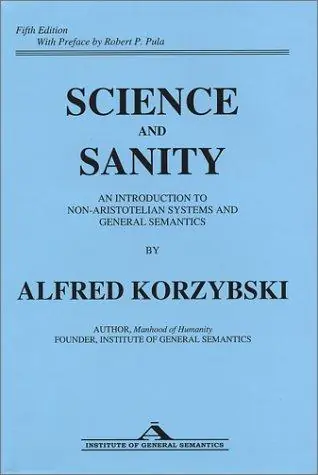
Science and sanity
by Alfred Korzybski · first published 1933
33% recommend59% neutral7% critical
Why HN recommends it
Dense, sweeping treatment of how language and abstraction shape thought, including the idea that the map is not the territory; readers say it opened their eyes to concerns about language and cognition.
Common criticism: Commenters say its broad, sweeping analysis leaves plenty to disagree with.
Summarised by Claude from recommending comments
Affiliate links. As an Amazon Associate I earn from qualifying purchases.
Mentions per year
What Hacker News says
Related books
 2017–2022
The Disappearance of the Universe
Gary Renard
Recommended by 2 · mentioned by 22 recommend · 2 mention2 recommend · 22 recommend
 2015–2026
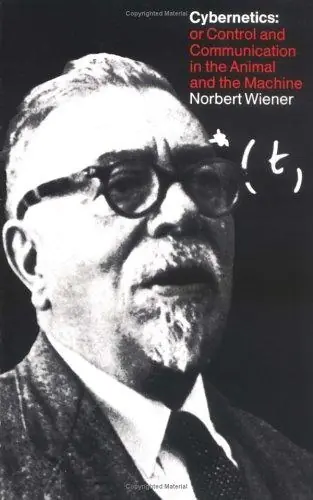
Cybernetics, or control and communication in the animal and the machine
Norbert Wiener, Doug Hill, Sanjoy Mitter
Recommended by 4 · mentioned by 104 recommend · 10 mention4 recommend · 104 recommend
 2011–2024
Mind and Nature
Gregory Bateson
Recommended by 6 · mentioned by 76 recommend · 7 mention6 recommend · 76 recommend
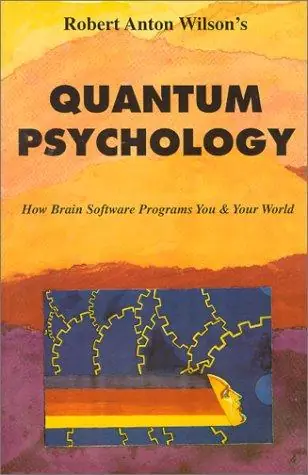 2008–2026
Quantum psychology
Robert Anton Wilson
Recommended by 16 · mentioned by 1816 recommend · 18 mention16 recommend · 1816 recommend
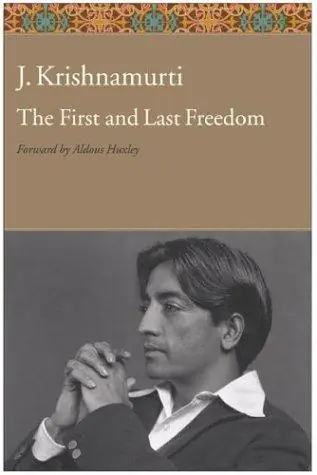 2013–2025
The first and last freedom
Jiddu Krishnamurti
Recommended by 3 · mentioned by 43 recommend · 4 mention3 recommend · 43 recommend
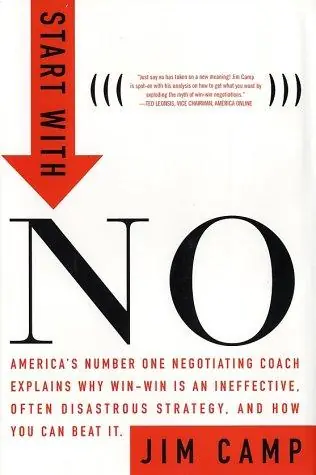 2009–2021
Start with no
Jim Camp
Recommended by 9 · mentioned by 139 recommend · 13 mention9 recommend · 139 recommend
 2012–2022
Free will
Sam Harris
Recommended by 15 · mentioned by 2015 recommend · 20 mention15 recommend · 2015 recommend
 2010–2026
Technics and civilization
Lewis Mumford
Recommended by 12 · mentioned by 2012 recommend · 20 mention12 recommend · 2012 recommend
Hmm. Not to repeat, I think I must dig deep into the archives... Korzybski, Alfred. Science and Sanity. Institute of GS, 1958. [1] The Institute of General Semantics has a current website [2], is on Facebook, and has several articles on Wikipedia.org [3]. One of the mind-bending premises (Wikipedia.org):…
on “Ask HN: What books have made the biggest impact on your mental models?” ↗"Science and Sanity" — Alfred Korzybski (1933) http://pialogue.info/books/Science-and-Sanity-Korzybski.pdf "The Presentation of Self in Everyday Life" — Erving Goffman (1956) https://monoskop.org/images/1/19/Goffman_Erving_The_Presenta...
on “Ask HN: Older textbooks/papers you consider classics still worth studying today?” ↗…courses also included readings from Alfred Korzybski and the General Semanticists, who played a large role in formulating the concept and practice of e-prime. Korzybski wrote a fascinating book called Science and Sanity: An Introduction to Non-Aristotelian Systems and General Semantics. In this work, Korzybski postulates that the multi-millennium-old Aristotelian system of thinking contributes a form of "essentialism"…
on “English-Prime - English without "is"” ↗…eloquent, but I'll have to read the article as well to make sure I understand correctly. What strikes me is that Alfred Korzybski spoke about those same issues (and much more) in his 1933 book called "Science and Sanity" (well worth a read, although bare in mind it took me several years to finish it). So when Chomsky wrote his stuff, Korzybski had already addressed this very comprehensively. Does Chomski at any point…
on “Aaron Swartz: The Book That Changed My Life” ↗One book not already mentioned is Alfred Korzybski's Science and Sanity. It makes fairly broad and sweeping analysis, so there is plenty to disagree with. That said, this book opened my eyes to important concerns about language and cognition that, only in retrospect, seem…
on “Ask HN: What books changed the way you think about almost everything?” ↗"Science and Sanity" by Alfred Korzybski was a good one for me. It's where we get the phrase 'the map is not the territory.' It's been a decade since I read it so I really need to pick it up again. It's a very insightful…
on “Ask HN: What books changed the way you think about almost everything?” ↗…mostly undervalued thinkers in my opinion..." before even clicking the link. Oddly enough, I find Korzybski's name mentioned right there, at the beginning. Bateson's "Mind and Nature" and Korzybski's "Science and Sanity" make a good, eye opening read.
on “Bateson and Me – Part 1 (2004)” ↗…“Novum Organum Scientia” Daniel Kanneman, “Thinking: Fast and Slow” Robert Meyer, Howard Kunreuthner, “The Ostrich Paradox” https://en.wikipedia.org/wiki/List_of_cognitive_biases Alfred Korzybski, “Science and Sanity” YouTube: “How To Catch A Baboon” https://www.youtube.com/watch?v=ctol7JwpcuQ Exemplary Practices and Perspectives: Amory Lovins, “Reinventing Fire” E.F. Schumaker, “Small Is Beautiful” Christopher…
on “Ask HN: How to start developing critical thinking?” ↗…you're asking. I do agree with you, this is generalizable across the board: file under the old saw "Perfect is the enemy of good." edit #2. Also applicable, from Alfred Korzybski's classic 1933 book "Science and Sanity": "When in doubt, read on." I've always generalized this statement (which I first encountered around 1968 while an undergraduate at UCLA when reading his book not for a class but because I had gone down…
on “The curse of knowing how, or; fixing everything” ↗…decade or so before Borges wrote the story in question. Understanding the themes of Borges story is greatly informed by a passing familiarity with Korzybski's work. WorldCat tells me the 4th edition of "Science and Sanity" is widely held by libraries, and if you're interested in the assertions made in this article, you might enjoy reading (at least parts of) it. https://search.worldcat.org/title/369632 The author completely…
on “AI Risks "Hypernormal" Science” ↗…inwardly, which silence we may indicate by closing our lips with the other hand. The verbal denial of the ‘is’ of identity covers this point also when shown on the Differential." (p500. Korzybski, Alfred. Science and sanity : an introduction to non-Aristotelian systems and general semantics. Lakeville, Conn. : International Non-Aristotelian Library Pub. Co. ; Institute of General Semantics. 1950) [1] Gang signs There's…
on “Hand gestures that last longer than spoken languages” ↗…identity with these things? Typically people regard things that they claim are part of their identity as more fixed than other things. Alternatively, he could be following the advice of Korzybski, in Science and Sanity en.wikipedia.org/wiki/Alfred_Korzybski
on “You aren't getting any better” ↗…happens to read the list you gave and also reads here, the following are not considered primary philosophical works: The Passion of the Western Mind by RICHARD TARNAS Ascent of Man by JACOB BRONOWSKI Science and Sanity by COUNT KORZYBSKI Science is not Enough by VANNEVAR BUSH What I Believe by MARK BOOTH (Ed) Zen Mind, Beginners' Mind by SHUNRYU SUZUKI Also. While Plato's Republic is a master-work his Symposium…
on “Alan Kay's reading list” ↗>General Semantics isn't bullshit like NLP is Uh.. did you read Science and Sanity?![2] It's absolutely BS. Korzybski thought "is" should be eliminated. When you say "The car is red", there are many things the car 'is' besides red, so this is a lie. (No, really!) Thus a language without…
on “How Swedes were fooled by the book “Surrounded by Idiots”” ↗A map is not the territory it represents, but, if correct, it has a similar structure to the territory, which accounts for its usefulness. — Alfred Korzybski, Science and Sanity (1933, p. 58)
on “Fuck Nuance [pdf]” ↗