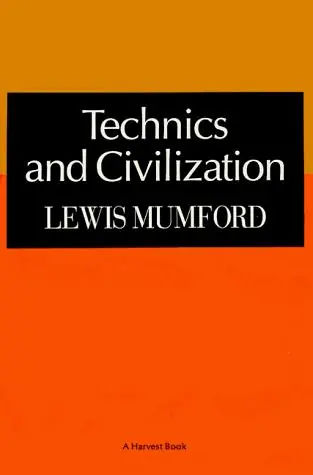
Technics and civilization
by Lewis Mumford · first published 1934
60% recommend40% neutral
Why HN recommends it
Historical, philosophical account of technology and society from an anthropological angle. Argues worldviews shape technologies, counterpointing McLuhan; the clock chapter stands out. Suits readers of tech history.
Summarised by Claude from recommending comments
'Technics and Civilization' first presented its compelling history of the machine and critical study of its effects on civilization in 1934 -- before television, the personal computer, and the Internet. Drawing upon art, science, philosophy, and the history of culture, Lewis Mumford explained the origin of the machine age and traced its social results, asserting that the development of modern technology had its roots in the Middle Ages rather than the Industrial Revolution. Mumford sagely argued that it was the moral, economic, and political choices we made, not the machines that we used, that
Affiliate links. As an Amazon Associate I earn from qualifying purchases.
Mentions per year
What Hacker News says
Related books
 2018–2025
The myth of the machine
Lewis Mumford
Recommended by 5 · mentioned by 65 recommend · 6 mention5 recommend · 65 recommend
 2016–2026
The nature of technology
W. Brian Arthur
Recommended by 4 · mentioned by 44 recommend · 4 mention4 recommend · 44 recommend
 2020–2024
Medical Nemesis
Ivan Illich
Recommended by 3 · mentioned by 73 recommend · 7 mention3 recommend · 73 recommend
 2010–2026
Tools for Conviviality
Ivan Illich
Recommended by 13 · mentioned by 3213 recommend · 32 mention13 recommend · 3213 recommend
 2020–2024
How Innovation Works
Matt Ridley
Recommended by 11 · mentioned by 1411 recommend · 14 mention11 recommend · 1411 recommend
 2010–2025
The social construction of reality
Peter L. Berger, Thomas Luckmann, David Colacci, Berger, Peter L., Luckmann, Thomas A.
Recommended by 5 · mentioned by 75 recommend · 7 mention5 recommend · 75 recommend
 2010–2025
On the Genealogy of Morality
Friedrich Nietzsche, Horace B Samuel
Recommended by 10 · mentioned by 1910 recommend · 19 mention10 recommend · 1910 recommend
 2010–2026
Operating manual for spaceship earth
R. Buckminster Fuller
Recommended by 15 · mentioned by 1815 recommend · 18 mention15 recommend · 1815 recommend
…think it was around when I made the list but I hadn't read it yet. I think it might be too long for the intended purpose (maybe a little too academic?). On the other hand Mumford also wrote a trilogy "Technics and Civilization" that I did hope they would read ... And certainly the McLuhan books are more cryptic for most readers. On the other hand ...
on “Alan Kay's reading list” ↗Also worth reading: Lewis Mumford’s Technics and Civilization, 1934. http://en.wikipedia.org/wiki/Technics_and_Civilization
on “Tablets” ↗…For a more culture theory approach, try Neil Postman's "Technopoly" (1992) http://www.worldcat.org/oclc/24694343]. If you're into old-school tech determinism and political economy, both Lewis Mumford's "Technics and Civilization" (1934)[http://www.worldcat.org/oclc/560667] and Harold Innis' "Communication and Empire" (1972) [http://www.worldcat.org/oclc/281110] are more intelligible than Marshall McLuhan's work.
on “Skills Don’t Pay the Bills” ↗…Hiltzik - on Xerox PARC and its highly inventive cast of characters “Man’s Search for Meaning” by Viktor Frankl - on choosing your own attitude “Dreamland” by Sam Quinones - on America’s opioid epidemic “Technics and Civilization” by Lewis Mumford - on technological progress (and machines) from the perspective of someone in the 1930s “The Color of Law” by Richard Rothstein - on the myth of de facto segregation (vs de jure segregation)
on “Ask HN: 2018 Summer Reading List?” ↗Lewis Mumford's Technics and Civilization - Part 1 https://youtu.be/vxkg_klE5Xw
on “Ask HN: What is the best podcast you listened to in 2022?” ↗Lewis Mumford wrote some very interesting books about technology and society: https://en.wikipedia.org/wiki/Technics_and_Civilization https://en.wikipedia.org/wiki/The_Myth_of_the_Machine
on “Ask HN: Good Books on the History of Technology?” ↗…Other classics in this category: Tools for Conviviality Ivan Illich (1973) The Technological Society Jacques Ellul (1954, English translation 1964) The Human Use of Human Beings Norbert Wiener (1950) Technics and Civilization Lewis Mumford (1934) I admit I have only read brief excerpts from these -- but they have all been influential. [edit: I see I overlooked the 'still in print' restriction. BUT if you want 'the greatest…
on “The greatest tech books of all time” ↗It's more philosophical but Mumford's Technics and Civilization is really good, you should at least read the part about the invention of the clock that serves as the prototype for the relation between man and important technology. I'm also writing a book on philosophy…
on “Ask HN: Good Books on the History of Technology?” ↗Lewis Mumford's Books; - Technics & Civilization - The Culture of Cities - The Story of Utopias Lewis Mumford talks about technology, but from an anthropological pint of view. Another book I would recommend is The Nature of Technology by Brian Arthur The other I would recommend is James Burk's Connections he's has some books but I but the documentary is highly recommended.
on “Ask HN: Good books on philosophy of engineering?” ↗…difficult to read, but yielding enormous positive transformation, then for me Aldous Huxley's "Heaven and Hell" (which contains "Doors of Perceptions"), Erich Fromm's "To Have or to Be", Lewis Mumford's "Technics and Civilization" and his "The Myth of the Machine". YMMV, but for me all of these were "radical" in challenging my purely rational, instrumental, and I think very limited ideas of knowledge, technology and "progress"…
on “What's the most radical book you've read?” ↗And as a follow-up, Lewis Mumford, Technics and Civilization. Where McLuhan argues technologies shape worldviews, Mumford argues worldviews also shape technologies. And then perhaps into the world of science and technology studies (STS), where these questions…
on “Kill your Feeds – Stop letting algorithms dictate what you think” ↗Technics and Civilization by Lewis Mumford and Critical Path by R Buckminster Fuller
on “Ask HN: Favourite science history book of the 20th century?” ↗I recommend Mumford's Technics and Civilization.
on “AWS and Blockchain” ↗These are good questions. Here are some reading sources to help with your exploration of the subject: https://en.m.wikipedia.org/wiki/The_Myth_of_the_Machine https://en.m.wikipedia.org/wiki/Technics_and_Civilization https://en.wikipedia.org/wiki/Max_Weber https://en.wikipedia.org/wiki/Bureaucracy https://en.wikipedia.org/wiki/Systemantics https://en.wikipedia.org/wiki/The_Question_Concerning_Techno... https://geezmagazine.org/blogs/entry/jacques-elluls-76-reaso...
on “Eliminating Toil” ↗This is similar to what Lewis Mumford has said in Technics and Civilization. Basically, more abundance means everything gets cheaper. Unfortunately the wealth created is locked up within a few classes and barely trickles down. Like the farmer who only produces cash crops and…
on “Rethinking Work” ↗