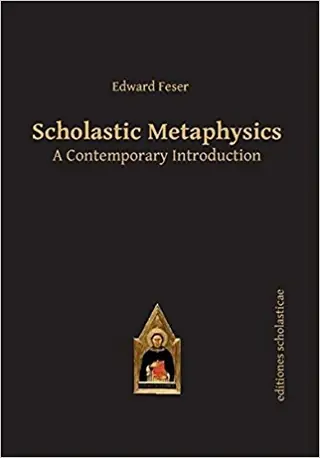
Scholastic Metaphysics
by Edward Feser · first published 2014
100% recommend
Scholastic Metaphysics: A Contemporary Introduction provides an overview of Scholastic approaches to causation, substance, essence, modality, identity, persistence, teleology, and other issues in fundamental metaphysics. The book interacts heavily with the literature on these issues in contemporary analytic metaphysics, so as to facilitate the analytic reader's understanding of Scholastic ideas and the Scholastic reader's understanding of contemporary analytic philosophy. The Aristotelian theory of actuality and potentiality provides the organizing theme, and the crucial dependence of Scholast
Affiliate links. As an Amazon Associate I earn from qualifying purchases.
Mentions per year
What Hacker News says
Related books
 2010–2025
The Philosopher's Toolkit
Julian Baggini, Peter S. Fosl
Recommended by 8 · mentioned by 88 recommend · 8 mention8 recommend · 88 recommend
Aquinas
Edward Feser
Recommended by 4 · mentioned by 74 recommend · 7 mention4 recommend · 74 recommend
 2010–2026
Philosophical investigations
Ludwig Wittgenstein
Recommended by 42 · mentioned by 11442 recommend · 114 mention42 recommend · 11442 recommend
 2007–2026
Siddhartha
Hermann Hesse
Recommended by 138 · mentioned by 186138 recommend · 186 mention138 recommend · 186138 recommend
 2012–2026
Antifragile
Nassim Nicholas Taleb, Genís Sánchez Barberán, Albino Santos Mosquera
Recommended by 135 · mentioned by 281135 recommend · 281 mention135 recommend · 281135 recommend
 2007–2026
The Black Swan
Nassim Nicholas Taleb, David Chandler
Recommended by 263 · mentioned by 666263 recommend · 666 mention263 recommend · 666263 recommend
…I think it is best to start with a commentary or something more pedagogically suitable. Contemporary expositors like Edward Feser or David Oderberg write lucidly and approachably on the subject (see “Scholastic Metaphysics” and “Real Essentialism”). That never said, it takes time to understand this stuff, especially when all sorts of bad intellectual habits must be broken.
on “Hylomorphism” ↗…some philosophers are known for. On the introductory side, "Aquinas" [0] is probably a good starting point. A follow up, or if you can handle something a bit more substantive to begin with, would be his "Scholastic Metaphysics" [1]. I emphasize metaphysics first because the most basic philosophical questions are metaphysical; everything else benefits greatly from a clear understanding of metaphysical issues. Avoid any philosophical…
on “Ask HN: Learning about philosophy” ↗…paradox of the sort skepticism generally faces (“there is no truth!” type of stuff). I recommend some of Edward Feser’s books on the subject. “The Last Superstition” is a light read in that respect, but “Scholastic Metaphysics” is more of a proper manual.
on “Hylomorphism” ↗…clarify these points. I also recommend Feser's books on related subjects which are known for their lucid prose and clear explanations. Good places to start are "Aquinas: A Beginner's Guide" and then "Scholastic Metaphysics: A Contemporary Introduction". Aquinas was decidedly Aristotelian and the scholastic philosophers broadly speaking were heavily influenced by Aristotle.
on “A Mathematical Theory of Communication (1948) [pdf]” ↗Scholastic Metaphysics: A Contemporary Introduction by Edward Fesser I stumbled across this completely by accident while doing research for a history of science class I was designing years ago. It took... a while... to stop…
on “Ask HN: What books have been worth your time?” ↗