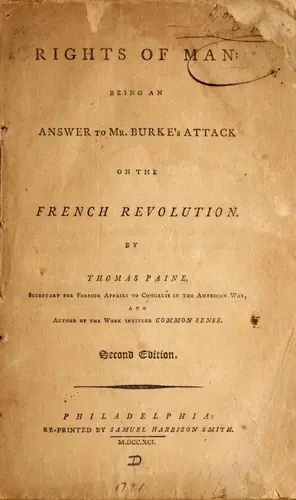
Rights of Man
by Thomas Paine · first published 1791
18% recommend82% neutral
Written in a fit of pique brought about by Edmund Burke's blistering attack of the French Revolution, Paine's The Rights of Man has come to be regarded as one of the most important works in the realm of Western political philosophy. In it, Paine contends that some rights that are granted through natural law, rather than by governments or constitutions. A must-read for those interested in politics, philosophy, and the intersection of the two.
Affiliate links. As an Amazon Associate I earn from qualifying purchases.
Mentions per year
What Hacker News says
Related books
 2008–2026
The Age of Reason
Thomas Paine
Recommended by 6 · mentioned by 146 recommend · 14 mention6 recommend · 146 recommend
 2009–2025
Common Sense
Thomas Paine
Recommended by 9 · mentioned by 599 recommend · 59 mention9 recommend · 599 recommend
 2007–2026
The Wealth of Nations
Adam Smith
Recommended by 92 · mentioned by 40592 recommend · 405 mention92 recommend · 40592 recommend
 2007–2026
Crime and punishment
Recommended by 113 · mentioned by 276113 recommend · 276 mention113 recommend · 276113 recommend
 2008–2026
Mein Kampf
Adolf Hitler
Recommended by 15 · mentioned by 53515 recommend · 535 mention15 recommend · 53515 recommend
 2007–2026
Brave New World
Aldous Huxley
Recommended by 202 · mentioned by 708202 recommend · 708 mention202 recommend · 708202 recommend
…few plays and poems. No Euclid's Geometry, no Herodotus Histories, no Bible or Koran, no Samuelson's Economics or Smith's Wealth of Nations, no Plato's Republic, no Communist Manifesto, no Leviathan or Rights of Man, no On the Origin of Species. Just off the top of my head. All of those and more are arguably in the top 100 greatest books of of all time.
on “The Greatest Books of All Time” ↗…coercive when backed by law (austerity measures). Incidentally, a very similar issue came up during the French Revolution (Bastille) at least according to Thomas Paine who wrote about it in passing in his Rights of Man (1770s). That and Common Sense are both very interesting reads if you can make the time. In my opinion, power should be entrusted to the people's representation in a republic with important limitations…
on “Risky bank debt makes customers safer” ↗…deceit. Very few people are taught specifically what the social contract entails. Its well past time people learn, lest they end up being the supporting cause of their own destruction. Thomas Paine's Rights of Man has a lot of good points on this.
on “Large language models reduce public knowledge sharing on online Q&A platforms” ↗…and de Staël for formalizing liberalism in the aftermath of the Revolution, essentially trying to save the good parts from the wreckage. But, like, Thomas Jefferson helped write the Declaration of the Rights of Man, which laid out the key principles Constant was trying to salvage, and he was most certainly influenced by Locke. Still, I think this book is well worth reading as a corrective to the Anglo-centric,…
on “Ask HN: What's the best book you read in 2021?” ↗…Even moving to agrarian living had growing pains. The best example philosophically detailing this, I think, is the work by Thomas Paine called Agrarian Justice. (that's the same Paine as Common Sense, Rights of Man, and Age of Reason) Agrarian Justice is a short pamphlet that I think everyone should read. It details in simple terms how civilized society is different from those who live off the land (such as some…
on “Confessions of A Job Destroyer” ↗Do you have a view on the ideas expressed in The Rights of Man? (Paine's reply to Burke wrt the French Revolution)
on “Books That Changed My Life” ↗…Government, its wars and its taxes, a bystander, not blinded by prejudice nor warped by interest, would declare that taxes were not raised to carry on wars, but that wars were raised to carry on taxes." Rights of Man http://ebooks.adelaide.edu.au/p/paine/thomas/p147r/complete....
on “IRS manual detailed DEA's use of hidden intel evidence” ↗I think we can be more definite than that. Based on "Common Sense" and "Rights of Man" it is pretty clear that Paine was oppossed to any kind of government that was more concerned with furthering its own power than the social good.
on “IRS manual detailed DEA's use of hidden intel evidence” ↗Thank you. I've read Paine's Rights of Man and understood him to be at least as capable a writer and thinker as Jefferson and others, but didn't know (or at least didn't remember) much about the details of his associations. Perhaps because I…
on “It took a decade for the Declaration of Independence to matter in American life” ↗…another matter altogether. That is precisely what an amendment would be about. Thomas Paine derived the justification for self governance, and the basis for its authority in his books. In particular, "Rights of Man", and "Age of Reason" contain most of this in easy to understand form. A core idea is we agree to governance so we may better exercise our liberty. A lack of governance actually diminishes that for…
on “Study: US is an oligarchy, not a democracy (2014)” ↗Why want to encumber an aristocracy, not creators of wealth. The creators in question are dead. Thomas Paine covers this in his pamhlet _Rights of Man_.
on “The Temporarily Disappearing Estate Tax ” ↗…American, or belonging to any particular social compact. Beyond the founding documents of the American Republic, this is self-evident in many other early republican writings. If you've read Thomas Paine ("Rights of Man") you'd know he even picks a fight with Edmund Burke over this very issue when it comes to the French Revolution, with Paine supporting the cause of the French people on the grounds that they held "natural…
on “Obama: If you are a US citizen the NSA can’t listen to your calls” ↗…term progressive in the context of taxation pre-dates the Progressive Era by at least a century. For instance, Thomas Paine proposed progressive taxes on estates (using the term numerous times) in his Rights of Man (1791). (He even drew up tables of suggested taxes, the rates of which rose with the value of the estate.) There are more commonplace examples from the first half of the nineteenth century that you can…
on “The Middle-Class Squeeze” ↗…generation will do it via inheritance, hardly any different than primogeniture. It's contrary to Lockean political legitimacy which requires the consent of the governed. And it's also contrary to Paine's Rights of Man which expressly argues against aristocracy and hereditary government, which self-evidently a meritocracy would create because there's nothing to prevent it and every incentive to pass down such power…
on “Down with meritocracy (2001)” ↗…with kings, divine right, wealth, purity, and other obviously unjust ways to define and manage power. This nation was formed on the idea of rejecting all of that. Thomas Paine derives most of this in "Rights of Man" and "Age of reason", where the first reference speaks to self governance and what free people means, and the second speaks to why the church is not a center of power either, both straight up rejections…
on “I was Zuckerberg’s speechwriter” ↗