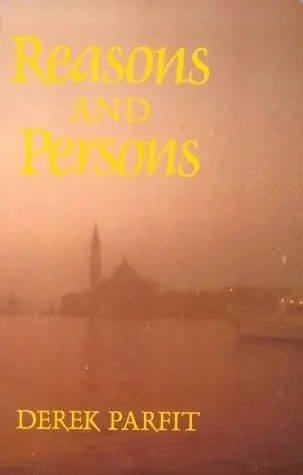
Reasons and Persons
by Derek Parfit · first published 1984
65% recommend30% neutral5% critical
Why HN recommends it
Rigorous yet readable moral philosophy, best known for its personal identity section with clear thought experiments like teleporters and the Repugnant Conclusion; suits curious readers without a philosophy background.
Summarised by Claude from recommending comments
Affiliate links. As an Amazon Associate I earn from qualifying purchases.
Mentions per year
What Hacker News says
Related books
 2018–2020
The dream of enlightenment
Anthony Gottlieb
Recommended by 2 · mentioned by 22 recommend · 2 mention2 recommend · 22 recommend
 2018–2020
The Dream of Reason
Anthony Gottlieb
Recommended by 2 · mentioned by 22 recommend · 2 mention2 recommend · 22 recommend
 2011–2022
How to think about the great ideas
Mortimer J. Adler
Recommended by 3 · mentioned by 33 recommend · 3 mention3 recommend · 33 recommend
 2010–2023
Bernard Williams
Alan Thomas
Recommended by 3 · mentioned by 43 recommend · 4 mention3 recommend · 43 recommend
How to Make Our Ideas Clear
Charles Sanders Peirce
Recommended by 3 · mentioned by 43 recommend · 4 mention3 recommend · 43 recommend
 2008–2024
Good and real
Gary L. Drescher
Recommended by 8 · mentioned by 108 recommend · 10 mention8 recommend · 108 recommend
 2017–2022
Think Like a Dinosaur
James Patrick Kelly
Recommended by 2 · mentioned by 102 recommend · 10 mention2 recommend · 102 recommend
 2009–2025
Practical ethics
Peter Singer
Recommended by 8 · mentioned by 168 recommend · 16 mention8 recommend · 168 recommend
I hate most philosophy, but I read Parfit's technical Reasons and Persons and genuinely enjoyed it. Did you ever think teleporters could be the basis for an argument against souls? Parfit thought so. Plus, his writing is optimized for being understandable -- no flowery bullshit.…
on “Derek Parfit has died” ↗…anyone who takes such a position has to allow that there's some possibility that they're wrong, and in fact such tech is possible and would work as intended. The theories of personal identity argued in Reasons and Persons by Derek Parfit are relevant here. I think it's important that we don't accept death as inevitable, because if people don't hold out hope of conquering death, then it's less likely that we'll conquer…
on “How Doctors Die (2013)” ↗…I don't think much expert philosophical knowledge is needed) but extraordinarily good and highly relevant to questions of ethics, though it's more about questions of personal identity: Derek Parfit's "Reasons and persons". He's more recently written a large two-volume work on ethics, which I haven't read.
on “Daniel Dennett: The Normal Well-Tempered Mind” ↗Reasons and Persons by Derek Parfit I read this about the same time I read the Selfish Gene, had a similar effect. It's one of the few philosophy books that I still think about today.
on “Ask HN: Books with a high signal to noise ratio?” ↗…these gray zone topics, that we forget just how huge the space of basically agreed moral principles is. There certainly are great moral philosophy problems. I remember when I first read Derek Parfit's Reasons and Persons and thought about "The Repugnant Conclusion" it was eye opening. It would definitely be useful for people choosing large-scale policies or facing real problems of humanitarian crisis or population ethics.…
on “Google will always do evil” ↗Try Derek Parfit. His book "Reasons and Persons" touches on some fascinating questions (identity) with clear thought experiments that actually reach the level of clarity this article suggests.
on “How Philosophers Think” ↗If one wants to go as deep as possible on this concept then check out Part 3 of Derek Parfit's "Reasons and Persons"[0]. [0]https://en.wikipedia.org/wiki/Reasons_and_Persons#Personal_i...
on “I Fired Myself” ↗…and learning algorithms". (What it says on the tin. Don't expect this to be a practical guide to training neural networks or anything like that; it is a mathematics book.) Philosophy: Derek Parfit's "Reasons and Persons". (Contains some exceptionally clear thinking on thorny questions about personal identity and the like.) Gary Drescher's "Good and Real". (Drescher is primarily a computer-science-and-AI guy rather than…
on “Ask HN: How big is your personal library?” ↗…questions: * Descarte's Meditations [2] is frequently used as an accessible introductory text * Thomas Nagel's What Is It Like to Be a Bat? [3] (someone else mentioned this as well) * Derek Parfit's Reasons and Persons [4], especially section 3 where he discusses what constitutes personal identity in the context of Star Trek style transporters. * W.V.O Quine's Two Dogmas of Empiricism [5], on truth and logical positivism…
on “Ask HN: Learning about philosophy” ↗…actual books. We might be able to do better if you told us more about your own interests and prejudices. Anyway, here are a few recommendations: Ethics and (technical questions about) personal identity: "Reasons and persons", by Derek Parfit. Quite heavy going, but Parfit's an outstandingly clear thinker and there are some very good ideas here. Applied ethics: "Living high and letting die", by Peter Unger. Argues for the…
on “Ask HN: Best Philosophical Books?” ↗You might read Reasons and Persons by Derek Parfit if you haven't already. Not that he offers solutions per se, but he starts from a similar view of the subject.
on “PG's Rarely Asked Questions” ↗Reasons and Persons by Derek Parfit http://marginalrevolution.com/marginalrevolution/2010/03/boo...
on “Ask HN: What is the most mind blowing book you've ever read?” ↗Indeed. I'd add to the mix Derek Parfit. "Reasons and Persons"[0], most famously calls into question the notion of the 'self' and how illusory it is. It has had a profoundly positive impact upon how I view myself, others and my relationship to them. [0]http://www.amazon.com/Reasons-Persons-Derek-Parfit/dp/019824...
on “How biological invaders challenge our idea of self and other” ↗On What Matters by Derek Parfit. Happened to be vol. 1, but vol. 2 is also fantastic. Honestly, Reasons & Persons would also make a fine gift.
on “Ask HN: What book have you given as a gift?” ↗…not like this. Notably, most nonfiction from academics is not at all like this. To give examples, "The e-myth revisited" is clearly in the category of only really having one point. On the other hand, "Reasons and persons" by Derek Parfit has a multitude of small nuanced points and arguments scattered through the entire text. I would definitely encourage you to seek out these denser, more serious books. They are harder…
on “The Need to Read” ↗