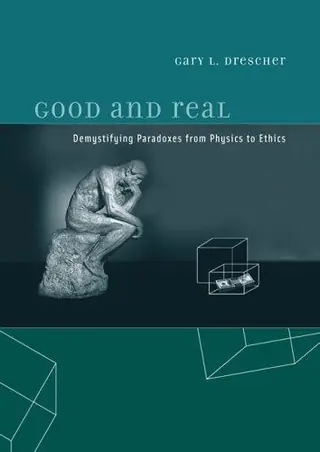
Good and real
by Gary L. Drescher · first published 2006
80% recommend20% neutral
Why HN recommends it
Wide-ranging philosophy book covering mind, ethics, decision theory and physics, written clearly and seriously. Its discussions of time and entropy and its chapter on ethics and consciousness stand out.
Summarised by Claude from recommending comments
"In Good and Real, Gary Drescher examines a series of provocative paradoxes about consciousness, choice, ethics, quantum mechanics, and other topics, in an effort to reconcile a purely mechanical view of the universe with key aspects of our subjective impressions of our own existence. Many scientists suspect that the universe can ultimately be described by a simple (perhaps even deterministic) formalism; all that is real unfolds mechanically according to that formalism. But how, then, is it possible for us to be conscious, or to make genuine choices? And how can there be an ethical dimension t
Affiliate links. As an Amazon Associate I earn from qualifying purchases.
Mentions per year
What Hacker News says
Related books
 2007–2026
Reasons and Persons
Derek Parfit
Recommended by 24 · mentioned by 3724 recommend · 37 mention24 recommend · 3724 recommend
 2010–2026
Nicomachean Ethics
Aristotle
Recommended by 28 · mentioned by 7028 recommend · 70 mention28 recommend · 7028 recommend
 2008–2026
Consciousness explained
Daniel C. Dennett
Recommended by 35 · mentioned by 7235 recommend · 72 mention35 recommend · 7235 recommend
 2008–2026
Finite and infinite games
James P. Carse, James Carse
Recommended by 58 · mentioned by 7858 recommend · 78 mention58 recommend · 7858 recommend
 2008–2026
A History of Western Philosophy
Bertrand Russell
Recommended by 64 · mentioned by 11264 recommend · 112 mention64 recommend · 11264 recommend
 2008–2026
Meditations by Marcus Aurelius
Marcus Aurelius, Meric Casaubon
Recommended by 184 · mentioned by 251184 recommend · 251 mention184 recommend · 251184 recommend
 2007–2026
Gödel, Escher, Bach
Douglas R. Hofstadter
Recommended by 505 · mentioned by 1,055505 recommend · 1,055 mention505 recommend · 1,055505 recommend
I recommend either Gary Drescher's "Good and Real", or the relevant parts of Overcoming Bias (which aren't exactly collected into one place yet).
on “Ask HN: Where does consciousness come from?” ↗…the best). Not all that entry-level but full of clever things and exceptionally clear (in approximately the way that maths/physics/computing people value clear thinking extra-highly): Gary Drescher's "Good and Real". Subtitle is "demystifying paradoxes from physics to ethics". Just for fun: Quine's "Quiddities: an intermittently philosophical dictionary". Not really a dictionary, but a collection of short essays…
on “Daniel Dennett: The Normal Well-Tempered Mind” ↗…"entropy increases futureward, we remember pastward, what a coincidence!" Rather, "if this were not an increasing entropy direction, we could not have memories of it." First saw the point in Drescher's Good and Real.
on “Relation between the psychological and thermodynamic arrows of time” ↗…that; it is a mathematics book.) Philosophy: Derek Parfit's "Reasons and Persons". (Contains some exceptionally clear thinking on thorny questions about personal identity and the like.) Gary Drescher's "Good and Real". (Drescher is primarily a computer-science-and-AI guy rather than a philosopher. He addresses a bunch of hairy philosophical questions from that perspective and I personally like it a lot. I confidently…
on “Ask HN: How big is your personal library?” ↗…closest thing to what I read on fallibleideas.com: http://wiki.lesswrong.com/wiki/Metaethics_sequence If you're easily distracted on a computer and you want this sort of stuff in book form, I recommend Good and Real: Demystifying Paradoxes from Physics to Ethics by Gary Drescher.
on “My New Philosophy Website” ↗…mostly fair. Much much more seriously intellectually than any of the recent "New Atheist" books. Philosophy of mind, epistemology, ethics, decision theory, philosophy of physics, many other things: "Good and Real", by Gary Drescher. "A breathtakingly original assault on all the Big Issues!", says Daniel Dennett, and he's right. Recommended on just about any topic: the "Oxford Readings in Philosophy" series of…
on “Ask HN: Best Philosophical Books?” ↗Reading the chapter about time in "Good and Real" by Drescher blew my mind. See http://commonsenseatheism.com/?p=11068 for a short version.
on “Thermodynamic Asymmetry in Time (2016)” ↗…ethical obligation to a potentially conscious rock that we do to animals, humans and, arguably, seemingly intelligent entities? For a nice exposition of this one can read chapter 2 of Gary Drescher's book 'good and real'.
on “A Brief Explanation of Greg Egan’s Dust Theory” ↗…computer mixing the quantum noise into its state if you want, so you get your avalanche effect and chaos theory stuff (though I think that's majorly overstating it, people don't behave that erratically). See Good and Real by Gary L. Drescher (2006), but also see my comment at https://news.ycombinator.com/item?id=38789146
on “"Are We Automata?" by William James (1879)” ↗What do you think about Good and Real by Gary L. Drescher? I wrote about it at https://news.ycombinator.com/item?id=38789146, so it's not perfect, but I haven't found anything that is.
on “Epistemic Learned Helplessness (2019)” ↗The book "Good and Real" opens with this thought experiment and has a good discussion.
on “A mirror flips left and right, but not up and down” ↗…Einsteinian 4D block universe in which the block universe is the optimal path between boundary conditions and everything unfolds as it must and already has. This is similar to points Drescher makes in _Good and Real_: a brain could try to understand the universe by taking the present and extrapolating forward but it also takes the present and extrapolate backward. You can 'remember' the future as easily as the past.…
on “Interview with Ted Chiang” ↗…any influence - if it did so, it would have to make some of the particles sometimes violate the principles that all particles are always observed to obey whenever we check carefully." - Gary Drescher, Good and Real, chapter 2.1: The Case against Ghosts At the very least it's highly likely that the positive results of parapsychology, or the vast bulk of them, are due to the sort of statistical problems that plague…
on “Parapsychology: the control group for science” ↗…is that doesn't distinguish the positive time direction, since flipping the direction and running it back past zero would produce the same evenly spread gas. The resolution that Gary Drescher gives in Good and Real is to stop thinking in terms of a positive and negative time direction, but instead define an away-from-order direction. This is the same direction in which memories (like "wakes" that follow a moving…
on “Quantum Entanglement Drives the Arrow of Time” ↗That just means that you can't realize infinite precision, infinite length, or infinite time. That's fine, and is probably correct. Good and Real by Gary L. Drescher (2006) talks about it, but large parts of the book are "wrong" (in the same way Occam's razor is wrong, not the same way the flat Earth is wrong). I'd say almost all of it is fixable…
on “The Limits to Growth (1972)” ↗