Quantum computing for computer scientists
by Noson S. Yanofsky · first published 2008
77% recommend23% neutral
Why HN recommends it
A gentle, self-contained route into quantum computing for computer scientists, covering the needed linear algebra and math without heavy physics. Suits programmers with a CS background and committed readers.
Summarised by Claude from recommending comments
"The multidisciplinary field of quantum computing strives to exploit some of the uncanny aspects of quantum mechanics to expand our computational horizons. Quantum Computing for Computer Scientists takes readers on a tour of this fascinating area of cutting-edge research. Written in an accessible yet rigorous fashion, this book employs ideas and techniques familiar to every student of computer science. The reader is not expected to have any advanced mathematics or physics background. After presenting the necessary prerequisites, the material is organized to look at different aspects of quantum
Affiliate links. As an Amazon Associate I earn from qualifying purchases.
Mentions per year
What Hacker News says
Related books
 2013–2026
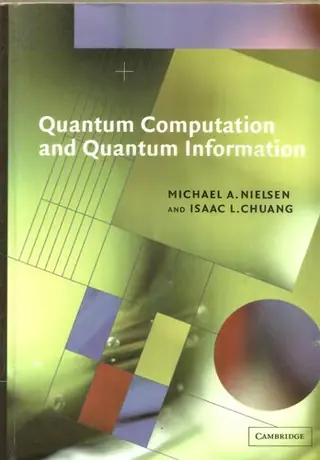
Quantum computation and quantum information
Michael A. Nielsen, Isaac L. Chuang, CAMBRIDGE INDIA
Recommended by 30 · mentioned by 4030 recommend · 40 mention30 recommend · 4030 recommend
 2015–2025
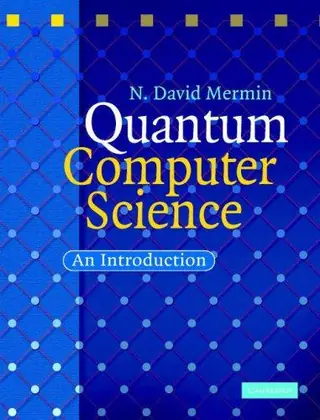
Quantum Computer Science
N. David Mermin
Recommended by 11 · mentioned by 1111 recommend · 11 mention11 recommend · 1111 recommend
 2014–2024
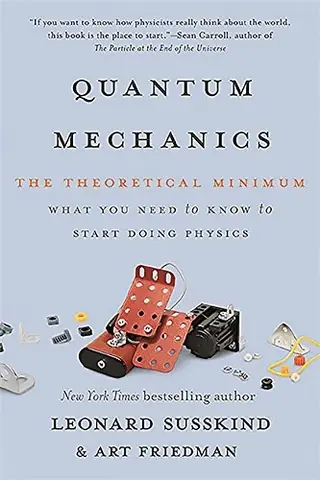
Quantum Mechanics
Leonard Susskind, Art Friedman
Recommended by 9 · mentioned by 139 recommend · 13 mention9 recommend · 139 recommend
 2007–2026
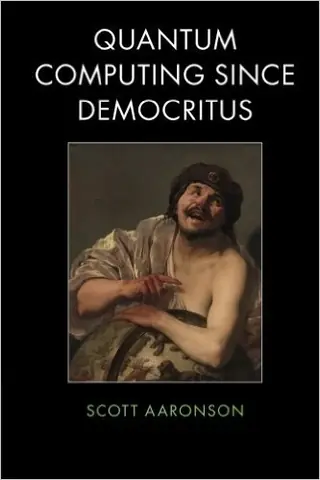
Quantum Computing Since Democritus
Scott Aaronson
Recommended by 73 · mentioned by 9273 recommend · 92 mention73 recommend · 9273 recommend
 2007–2026
Algorithms
Robert Sedgewick
Recommended by 50 · mentioned by 8250 recommend · 82 mention50 recommend · 8250 recommend
 2015–2026
The Go Programming Language
Alan A. A. Donovan, Brian W. Kernighan
Recommended by 40 · mentioned by 8040 recommend · 80 mention40 recommend · 8040 recommend
 2007–2026
The algorithm design manual
Steven S. Skiena
Recommended by 195 · mentioned by 265195 recommend · 265 mention195 recommend · 265195 recommend
 2014–2026
Designing Data-Intensive Applications
Martin Kleppmann
Recommended by 457 · mentioned by 659457 recommend · 659 mention457 recommend · 659457 recommend
Quantum Computing for Computer Scientists Note, you have to be willing to put the time in, especially if your linear algebra is rusty or (like me) you have only a passing familiarity with complex numbers. With that in mind, it's almost entirely…
on “Ask HN: What's the best computer science book you've read recently?” ↗…your problem, then a quantum computer will be a good tool for you. To re-disclaim, I am not an expert, I'm a reasonably technical interested bystander. For me, the "Oh, I get it!" book was Yanofsky, "Quantum Computing for Computer Scientists". [1] https://en.wikipedia.org/wiki/Quantum_algorithm_for_linear_s...
on “Hartree-Fock on a superconducting qubit quantum computer” ↗…learned quantum computing. I believe this material is easily within the grasp of all software engineers. If you're looking for a textbook instead of a video, I strongly recommend the book (also called) Quantum Computing for Computer Scientists by Noson S. Yanofsky.
on “Quantum Computing for Computer Scientists [video]” ↗Yanofsky and Manucci's "Quantum Computing for Computer Scientists" is a smooth intro if you come from a CS background. Nielsen and Chuang's "Quantum Computation and Quantum Information" is more thorough and advanced from a mathematical point of view. But it contains…
on “Rigetti launches the public beta of its Quantum Cloud Services” ↗I'm studying Quantum Computing for Computer Scientists [1] - until I found this book, I thought anything covering quantum would be too physics oriented. As the title implies, this book is nothing like that, covering all the mathematics needed (matrices and…
on “Ask HN: What are you learning?” ↗I found this text helpful: Quantum Computing for Computer Scientists by Noson S. Yanofsky and Mirco A. Mannucci https://www.cambridge.org/core/books/quantum-computing-for-c...
on “Ask HN: Resources to start learning about quantum computing?” ↗I'd do zero requisites "Quantum Computing for Computer Scientists" by Yanofsky. That is a nice base.
on “Ask HN: Quantum Computation, Computers and Programming” ↗…understand Bra Ket notation [<Bra|Ket>] (Ket as Column vector, Bra (Row vector) as Complex Conjugate of Ket (denoted as dagger) ) -- understand Kronecker product ( for multi-qubit systems) - Quantum Computing for Computer Scientists book - https://www.amazon.com/Quantum-Computing-Computer-Scientists-Yanofsky/dp/0521879965 - Quantum Math Primer (Faculty of Khan) (found a bit hard the first time around, pretty dense) : https://www.youtube.com/playlist?list=PLdgVBOaXkb9AtG88OsK_c8FDEBDLCC6_9 #…
on “Ask HN: Resources to start learning about quantum computing?” ↗I also strongly recommend 'Quantum Computing for Computer Scientists'...this is a really, really good book for those coming from a C.S. background.
on “Quantum Development Kit preview” ↗I recommend the textbook Quantum Computing for Computer Scientists.
on “Qusim.py – A toy multi-qubit quantum computer simulator written in Python” ↗This video, “Quantum Computing for Computer Scientists” is quite approachable: https://m.youtube.com/watch?v=F_Riqjdh2oM&pp=ygUeTWljcm9zb2Z...
on “Peter Shor's MIT Fall 2022 course lecture notes on quantum computing” ↗…next. I had the impression I wasn't learning very quickly, when in fact (due to the textbook's density) I was taking in a huge amount of information. After a few weeks with the Mermin textbook, I bought Quantum Computing for Computer Scientists[1] by Yanofsky & Mannucci. This is a much softer introduction than Mermin, almost too soft: I skipped the first few chapters on linear algebra and complex numbers. However, in combination with the Mermin…
on “Ask HN: Resources to start learning about quantum computing?” ↗Also becoming curious in quantum computing again (the current wave in classical software development is depressing IMHO so looking for an alternative for the futre). I read a good portion of Quantum Computing for Computer Scientists as an undergrad studying physics for a paper, but in searching for new texts, most people point to Nielsen and Chuang yet comment it is dated. Any good literature reviews out there to consider to get…
on “The Theory of Quantum Information” ↗…that they can represent using code written for the Python programming language, rather than conventional differential equations on paper. From https://news.ycombinator.com/item?id=30782678 : >> This "Quantum Computing for Computer Scientists" video https://youtu.be/F_Riqjdh2oM explains classical and quantum operators as just matrices. What are other good references? Unfortunately the QuantumQ game doesn't yet have the matrix forms of the…
on “Future is quantum: universities look to train engineers for an emerging industry” ↗> grade 10 level pop-science at best The quantum computing books include at least one undergraduate text (Quantum Computing for Computer Scientists) and a more expansive reference (Quantum Computation and Quantum Information). The CS books for data science include two undergraduate texts (SICP; Algorithm Design Manual by Skiena). The regular CS…
on “Five Books: The best books on everything” ↗