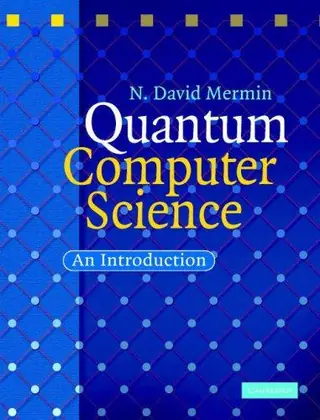
Quantum Computer Science
by N. David Mermin · first published 2007
100% recommend
Why HN recommends it
A short, approachable introduction to quantum computing for computer scientists and mathematicians, assuming only basic linear algebra, not physics. Often paired with Nielsen and Chuang as a gentler start.
Summarised by Claude from recommending comments
In the 1990's it was realized that quantum physics has some spectacular applications in computer science. This book is a concise introduction to quantum computation, developing the basic elements of this new branch of computational theory without assuming any background in physics. It begins with an introduction to the quantum theory from a computer-science perspective. It illustrates the quantum-computational approach with several elementary examples of quantum speed-up, before moving to the major applications: Shor's factoring algorithm, Grover's search algorithm, and quantum error correctio
Affiliate links. As an Amazon Associate I earn from qualifying purchases.
Mentions per year
What Hacker News says
Related books
Quantum computing for computer scientists
Noson S. Yanofsky
Recommended by 10 · mentioned by 1310 recommend · 13 mention10 recommend · 1310 recommend
 2013–2026
Quantum computation and quantum information
Michael A. Nielsen, Isaac L. Chuang, CAMBRIDGE INDIA
Recommended by 30 · mentioned by 4030 recommend · 40 mention30 recommend · 4030 recommend
 2007–2026
Quantum Computing Since Democritus
Scott Aaronson
Recommended by 73 · mentioned by 9273 recommend · 92 mention73 recommend · 9273 recommend
…classical methods; this has huge ramifications for drug & material design.[2] What a time to be alive! I have a BSc in Computer Science, and am teaching myself quantum computing. I'm really liking the book Quantum Computer Science: An Introduction by David Mermin. All this stuff is within your grasp! You aren't required to understand quantum weirdness to use a quantum computer. [0] https://quantumexperience.ng.bluemix.net/qx/experience…
on “Quantum Development Kit preview” ↗…standard textbook for quantum computing; it’s excellent (even though 16 years old by now). If you wanted to start with something shorter and more introductory, you could try David Mermin’s “Introduction to Quantum Computer Science.”
on “A Polynomial Time Bounded-Error Quantum Algorithm for Boolean Satisfiability” ↗N. David Mermin's "Quantum computer science: An introduction" is also a really good text for people with a CS background. It's a dead-tree book but I think the lecture notes he used to make the book are free online.
on “Quantum computers ready to leap out of the lab in 2017” ↗…really helped my to implement quantum state & process tomography during my PhD btw (much more than most journal articles on the subject), thanks again for writing it. I think together with David Mermin's "Quantum Computer Science" (which is much shorter though) it's still one of the best books on the subject.
on “Why now is the best time to study quantum computing (2014)” ↗A good recommendation for the quantum computing enthusiast: https://www.amazon.com/Quantum-Computer-Science-David-Mermin...
on “The Theoretical Minimum” ↗I've recommended this here before, but David Mermin's "Quantum Computer Science: An Introduction" is also good (like this paper, it's targeted at computer scientists who have a little math knowledge and little-to-no physics background). There's a dead-tree version, but the lecture…
on “An Introduction to Quantum Computing, Without the Physics” ↗…that as a theoretical computer scientist, I spend a lot of my time hanging around people who are abnormal in more-or-less the same ways I am, and in many cases more so. Besides QCSD, I’d try Mermin’s Quantum Computer Science: An Introduction for QC, or any of my 50 favorite books from this list https://www.scottaaronson.com/blog/?p=3679 if you’re just looking for some interesting reading material.
on “I'm Scott Aaronson, quantum computing/computational complexity researcher. AMA” ↗…learning quantum physics was: - Quantum algorithms and computing: "Quantum Computing Since Democritus" by Scott Aaronson [0] and "Quantum Computation and Quantum Information" by Nielsen and Chuang [1]. "Quantum Computer Science" by Mermin is really good too. - Leonard Susskind's lectures on quantum mechanics [3] - "Introduction to Quantum Mechanics" by David Griffiths [4] -- just your regular QM textbook. Recommended by many…
on “Ask HN: How to start on the path of learning Quantam Physics?” ↗…QBit rather than qubit, it's a great pedagogical work by someone with a very deep understanding of quantum mechanics. It's also in hardcover, which also helps lend it more weight: https://www.amazon.com/Quantum-Computer-Science-David-Mermin... As others have recommended, anything by Scott Aaronson is gold. Computational complexity is his passion, and although I think his work is very thorough and accessible, I would suggest…
on “Ask HN: Resources to start learning about quantum computing?” ↗If anyone's looking for a clear and concise intro book, the best I've found is N. David Mermin's Quantum Computer Science. It's geared towards CS students, so very approachable, requires only familiarity with the basics of finite-dimensional complex vector spaces
on “Fujitsu and RIKEN develop world-leading 256-qubit sup quantum computer” ↗…more valuable than a giant list of resources with zero guidance where to start. How I learned: I started out like you, in possession of an undergraduate education in computer science. I began reading Quantum Computer Science: An Introduction[0] by N. David Mermin. This is a very good textbook, but I absolutely could not skim it. I had to ensure I understood every single line before moving onto the next. I had the impression…
on “Ask HN: Resources to start learning about quantum computing?” ↗…Lecture Notes (use as reference in case video is not clear, or camera shot lags/changes) https://www.cs.cmu.edu/~odonnell/quantum18/ - Mermin's Textbook https://www.goodreads.com/book/show/1959623.Quantum_Computer_Science - Nielsen & Chuang's Textbook https://www.amazon.com/Quantum-Computation-Information-10th-Anniversary/dp/1107002176 -- Nielsen's Lectures https://www.youtube.com/playlist?list=PL1826E60FD05B44E4 #…
on “Ask HN: Resources to start learning about quantum computing?” ↗David Mermin has written a very good introduction specifically targeted towards computer scientists and mathematicians looking to learn and contribute to this field. His book "Quantum Computer Science" is really great, and I highly recommend reading it if you're interested in learning more. Basic linear algebra is pretty much all that's required, although familiarity with mathematical notation definitely…
on “Quantum A.I. Publications” ↗