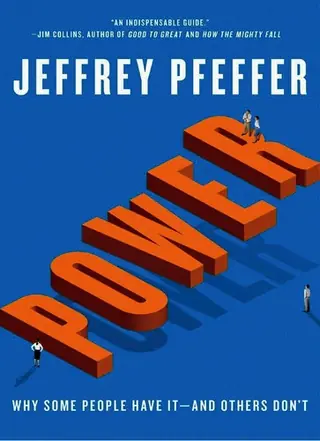
Power
by Jeffrey Pfeffer · first published 2011
82% recommend18% neutral
Why HN recommends it
Argues that career outcomes depend heavily on power dynamics rather than merit alone, offering a frank, research-backed view of how influence works in organizations; suits anyone navigating work politics.
Summarised by Claude from recommending comments
"The summa of one of the greatest minds in management theory, this book shows readers how to succeed and wield power in the real world"--
Affiliate links. As an Amazon Associate I earn from qualifying purchases.
Mentions per year
What Hacker News says
Related books
 2021–2024
Docs for Developers
Jared Bhatti, Heidi Waterhouse
Recommended by 4 · mentioned by 74 recommend · 7 mention4 recommend · 74 recommend
 2018–2026
Leadership BS
Jeffrey Pfeffer
Recommended by 1 · mentioned by 21 recommend · 2 mention1 recommend · 21 recommend
 2018–2024
Stealing the Corner Office
Brendan Reid
Recommended by 9 · mentioned by 119 recommend · 11 mention9 recommend · 119 recommend
 2016–2022
Thanks for the Feedback
Douglas Stone, Sheila Heen
Recommended by 10 · mentioned by 1210 recommend · 12 mention10 recommend · 1210 recommend
 2019–2025
The Making of a Manager
Julie Zhuo
Recommended by 14 · mentioned by 1514 recommend · 15 mention14 recommend · 1514 recommend
 2008–2025
Becoming a technical leader
Gerald M. Weinberg
Recommended by 28 · mentioned by 3028 recommend · 30 mention28 recommend · 3028 recommend
 2012–2025
The First 90 Days
Michael D. Watkins
Recommended by 20 · mentioned by 2120 recommend · 21 mention20 recommend · 2120 recommend
To better understand how to navigate it: "Power: Why Some People Have It—and Others Don't" by Jeffery Pfeffer https://www.amazon.com/Power-Some-People-Have-Others-ebook/d... Really good read, and has Jim Collins and Robert Cialdini singing its praises…
on “Ask HN: Best books for dealing with workplace politics and dishonesty?” ↗Probably the two most important works on the topic in 30 years: https://www.amazon.ca/Power-Some-People-Have-Others/dp/00617... https://www.amazon.ca/Getting-Yes-Negotiating-Agreement-With...
on “Ask HN: Resources for introverted devs to learn workplace politics?” ↗…says this specifically as well. Pfeffers books on management provide the insight into the dynamics leadership emerges from. His triad of, "performance, credentials, and relationships," that describe power in a situation also describe the necessary factors we look back on as leadership. https://www.amazon.ca/Power-Some-People-Have-Others/dp/00617... I like Jocko Willnick's whole attitude about ownership,…
on “Ask HN: Best book / resources on leadership, especially for tech teams?” ↗- Power: Why Some People Have It and Others Don't by Jeffrey Pfeffer - What Got You Here Won't Get You There: How Successful People Become Even More Successful by Marshall Goldsmith These two books are…
on “Ask HN: Books to read when you transform from SWE into SWE Management?” ↗…to see a theme.) The Mathematical Theory of Communication, by Claude Shannon is beautiful, and gives you an intuition for concepts like bandwith, signal, message entropy, finite fields, among others. Power, by Jeffery Pfeffer, when combined with the Dictator's Handbook by Smith and DeMesquita forms the foundation for any serious management and strategy consulting. GEB, by Hofstader was a way to have an…
on “Ask HN: Which book can attract anyone towards your field of study?” ↗…into each company in my portfolio is what matters. That's both especially true because I have index funds, and why I have index funds. As a footnote, if you'd like a more extreme take on this, Pfeffer's Power is a good read (but quite controversial -- the book basically makes the claim that CEOs are fundamentally psychopaths). Pfeffer is at Stanford. Dictator's Handbook is considered hardly controversial…
on “A lot of “idiotic” things have reasonable explanations (2011)” ↗Exactly. Those of you who think the world is fair or based on merit need to read "Power: Why Some People Have It - And Others Don't" by Jeffrey Pfeffer. The world isn't fair. This is true whether you're in academia or industry, and accepting this fact isn't a bad thing, nor does it mean…
on “Goodbye to academic research” ↗…managers saw a lot of that, but tended to be decent people. And line employees never saw that -- middle management shielded them. Good books to understand these dynamics better: * Dictator's Handbook. * Power, by Pfeffer. Disclaimer, since I got jumped on this before: This refers to big organizations. If you're the CEO of a 5-person startup, this doesn't apply to you.
on “Inside eBay’s bizarre campaign against a blog critic” ↗It's been analyzed in much greater depth. Pfeffer's "Power" and de Mesquita's "Dictators Handbook" are treatments from a psychological and game-theoretic point of view, respectively. Both are well-researched scholarly tracts from top professors in the field.…
on “UC Berkeley inappropriately admitted students as favors to donors” ↗…or industry. The method, if one is to get more freedom of choice in work, is to get yourself onto important projects that contribute to the bottom line. For a broader view, years ago I read the book, "Power: Why Some People Have It—and Others Don't" by Jeffery Pfeffer, and it was an excellent object lesson in understanding how and why companies work the way they work, how decisions are made, and why you…
on “You Shouldn't Become a Programmer” ↗Go to school and stay in it. Success is a function of (Performance, Credentials, Relationships) Read Pfeffer's "Power" for details. They are weighted differently in different fields. If someone is really smart, they can solve problems at higher levels of abstraction and with more open dynamics than in code. It's useful,…
on “Ask HN: Career advice for a 17 year old Russian computer prodigy” ↗…Start with why(Simon Sinek) - Move (preferably were there is higher return - similar to hill climbing algorithms) - Discipline, Focus & Persistence - Improve your social intelligence - Learn about power dynamics (Power from Jeffrey Pfeffer)
on “Co-Founding Considered Harmful” ↗Ironically enough, I have a textbook for that: Jeff Pfeffer -- Power: why some people have it -- and others don't. It's good, and not what you would expect from the title.
on “Ask HN: What are the most eye-opening textbooks you have ever read?” ↗Interesting, but the author is still sounding it out. Highly recommend Stanford prof Jeffery Pfeffer's "Power: Why some people have it...." book. The essential idea is that each field has a weighted triad of Performance, Credentials, and Relationships. Elite networks typically index on the latter two, and ascendant…
on “Getting to Know the Right People” ↗Pfeffer's book "Power" will let you know pretty fast whether you are suited to or ready for leadership. +1
on “The mythos of leadership” ↗